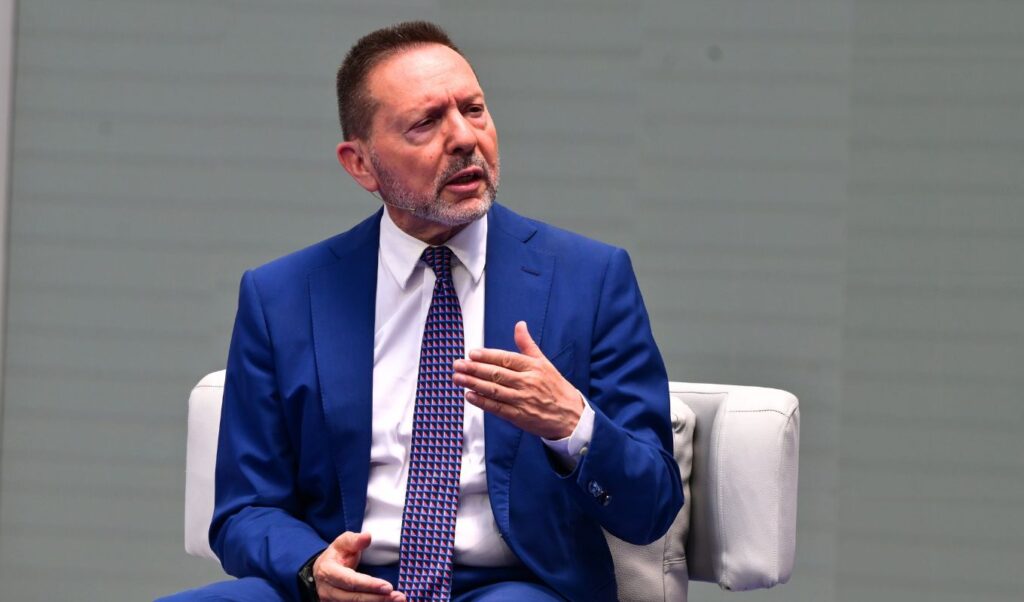
Yannis Stournaras emphasized that Greece today stands in a far stronger position than it did just a few years ago, fully meeting the conditions needed to capitalize on the opportunities emerging from the transformation of both the European and global economy.
Read also: Yannis Stournaras at the Economist conference: GDP will not decline after the Recovery Fund ends
Speaking at the General Assembly of the Hellenic Bank Association, the Bank of Greece Governor cautioned that the deteriorating geopolitical environment and the new energy crisis are expected to weigh on short-term growth prospects across Europe in 2026.
Yannis Stournaras: What he said about the course of the Greek economy
Stournaras explained that rising international energy prices, combined with heightened uncertainty, are negatively affecting consumer and business confidence, dampening domestic demand and intensifying inflationary pressures throughout the economy.
Greek economy set for above-average growth
According to Bank of Greece forecasts, the Greek economy is expected to continue growing at rates above the Eurozone average, supporting the process of real income convergence. Specifically, GDP growth is projected at 1.9% in both 2026 and 2027, rising to 2.0% in 2028. Higher energy costs are expected to trigger second-round effects on prices across both services and industrial goods, while food inflation is forecast to remain elevated, primarily reflecting rising energy costs at every stage of the production and supply chain. Headline inflation is projected at 3.8% in 2026, up from 2.9% in 2025, before easing to 2.6% in 2027 and 2.3% in 2028, as energy and food price pressures are expected to gradually subside.
The primary surplus and public debt
Stournaras also highlighted the primary surplus and the continued downward trajectory of the public debt-to-GDP ratio, which fell to 146.1% in 2025 from 154.2% in 2024 — recording the largest annual reduction among all European Union member states.
What he said about the banks
Turning to the banking sector, Stournaras stressed that the strengthening of the Greek banking system’s fundamentals has laid the groundwork for further expansion of banks’ activities. Greek banks are called upon to ensure uninterrupted financing of the real economy by applying prudent lending standards, leveraging their strong liquidity positions, and further bolstering their capital adequacy.
In doing so, they will continue to support investment, private consumption, and sustainable economic growth, while also contributing to the preservation of financial stability.
Challenges facing Eurosystem central banks
With regard to Eurosystem central banks, Stournaras pointed to the rise of stablecoins, which require a timely adaptation of central bank money formats, central bank-controlled payment systems, and the broader regulatory and supervisory environment. The key new challenges facing Eurosystem central banks include:
- The introduction of the digital euro as a complement to cash and existing electronic payment methods, providing citizens and businesses with a secure and reliable digital form of central bank money.
- Connecting the TARGET payment system’s settlement services — Europe’s automated large-value payment infrastructure — with the new Distributed Ledger Technology (DLT) to facilitate wholesale transactions.
- Interlinking and integrating Eurosystem payment systems with those of other European countries, as well as non-European nations such as India, to facilitate cross-border transactions.
- Applying artificial intelligence within central banks themselves, as well as across the financial institutions they supervise.
Challenges remain
In his closing remarks, Stournaras underlined that significant challenges remain. At the domestic level, the Greek economy continues to grapple with structural weaknesses, including low productivity, demographic pressures, skills shortages in the labor market, limited innovation diffusion, difficulties in accessing affordable housing, and shortcomings in public administration and the justice system.
At the same time, the still-elevated public debt, the persistent current account deficit and the associated negative international investment position of the country, as well as inflation that continues to exceed the Eurozone average, are all factors that demand ongoing vigilance.
The goal: improving investment quality
It is therefore essential to improve the quality of investment. The effective use of available European funds and the attraction of private capital should be directed toward high-productivity sectors that can rapidly expand the economy’s productive potential — such as manufacturing, research and innovation, digital technologies, artificial intelligence, energy infrastructure, the green transition, and outward-oriented, high-value-added industries. At the same time, further strengthening human capital through skills development and closer alignment between education, research, and the needs of the productive sector is a prerequisite for achieving sustainable productivity growth.