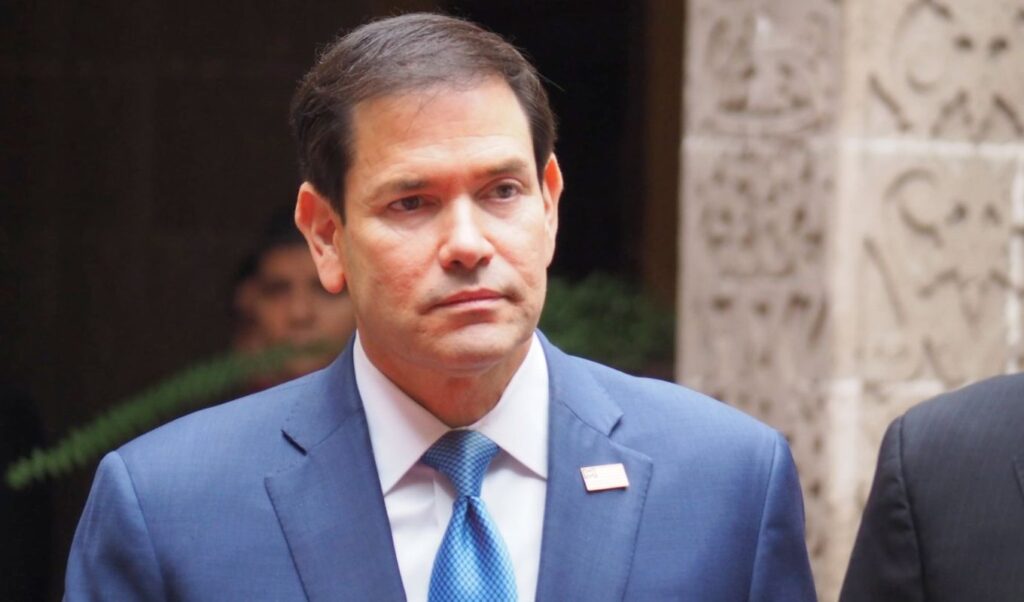
The die is cast. During the first week of October, the head of the State Department, Marco Rubio, is expected in Athens. According to well-informed sources speaking to Parapolitika, the US Secretary of State wishes to carry out his long-awaited visit within the framework of the sixth round of the “Greece-US Strategic Dialogue,” immediately after the first weekend of next month. Those directly involved have already prepared everything and are only awaiting the final date, based on Secretary Rubio’s schedule. The dates circled on the calendar are October 6 through 8.
Read more: What Rubio brings to Athens: His meeting with Gerapetritis is pivotal
The agenda
According to sources, Secretary Rubio will not be coming alone. He is expected to be accompanied by State Department officials and two US Deputy Secretaries of Homeland Security. In his meetings with the Greek government, the discussions are set to cover issues spanning diplomacy, defense, and energy — as Washington has made clear it views Greece as a critical hub for southeastern Europe — along with migration, internal security, terrorism, and even drug trafficking, including the potential strengthening of controls at Greek airports.
It is considered all but certain that behind closed doors at the Foreign Ministry on Vasilissis Sofias Avenue, there will be extensive discussion on developments in the Middle East and on Greek-Turkish relations. The Americans are well aware of the tensions of recent days and the “sea that is getting a little rough,” as the Prime Minister characteristically described it in an interview with ERT. The timing of Rubio’s visit therefore serves to deepen that awareness. Although Athens has repeatedly stated that it does not need “guardians” or “arbiters,” the internationalization of Turkish provocations remains a key strategic choice for Greece. It is equally certain that Rubio’s agenda will include discussion of the increasingly significant American military presence at key points across Greek territory, with Souda Bay and Alexandroupolis taking center stage.
It is worth noting that Turkey will also have its own contact with American leadership. Donald Trump is set to meet with Tayyip Erdogan in New York, on the sidelines of the 81st UN General Assembly, according to an announcement by US Ambassador to Ankara, Tom Barrack.
Turkey’s tactics
Analysts believe that Rubio’s visit will take the wind out of Turkey’s sails, as Ankara continues to escalate tensions by repeating — almost on a daily basis — an old playbook: namely, the narrative of demilitarization and its linkage to the questioning of Greek sovereignty over Aegean islands. This argument was first raised by Turkey in 1964. It resurfaced after 1974, and since 2020 it has become an almost inseparable part of Turkish officials’ rhetoric — as evidenced once again by the recent statements of Turkish Foreign Minister Hakan Fidan, who declared that “the arming of islands with demilitarized status constitutes a threat to us.”
The response came from Greece’s newly appointed but highly experienced Foreign Ministry spokesperson, Panagiotis Yannakoulis, who reiterated that Turkey’s unilateral claims regarding the demilitarization of Greek Aegean islands have no legal basis in international law and have been repeatedly and categorically rejected in their entirety. He added pointedly that “describing the defensive fortification of Greek territory as a ‘threat’ is not only unfounded but also paradoxical, given that Turkey — in violation of international law — continues to maintain an active threat of war (casus belli) against Greece in the event that Greece exercises its legitimate sovereign rights.”
In a letter dated July 2021 addressed to UN Secretary-General António Guterres, Turkey formally and officially demanded the demilitarization of islands in the Aegean and Mediterranean, arguing that the current situation threatens Turkey’s security and regional peace. In a move consistent with its standard approach, Turkey even presented the alleged mandatory demilitarization as a precondition for Greek sovereignty over those islands. “If Greece does not fulfill the obligations arising from the Treaties, then it will not be able to claim sovereign rights over the islands, including the delimitation of maritime zones,” the Turkish letter stated verbatim. Greece responded at the time with its own letter, emphasizing what — according to exclusive information — Greek officials continue to stress today in private conversations with their Turkish counterparts: that Athens holds in its arsenal the “weapon” known as Article 51 of the UN Charter — the right to self-defense, which is inherent and inalienable. The right to legitimate defense, as MP and professor Angelos Syrigos explains in his new book “Greece and Turkey: 50 Questions and Answers,” is a rule of jus cogens — sitting at the very top of the hierarchy of international law. “What is threatened cannot be demilitarized,” government officials note pointedly, especially as Turkey attempts to cast a shadow of ambiguity over Greek islands and as the threat of war persists.
Turkish commandos a stone’s throw from Samos
What is remarkable is that Turkey is accusing Greece of militarizing its islands, while quietly and behind the scenes deploying thousands of Turkish commandos directly across from Samos. This refers to the 51st Commando Brigade, which was recently repositioned to the Söke area. The brigade numbers 2,500 men and had previously been stationed in southeastern Turkey, tasked with combating Kurdish PKK fighters, whom Turkey designates as “terrorists.”
Dendias heads to Egypt
Against this backdrop, and ahead of the resumption of surveys for the Greece-Cyprus electrical interconnection — which will serve as a major stress test for Greek-Turkish relations — Greece is taking care to keep its regional allies close. To that end, on Monday, Nikos Dendias will travel to Egypt, where on Tuesday he will hold a trilateral meeting with his Egyptian and Cypriot counterparts. The “MEDUSA” exercise is currently underway, involving forces from Greece, Egypt, Cyprus, France, and Italy in Crete, making coordination of movements all the more essential. Greece and Egypt are bound, moreover, by the historic partial maritime boundary delimitation agreement signed in 2020 by Dendias and his then-counterpart Sameh Shoukry — an agreement that effectively nullifies the illegal Turkey-Libya memorandum. What matters most now is not to “abandon” Cairo, especially at a time when Egypt appears to be warming to Ankara’s diplomatic overtures, having even resumed joint military exercises with Turkey for the first time in 13 years of frozen — and at times hostile — relations.