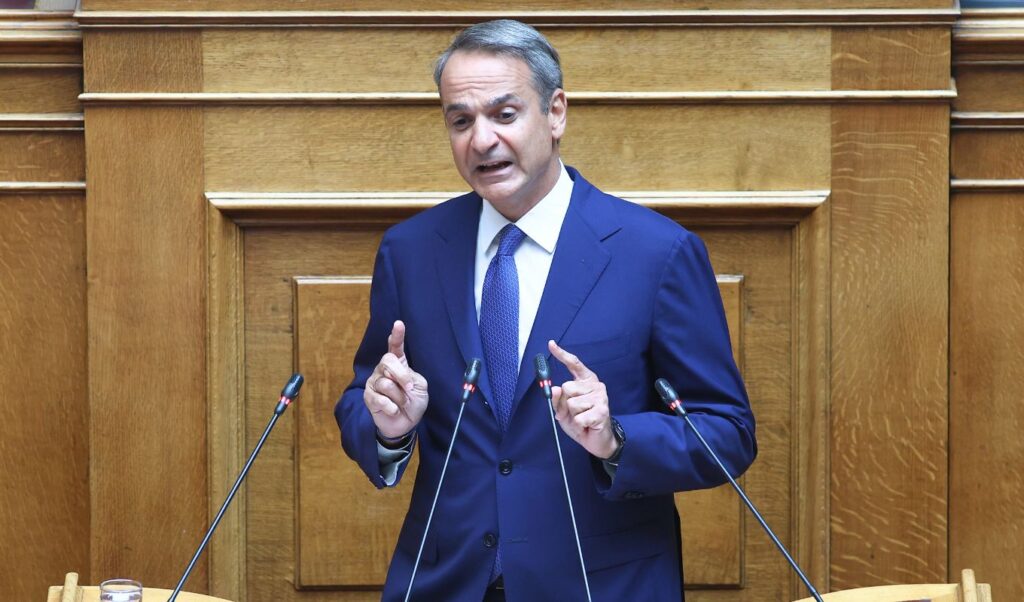
Greek Prime Minister Kyriakos Mitsotakis delivered his regular Sunday review from San Francisco on September 20, as he embarked on a five-day trip to the United States, where he is meeting with leading tech companies before heading to New York for the 81st UN General Assembly.
This week’s review covered a wide range of topics, including credit rating upgrades by Moody’s and Scope for the Greek economy, discussions on constitutional reform, the cost-of-living crisis, migration, protecting children from social media, culture, investments, and sports.
Mitsotakis addresses the cost-of-living crisis and fuel prices
On the issue of rising living costs, Kyriakos Mitsotakis stated that “in the coming days, we will announce a significant intervention by the government and the refineries to bring the starting price of heating oil below €1.75 per liter — lower than where it closed last season.” He added that “we are proceeding with an across-the-board increase in the heating allowance, not only for households using oil, but also for those heating their homes with other energy sources.”
“The largest support is consistently directed toward regions where needs are greater due to climatic conditions. We are also extending the diesel subsidy throughout October. Of course, even if a government has fiscal reserves, the scale of the problem makes a European-level intervention necessary — and I am pushing for exactly that. Should the European Union allow for emergency national interventions that are not counted against spending limits, we could also consider a temporary reduction in fuel taxation,” the Prime Minister continued.
Kyriakos Mitsotakis’s Sunday review — full text
“By the time you read this review, it’s 10 in the morning in Greece. Here in San Francisco, the day has just begun. So technically, you already know more about Sunday than I do. Good morning — or good night, depending on which side of the Atlantic you’re on. I’m here for meetings with leading high-tech companies before flying to New York for the UN General Assembly. But let’s get into the week’s news!
I’ll start with two pieces of good news for the Greek economy. Within just 24 hours, Moody’s upgraded the country’s outlook, while Scope upgraded its credit rating. As I noted yesterday, these two upgrades are yet another confirmation of the progress our economy has made in recent years — and above all, of the distance we’ve traveled from the days when Greece was shut out of investment-grade status and forced to borrow under far less favorable terms. I understand this may all sound rather technical, but it matters enormously: the more creditworthy a country is considered, the cheaper it can borrow, the more easily it attracts investment, and the greater its capacity to grow. And that, ultimately, means more jobs, better wages, and more resources for healthcare, education, and the welfare state.
Greece has changed — and continues to change — and this isn’t only about the economy. One of the next major steps is constitutional reform, which we debated in Parliament this week. This is an issue that, by rights, should unite us more than it divides us, because it doesn’t concern a single government or opposition party — it concerns the rules by which our country will operate for years to come. And yet, we saw forces that describe themselves as serious and responsible refuse to support even changes they essentially agree with, or have included in their own platforms. The opposition has every right, of course, to put forward its own proposals — that is democracy. But when you publicly state that Article 16 needs to change, that ministerial accountability requires a different approach, and that the judiciary needs stronger safeguards, you cannot at the same time choose to abstain and make every reform harder to achieve. That is precisely what happened. It is a response that falls far short of what the moment demands. But citizens are watching and drawing their own conclusions. I hope that in the next Parliament, this opportunity will not be lost — and that all parties will approach their responsibility to the country with greater seriousness.
Turning to the cost-of-living crisis: in the coming days, we will announce a significant intervention by the government and the refineries to bring the starting price of heating oil below €1.75 per liter — lower than where it closed last season. At the same time, we are proceeding with an across-the-board increase in the heating allowance, not only for households using oil, but also for those heating their homes with other forms of energy. The largest support is consistently directed toward regions where needs are greater due to climatic conditions. We are also extending the diesel subsidy throughout October. Of course, even if a government has fiscal reserves, the scale of the problem makes European-level intervention necessary — and I am actively pushing for it. Should the European Union allow for emergency national interventions that are not counted against spending limits, we could also consider a temporary reduction in fuel taxation.
This is not, after all, the first time Greece has raised at the European level an issue that transcends its national borders. We are already seeing this in our efforts to protect children from the dangers of digital addiction and social media. Our country has been at the forefront of this debate. With the KidsWallet initiative, we created a working age-verification mechanism and were among the first to raise the need for a common European “digital age of consent.” It is significant that the European Commission’s proposal now adopts this core principle: independent social media accounts from the age of 15 onwards, with stricter restrictions for younger users and greater corporate responsibility from the platforms themselves. This is a vitally important message at a time when warnings about the capabilities of artificial intelligence are multiplying.
On migration as well, our positions are being vindicated and heard. At the European level, I was pleased to hear the President of the European Commission announce that she will propose a European emergency response mechanism for situations involving mass and instrumentalized migration flows — as occurred in 2021 on the Evros border and more recently in Ceuta. This is a proposal I had already put forward in early August in an article published in Politico. Because when a member state comes under such pressure at its borders, it is not only defending its own borders — it is defending Europe’s borders. And Europe must have a coordinated, ready-made response. I should also note that the Council of State ruled constitutional the mandatory registration of NGOs in the Registry of the Ministry of Migration and Asylum, as well as the auditing of their financial records. This is an important victory for transparency, accountability, and oversight. Anyone operating in such a sensitive field cannot function without rules and scrutiny.
Shifting to a completely different topic — and this time only in spirit — I turn to Kastellorizo, the easternmost point of Greece and of the European Union, where last Sunday we presented a comprehensive plan of 37 strategically important projects. Among these, I would single out the permanent annual income incentive of €5,000 for all residents, as well as civil servants, security forces, and armed forces personnel. I believe this is a practical way to support those who choose to live and serve in a place that presents great challenges but holds great significance for our country. The broader effort to strengthen regional communities applies across the board — to islands, mountain areas, small towns, and villages that need better infrastructure, services, and greater opportunities. In practice, this means giving people the ability to stay, return, or choose to build their lives there, with a sense of security. In Psara, for instance, the new multifunctional regional health center, valued at €2.1 million, directly addresses the self-evident need for quality healthcare and care services — wherever one may live.
In Porto Germeno, which was severely affected by the large wildfire in August, erosion and flood prevention works worth €2 million have already begun, with Piraeus Bank as the contractor. The goal is to complete the critical interventions before the heavy autumn and winter rainfall. The works cover 4,189 acres and 10 streams, in cooperation with the state, local government, and the Forestry Service. At the same time, we are providing a twelve-month reprieve for citizens and businesses affected by the July and August wildfires, suspending all enforcement actions against their movable or immovable property — with the exception of maintenance obligations — for those who have been certified as victims and have been enrolled in state aid or housing assistance and household compensation programs.
At the heart of our strategy, however, lies the broader vision of Greece’s digital and productive transformation. Greece is entering the global data center map more dynamically than ever, thanks to the agreement between PPC and Amazon Web Services to create one of the largest data processing centers in Western Macedonia, in Agios Dimitrios. This is a significant investment that will bring new, well-paying jobs and help keep young scientists in their home country. On the subject of investment, I should also mention that Greece is achieving the best performance in the European Union in terms of evaluation timeframes for investment plans, now completing assessments within 45 to 90 days. Through the new development law, we have already approved 928 investment plans with a total budget of €3.1 billion, with public support reaching €1.5 billion — creating the conditions to secure at least 15,000 high-productivity jobs.
On Thursday, we had the pleasure of officially inaugurating the country’s most modern sports complex, the Ellinikon Sports Park — open not only to residents of the neighboring municipalities, but to people from across Attica. Spread over 200 acres, with football, basketball, athletics, and tennis facilities, it offers a space for athletes and sports clubs, as well as families with children and people of all ages who want to exercise, walk, or simply spend time outdoors. It is the first major project of the Ellinikon development to be delivered to citizens for everyday use, and we are very proud of it.
We are equally proud of our athletes for their outstanding performance at the 20th Mediterranean Games in Taranto. Greece won 71 medals — 26 gold, 26 silver, and 19 bronze — and, for the first time, finished third in the overall standings among 27 nations. Our warmest congratulations to the athletes themselves, their coaches, and the sports federations. And speaking of sports, the “Sport for All” programs continue this year as well, targeting children, adults, seniors, people with disabilities, and socially vulnerable groups. Already, 115 municipalities have participated, with 829 physical education graduates running 6,584 approved programs in which approximately 150,000 participants are expected to take part.
I’ll close with something beautiful for Athens. The magnificent archaeological site of Kerameikos has been returned to residents and visitors, fully upgraded and now accessible to people with mobility and visual impairments. New pathways have been created, ancient remains have been highlighted, 1,000 trees and shrubs have been planted, and — through a new exit on Agion Asomaton Street — the sarcophagus of Philotera is being exhibited for the first time, one of the most important funerary monuments of Kerameikos from the Roman period. A project that had been pending for years has now been completed with Recovery Fund resources. Together with the Pnyx, the Ancient Agora, the Acropolis, and the National Garden, Kerameikos makes Athens a little more open, accessible, and beautiful. If you get the chance, make it part of your walk today. Have a wonderful day.”