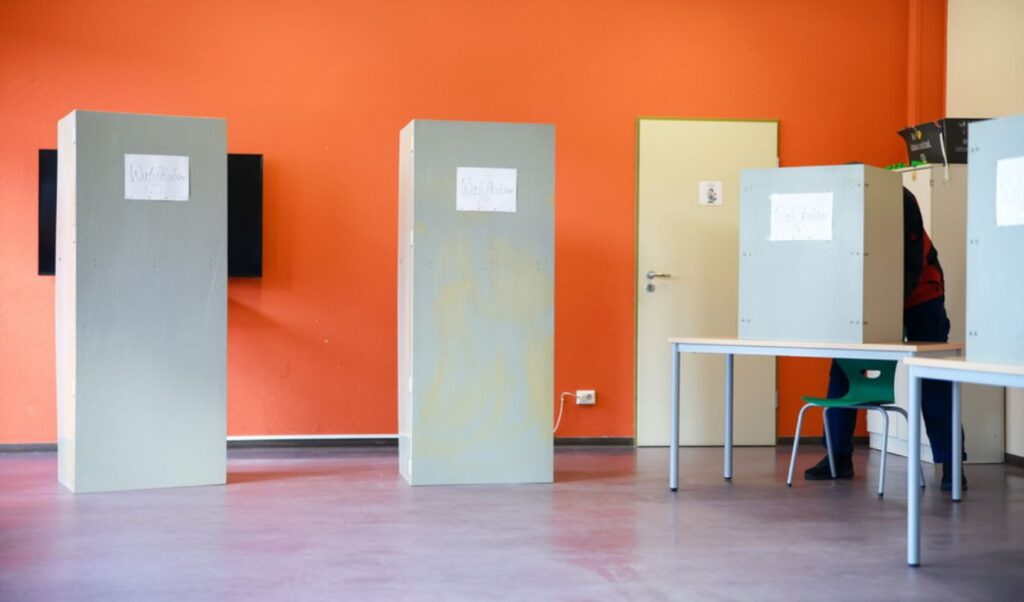
Under normal circumstances, today’s (20/09) state elections in Germany — in Berlin and Mecklenburg-Western Pomerania — would barely register beyond the 4.5 million residents of the two states. But what exactly counts as “normal” these days, even for local German elections? The rise of the far right, the Christian Democrats’ (CDU) string of record-low results, compounded by broader economic hardship, an unstable international environment, and a chancellor who still doesn’t know whether he’s counting his days in office — together, these elements paint a picture that is dystopian, if not outright dangerous.
Germany: The CDU struggles in Angela Merkel’s former constituency
In the ballot boxes of Mecklenburg-Western Pomerania — a small, formerly East German state on the Baltic coast — the political future of Friedrich Merz may well be decided today. If polling projections hold, his party (CDU) will barely scrape past the 5% threshold needed to enter the state parliament, something that would have been unthinkable until recently in Angela Merkel’s former constituency. The chancellor has already convened a meeting of his party’s Executive Committee for this afternoon, with all possible outcomes on the table. Meanwhile, the Alternative for Germany (AfD) is set to battle the Social Democrats (SPD) of Manuela Schwesig for first place on near-equal terms, with polling figures hovering around 36%. The current state premier’s campaign, titled “The Woman Against Blue” (Die Frau gegen Blau) — a direct reference to the AfD’s party color — will attempt to prove today both that she still commands the state and that the troubles plaguing her party at the national level have not brought her down with them.
Germany’s least densely populated state
Home to 1.6 million residents and bordering Poland, Mecklenburg-Western Pomerania is Germany’s least densely populated state. It has the country’s lowest proportion of foreign nationals (6.5–7.8%, predominantly Ukrainians and Poles) and an unemployment rate of 8% — nearly double the national average. The state is home to 16 national parks, hundreds of coastal hotels and campsites, and was once the holiday destination of choice for citizens of the former East Germany. At the same time, it was the scene of one of the darkest chapters of German reunification: in August 1992, in Rostock-Lichtenhagen, neo-Nazis besieged and set fire to an apartment complex housing Vietnamese workers and Roma, to the cheers of a crowd of 3,000 and amid the paralysis of local authorities. “Germany for Germans — Foreigners out!” That chilling slogan is making a disturbing comeback 24 years later, under the AfD banner. The party’s lead candidate, Leif-Erik Holm — a former radio producer and presenter — leverages his media savvy to push the narrative of “us down here versus those up there who don’t understand us and don’t care about us.” He is also calling for the creation of a dedicated “Deportation Task Force,” a body with explicit parallels to the American ICE agency. On energy, he argues the crisis can be resolved by reactivating the Nord Stream 2 pipeline and nuclear power stations. On education, he insists the focus must shift back to academic performance rather than inclusion.
Classifying Berlin
Berlin, for its part, defies classification by any standard that applies to the rest of Germany. Colorful, alternative, multicultural and riddled with contradictions. Thrilling for visitors, difficult for residents, and spectacularly broke — it entered 2026 with a budget deficit of approximately €4.6 billion. “Berlin is poor but sexy,” its then-mayor Klaus Wowereit famously declared back in 2003. Lately, however, the city seems to be losing even that second quality — the internal rhythm and atmosphere that once made it legendary and drew thousands of people from around the world. The city’s most pressing problem today is housing: the population has grown far faster than infrastructure can support, while residents fiercely protect what little open space remains from being converted into apartment blocks. Housing and rent are also the central themes of the Left Party’s candidate Elif Eralp — Germany’s answer to New York’s Zohran Mamdani. With a modern image, red lipstick, sharp anti-capitalist rhetoric, and calls for the socialization of housing complexes, she has exchanged ideas with Mamdani himself; his campaign strategist visited Berlin just months ago to advise her. According to polls, Eralp stands a strong chance of becoming the first person of Turkish descent to govern Berlin — a city that is home to the largest Turkish community outside of Turkey.
Stefan Evers’ small “miracle”
Meanwhile, CDU candidate Stefan Evers has already pulled off something of a minor miracle: he is trailing the Left by just one percentage point, despite having entered the race only in August — by which point it had become abundantly clear that outgoing mayor Kai Wegner was in free fall. Wegner never recovered from the scandal surrounding a five-day power outage that left 100,000 residents without electricity early last year, which found him — of all places — at a tennis club. Evers, Berlin’s Senator for Finance, identifies as both conservative and gay, thereby winking at voters on both ends of the spectrum. “I am conservative, and that’s a good thing,” he says, riffing on Wowereit’s iconic 2001 declaration: “I am gay, and that’s a good thing.” He champions the importance of rules and mutual respect, places law and order and urban cleanliness at the center of his platform, and misses no opportunity to warn of the “catastrophe” that would follow should the city fall under a Left–SPD–Greens coalition.
The appeal of democracy
Government spokesperson Stefan Cornelius — who critics say is Friedrich Merz’s alter ego and reads public sentiment just as poorly as his boss — recently dismissed unfavorable polls as “not serious.” Yet there is one survey he probably should have paid closer attention to. According to research conducted by the Forsa Institute for the n-tv/RTL networks, 32% of Germans say they are dissatisfied with “democracy in Germany and the political system as enshrined in the constitution,” while 68% express the opposite view. In the eastern regions, the picture is markedly different: only 51% express satisfaction with the political system, while 48% are critical of it. Among AfD voters nationally, the figures are 41% in favor and 59% opposed. This snapshot of public sentiment — to borrow a phrase from Mr. Cornelius — sheds new light on what has been unfolding at the German ballot box in recent months. Democracy is losing its legitimacy, and a significant portion of the population has already turned its back on it. That is precisely why today’s elections, though they concern just 6% of Germany’s total population, carry weight far beyond their scale — for the chancellor’s future, but above all for the direction the country is headed.