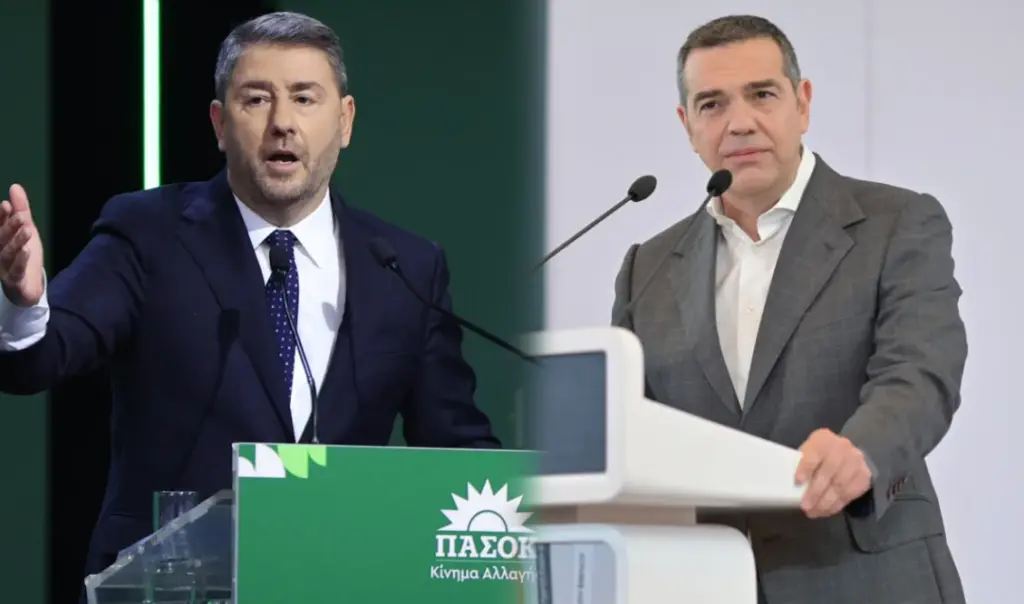
Just ten days apart, Alexis Tsipras on September 2 and Nikos Androulakis on September 12 will present their governing programs before Thessaloniki’s business and trade associations. According to all converging reports, the two center-left leaders are searching — without spectacular results — for that central idea that will appeal to the broadest possible audiences. Despite the fact that PASOK and ELAS show no major divergences on ideological and policy matters, there are other substantial differences and issues that both must resolve.
At Charilaou Trikoupi headquarters
Nikos Androulakis went all in at last year’s Thessaloniki International Fair, presenting a comprehensive and fully developed program that received highly flattering reviews. While some updates may be in order, it is anything but easy for the team at Charilaou Trikoupi headquarters to add something that will generate buzz and mobilize new forces. This is especially true given that throughout the years Androulakis has led PASOK, significant policy milestones have been achieved, policy-production bodies have been operating, and all of this programmatic work has been communicated consistently over the preceding period. At the same time, this appears to be one of the official opposition’s key advantages — that it constitutes a cohesive political force with a plan and the corresponding political figures to implement it.
According to current indications, PASOK’s investment will focus on issues such as private debt — where the party has done significant groundwork — as well as matters related to the welfare state, including public health, education, social housing, and support for vulnerable groups. Meanwhile, the team at Charilaou Trikoupi has yet to settle on the timing of their next expansion through the addition of independent MPs. Based on fully reliable sources, contacts have already been made, and the cases of Nina Kasimati and Alexandros Avlonitis are considered done deals, while communication with Giota Poulou, Myrto Korovesi, and Theodora Tzakri may also be rekindled.
The key axes
Tsipras, for his part, may be moving along new policy paths, but the risk of being judged by his older positions and views looms large — particularly when comparisons are drawn with the Thessaloniki Programme he delivered in 2014 as leader of the official opposition. With this in mind, the former prime minister is expected, according to reliable sources, to adopt a considerably moderate approach, emphasizing his respect for fiscal discipline and his complete lack of intention to pursue any form of economic derailment.
In recent days, he has held several working sessions with ELAS’s economic team as well as with figures who have an in-depth knowledge of the market. Senior sources close to the party’s Amalias Avenue headquarters indicate that the former prime minister will present a holistic convergence plan across all levels with Europe, built around the three-pronged framework of “honest governance, fair growth, and productive reconstruction.” According to Tsipras, real convergence with Europe is not solely a matter of per capita income, but also encompasses productivity, wages, the rule of law, public health and education, housing, resilience, and more. His proposal regarding a productive development model and the organization of the country’s investment engine is expected to attract particular interest, with an emphasis on national public goods such as water and energy.
At the same time, immediately following the completion of the successive Thessaloniki appearances and program presentations, Tsipras will also turn his attention to internal party matters — particularly the drafting of electoral lists, and specifically the figures who are either independent MPs or have surrendered their parliamentary seats and are waiting in the anteroom of the Amalias Avenue headquarters. According to reports, discussions have begun regarding the individuals representing ELAS on political panels, with some arguing that figures carrying greater political weight should be included.
Introversion and the Akrita affair
Entirely different issues are being faced at SYRIZA’s Koumoundourou headquarters, where there is a relative sense of renewed confidence stemming from the party’s broader public presence. The confrontation with the government over the figure of Elena Akrita placed SYRIZA squarely in the spotlight, while party positions — such as its opposition to the early repayment of debt — were more widely discussed. During the course of the week, a decision will also be made on how the party will be represented at the Thessaloniki International Fair, and what roles figures such as Rena Dourou, Nikos Pappas, and Pavlos Polakis will play — for example, at the press conference and in meetings with business associations. After the fair, efforts toward a policy agreement — and by extension an electoral alliance — with New Left will also be placed on the table.
Originally published in the newspaper “Kyriakatiki Apogevmatini”