The Mitsotakis government is charting its pre-election strategy with stability, credibility, and economic performance as its core pillars. Ahead of the Thessaloniki International Fair (TIF), the Prime Minister is preparing a new “contract of truth” with citizens, emphasizing consistency in commitments and support for the middle class, compliant taxpayers, and small and medium-sized enterprises. He is also framing the central dilemma of the upcoming election as a choice between “stability and progress” versus an opposition that, he argues, has no plan. The government is highlighting the results of the Recovery Fund: an 11-point GDP increase, 550,000 new jobs, and a 60% rise in investments, while Hatzidakis is asserting full absorption of the €35.95 billion fund.
Kyriakos Mitsotakis’ new “contract of truth” with citizens
The government is playing the card of stability and credibility on the road to national elections, with the upcoming Thessaloniki International Fair (TIF) serving as the launchpad for activating its strategy and strengthening the bond of trust with citizens.
Within days, the Prime Minister is set to take the stage at the final TIF of his second term in office, aiming to sign a new “contract of truth” with the Greek people. He will draw on the track record his government has built in terms of consistency between words and actions, while also reaching out to disaffected voters with the goal of rallying support — particularly social groups that have drifted to the right or shifted into undecided territory. At the same time, he is actively inviting comparison with political rivals on the question of delivering on promises made to citizens.
Just days before his upcoming announcements, the Prime Minister also framed the key dilemma of the coming election: on one side of the scale, “stability and progress”; on the other, political forces whose only common denominator is to “get rid of New Democracy and Mitsotakis,” with no plan for what comes next.
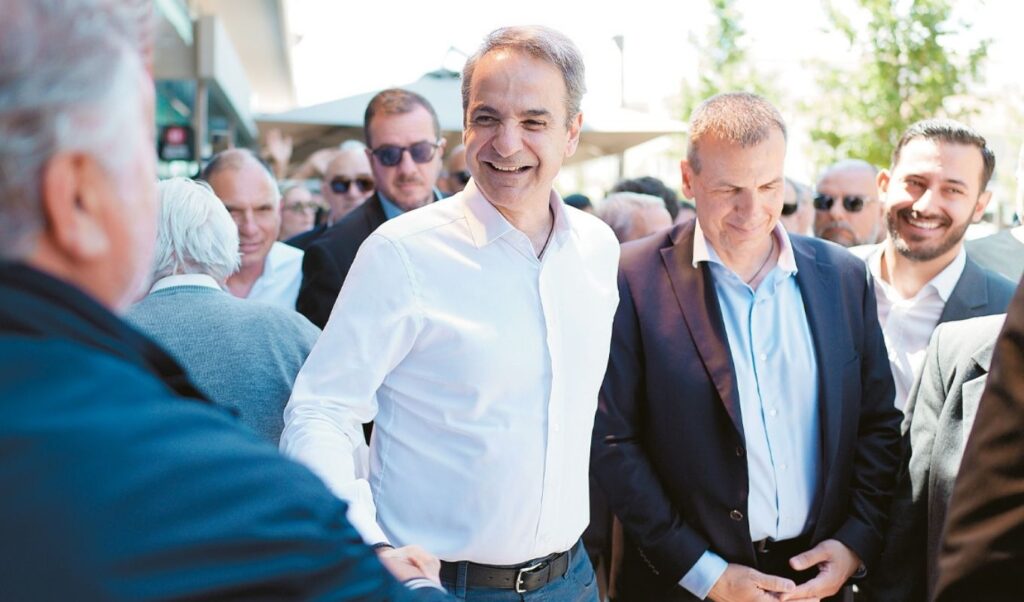
“We have built relationships of trust over these eight years. They may have been tested at times, when mistakes were made, but ultimately citizens will recognize in New Democracy the only political force capable of keeping the country on a steady course — in very difficult geopolitical and economic times, with very significant challenges — and the only force that can guarantee every Greek man and woman a truly better future,” Kyriakos Mitsotakis stated last Friday during a speech at a public gathering in Kozani.
In the same vein, the Prime Minister announced that at the upcoming TIF he will present not only the government’s economic plan for the coming year, but also its roadmap through to 2030. His speech the following Saturday is expected to outline the central pillars of New Democracy’s pre-election platform. Mitsotakis also pre-announced a new increase to the minimum wage before the elections, raising the bar above €950. “In 2023, I made specific commitments. I told you then that the minimum wage would reach €950,” the Prime Minister said, adding: “I am now telling you with certainty that before the elections it will have exceeded €950.” The government is seeking to reinforce its narrative of effectiveness and commitment to delivering on its program, with the motto “we said it, we’re doing it” as the central element of its pre-election strategy.
Government spokesperson Pavlos Marinakis previewed a package of measures focused on the middle class, compliant taxpayers, and small and medium-sized enterprises, ahead of Prime Minister Mitsotakis’ announcements at the Thessaloniki International Fair. Speaking on Real FM last Saturday, Marinakis stated specifically: “I think that now, in particular, much greater emphasis needs to be placed on the middle class, small and medium-sized businesses, and those who comply,” signaling the direction of the upcoming announcements. He went on to explain: “Because we talk — rightly so — about those who need support, vulnerable borrowers, and we have done more for them than all previous governments combined. But the truth is that the time has now come to pay much more attention to those who, all these years, have been paying their taxes, complying with the rules, and contributing — to Greek society as a whole, but especially to these categories of our fellow citizens.”
Indeed, Kyriakos Mitsotakis himself has set the framework for the upcoming TIF, describing it as a “credibility test” for political forces. Against this backdrop, the words “credibility,” “consistency,” and “trust,” combined with the stability narrative, dominate the government’s rhetoric — as it seeks to leverage its comparative advantage over rivals in terms of effective governance. According to the latest polls being factored into pre-election strategy planning at the Prime Minister’s office, Kyriakos Mitsotakis is rated by citizens as the most capable of managing the economy. And broadly speaking, despite the wear and tear the government has experienced after seven years in power, citizens continue to view the government as more effective than both PASOK and Alexis Tsipras’ SYRIZA. “New Democracy is the only political force that guarantees both stability and progress,” the Prime Minister said, defining the stakes of the election and turning his fire on the opposition: “What we face are parties with a single mission — to get rid of New Democracy and Mitsotakis.” As he added, this is being pursued “with no plan, as if a country can be governed with some magic scheme.”
550,000 jobs created as GDP rises by 11 points
The government is treating the upcoming major political event in Thessaloniki as an opportunity to take stock of its time in office, where Prime Minister Kyriakos Mitsotakis is expected to unveil New Democracy’s program ahead of the 2027 elections.
The tone was set by Kyriakos Mitsotakis in Kozani last Friday, where — ahead of his eighth appearance at the TIF as Prime Minister — he stressed that a fair and honest assessment would be made. “What we achieved during the years we were in government, how consistent we were with our pre-election commitments. But the most important thing is to talk about the future. To talk about the economic planning for the coming year, to explain to citizens that in order to be able to support society — with tax cuts, pension increases, wage increases — we must first and foremost stand on solid foundations,” the Prime Minister said specifically, as the government puts the positive trajectory of the economy front and center, along with its efforts to translate that progress into tangible results for citizens.
In this context, in his most recent review of the government’s work, Mitsotakis highlighted the payment of new widows’ pensions following the legislative reform abolishing the cuts introduced by the Katrougalos law, the initiative taking effect to bring lower prices on basic consumer goods to supermarket shelves, and made special mention of the transition from the Recovery Fund to the Social Climate Fund.
In his post, the Prime Minister referred to actions in social policy, education, the energy transition, and the new cycle of European funding, underscoring that the changes being set in motion aim to improve citizens’ daily lives and create a more modern productive model for the country. On the Recovery Fund specifically, he noted that “the most significant legacy is that the 74 reforms under the program resolved long-standing issues of decades and brought the country closer to what is taken for granted in the rest of Europe. It was a real opportunity, and we made the most of it.”
In this framework, the Prime Minister referred to the results of the Recovery Fund, stressing that they exceeded the original projections. Specifically, according to the Prime Minister, GDP increased by 11 percentage points, 550,000 new jobs were created, and investments rose by 60%.
Mitsotakis also placed particular emphasis on major infrastructure projects, led by the Thessaloniki Metro, noting that with the delivery of the extension to Kalamaria, Thessaloniki has now settled one long-overdue debt. He also highlighted that the extensions toward western Thessaloniki are already on track, with preliminary planning work set to begin immediately. Remaining on Thessaloniki-related projects, the Prime Minister announced that a tender for the redevelopment of the city’s railway station will be launched by the end of the year.
From Thessaloniki, the Prime Minister turned to Western Macedonia, noting that the major changes taking place in northern Greece “are not limited to one city.” “Western Macedonia is called upon to leave behind a productive model that has defined its life for decades. At the end of the day, what I believe truly matters is that the people of the region can plan their lives there with greater security and optimism,” Kyriakos Mitsotakis emphasized.
Hatzidakis fires back with facts and figures: “The opposition lives in a different country”
Deputy Prime Minister Kostis Hatzidakis yesterday delivered a data-driven rebuttal to opposition criticism of the Recovery Fund, as the massive program — which has left a powerful mark on Greek economic development — draws to a close.
“Tomorrow (i.e. today), the Recovery Fund comes to an end. Pencils down! The opposition is talking about what they claim is a huge government failure. They obviously live in a different country and are referring to some other Recovery Plan,” Hatzidakis stated, noting that reality tells an entirely different story.
As he pointed out, Greece will succeed — through final disbursements by year’s end — in fully absorbing the total of €35.95 billion (€18.22 billion in grants and €17.73 billion in loans).
In his review of the Recovery Fund’s outcomes, Hatzidakis noted that hundreds of projects were completed and advanced, and the facts on the ground stand ready to refute the opposition:
– The digital modernization of the state through gov.gr, 425 new electric buses in Athens and Thessaloniki, the renovation of 80 hospitals and 146 health centers, the northern section of the E65 motorway, the preventive health screening program for millions of Greeks, interactive whiteboards in schools, the “My Home 2” housing program, and more.
– Critical reforms were implemented: the new Judicial Map, the completion of the Land Registry, Special Spatial Plans for Renewable Energy, Tourism and Industry, the new Local Government Code, the codification of tax legislation, and others.
– Despite the myth that small and medium-sized enterprises were supposedly excluded from the Fund, SMEs received €1.66 billion in approved grants. On the loan side, 60% of contracts involved small and medium-sized businesses, with investment plans totaling €5.9 billion.
– The Ministry of Environment and Energy advanced the largest-ever “Exoikonomo” (energy efficiency) program, while in the field of Renewable Energy Sources, Greece became a net exporter of electricity.
– The Ministry of Labor and Social Affairs advanced the Digital Work Card, which represents the strongest guarantee of respect for working hours and payment of overtime. In parallel, the Personal Assistant program for people with disabilities was introduced.
– The Ministry of National Economy and Finance implemented the linking of POS terminals and cash registers across approximately 490,000 businesses, thanks to which the VAT gap was reduced to the European average — a reform of both fiscal and social justice.
Published in the Apogeumatini newspaper