Greece’s Foreign Minister Giorgos Gerapetritis is briefing his European Union counterparts Tuesday and Wednesday at the informal EU Foreign Affairs Council on Turkey’s provocative moves to designate maritime parks in the Aegean beyond its own jurisdiction, as well as Ankara’s renewed violations of Greek airspace.
Read also: New provocations from Turkey: Three UAVs committed violations over the Aegean
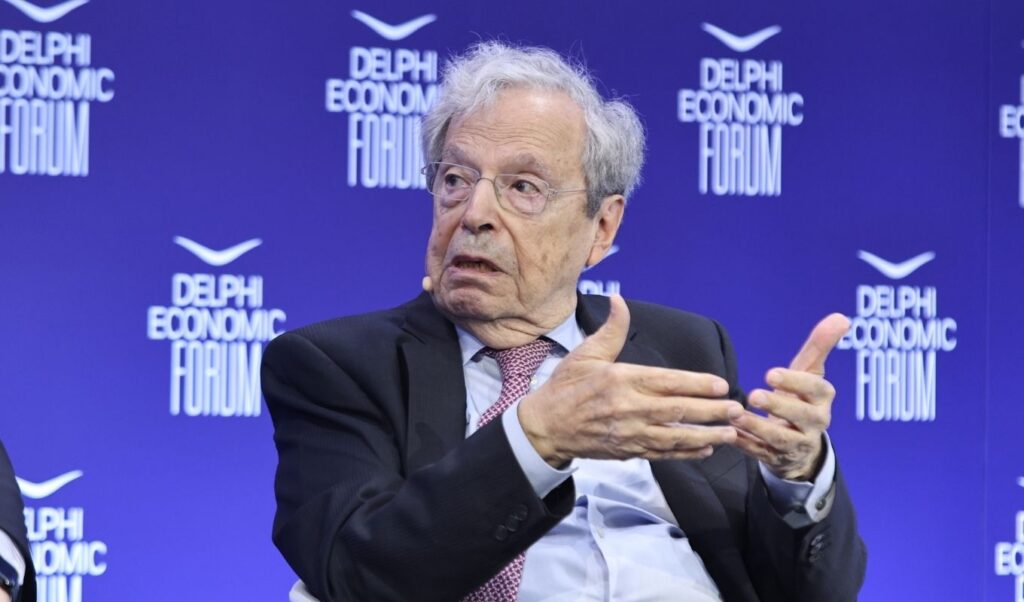
Former Deputy Minister and Professor Emeritus Christos Rozakis, in an exclusive interview with parapolitika.gr, argues that Greece squandered a golden opportunity during the so-called “calm waters” period to pursue substantive negotiations with its neighbor. He warns that Turkey’s unilateral actions now threaten to encircle and trap Greek islands within Turkish jurisdiction. He firmly supports extending Greece’s territorial sea to 12 nautical miles south of Crete, south of Kastellorizo, and east of Rhodes and Karpathos — a move he describes as critically important for Greek national interests.
He also argues that, with elections approaching in 2027, a newly mandated government will be better positioned to take the bold steps needed to break the current deadlock.
The Greek government pursued the “calm waters” policy as a necessary means of maintaining a functional relationship with Turkey, pointing to the dramatic reduction in airspace violations and migration flows. However, Ankara effectively rejected this approach by preparing its “Blue Homeland” legislation and taking unilateral actions, such as declaring its own maritime parks. How do you assess this dual Turkish strategy, and what should Greek diplomacy’s response be to these institutional challenges?
The “calm waters” period represented a very positive chapter in Greek-Turkish relations — one that lasted a considerable time and brought us a welcome period of stability. Unfortunately, we failed to make the most of it, perhaps because we assumed it would last indefinitely. In reality, it was no more than a “truce” in the undeclared cold war between the two countries. Turkey kept all its claims intact, and we maintained all our positions unchanged. Yet we should have seized that opportunity to pursue substantive negotiations with our neighbor, based on both sides’ stated positions.
With the spirit of Konstantinos Karamanlis’s policy in mind, we should have tried to separate the major issues — the continental shelf and the Exclusive Economic Zone (EEZ), which are our core concerns — from the secondary ones, namely Turkey’s broader territorial claims. The former should have been referred to the International Court of Justice through a special agreement (compromis), with a clear-eyed understanding that not all of our demands would necessarily prevail. The latter could have been negotiated bilaterally, since we are confident we would never lose ground and Turkey’s claims border on the absurd.
At this point, and with elections looming in 2027, there is little we can do beyond formal diplomatic protests, referrals to the UN, and appeals to EU institutions — while hoping that Turkey will not act on any of its stated intentions in the near term. The goal is to allow a newly mandated government to find the political courage to take the steps necessary to break the current deadlock. The one constant that gives us reason to hope there will be no outright rupture is the European Union — which, despite its current difficulties, remains in Turkish eyes a quiet aspiration: not for full membership, but for the very significant economic benefits it is capable of providing.
Turkey’s decision to declare its own “national marine parks” beyond its territorial waters, in international waters, is interpreted as an attempt to “encircle” and isolate Greek islands. If Ankara attempts to enforce these restrictions through the deployment of warships or coast guard vessels, how significant is the risk of a “coast guard battle” or an incident that could escalate into a military confrontation?
Turkey’s move to legislate two marine parks beyond its own territorial sea is a clear violation of international law. While international law does recognize the protection of the marine environment as being of the utmost importance to humanity’s survival, it does not thereby create a new jurisdictional zone for coastal states — least of all on the high seas. What international law does permit in semi-enclosed seas is the cooperative management of environmental protection by all bordering states, for the joint prevention or suppression of marine pollution. The Aegean and the Eastern Mediterranean are semi-enclosed seas, which means all surrounding states must cooperate on such protection. But unilateral action is not permitted — and Turkey acted unilaterally in this case.
As for Turkey’s motives, I believe they are closely tied to the broader design of the “Blue Homeland” doctrine. And if that doctrine were to be formally implemented, it would inevitably trap Greek islands within Turkish-claimed jurisdiction.
In the context of Greece’s pre-election debate, the question of extending Greek territorial waters to 12 nautical miles south of Crete keeps resurfacing. Would such a decision represent a genuine exercise of sovereign rights, or merely a “communications stunt” with no direct bearing on the dispute with Turkey?
Greece has every right to extend its territorial sea to 12 nautical miles along the southern coasts of Crete. It equally has the right to extend to 12 nautical miles along the southern coasts of Kastellorizo and the eastern coasts of Rhodes and Karpathos. All of these extensions lie outside the Aegean — which is the disputed area, where an extension would impede freedom of navigation.
I would not view these moves as political theater, but as actions of critical importance to Greek national interests.
The strategic cooperation between Greece, Cyprus, and Israel — including high-level military contacts such as the visit of Greece’s Chief of the Hellenic National Defence General Staff to Israel — is strongly condemned by Ankara. Given the intense rivalry between Turkey and Israel, how does the “Israel factor” affect Greek-Turkish relations and stability in the Aegean?
Turkey unfortunately perceives Israel as a dangerous enemy that has an armed conflict with Ankara as its next objective. This is not accurate — for three reasons. First, such a scenario would put Turkey in direct confrontation with the United States and American leadership. Second, it would mean a bloody war between a small but heavily armed power and a giant, with an unpredictable outcome. And third, Israel is currently engaged on three fronts simultaneously and is not about to risk opening a fourth.
Yet Turkey remains gripped by an obsession that implicates us and Cyprus as well, by virtue of our friendly relations with Israel. That said, this does not mean Turkey will launch a preemptive war against both countries to avoid an armed confrontation with Israel. We are very far from such scenarios — they belong in the realm of science fiction.
Following the latest Turkish provocations, the Greek government has faced sharp criticism for failing to take immediate steps to push for EU sanctions against Turkey. Do you believe the European Union has the reflexes and the political will to offer Greece tangible support, or should Athens focus on strengthening regional alliances — such as the trilateral partnership with Israel and relations with the United States?
The European Union’s contribution to the Greek-Turkish equation lies in deterring conflict with Turkey — not in managing its aftermath. In other words, Turkey will not attack an EU member state because it fully understands the cost of doing so. As for other alliances, Greece has made the right moves in all directions to safeguard its security. But it must be clear-eyed about one thing: in the unlikely but catastrophic event of an actual conflict, Greece would be standing largely alone. This is something Athens appears to have understood, judging by its defense procurement decisions — which themselves carry significant deterrent value. As the Romans wisely put it: if you want peace, prepare for war.