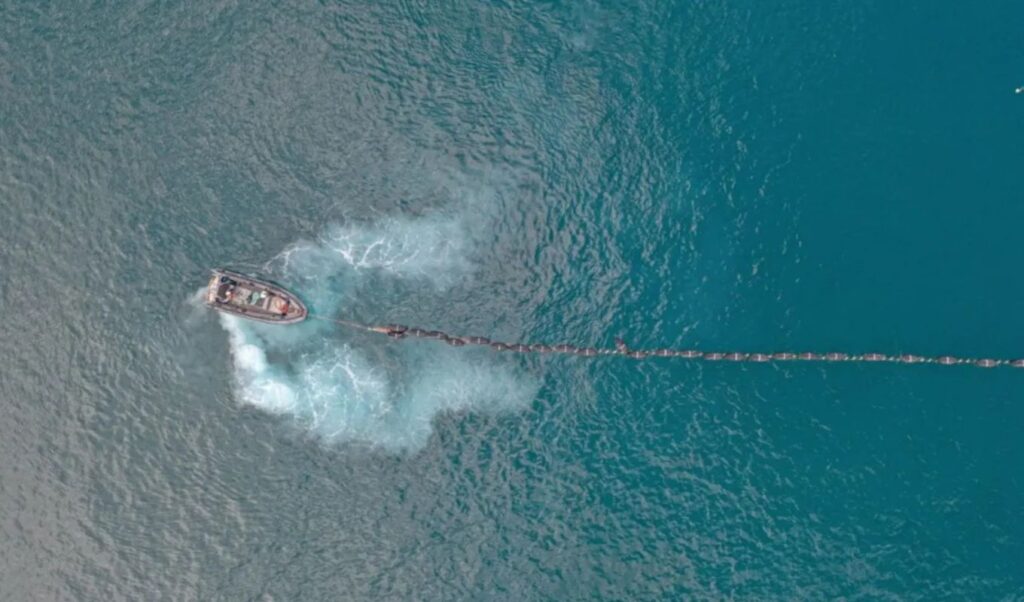
The launch of survey operations by the French vessel Abeille Marengo — which has been stationed in Heraklion, Crete since last Tuesday awaiting the issuance of a NAVTEX notice — appears to be entering its final stretch. The electrical interconnection project between Greece and Cyprus is being relaunched at a particularly sensitive phase in Greek-Turkish relations, emerging as a critical barometer for the balance of power in the region.
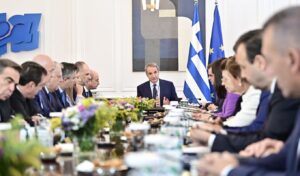
According to sources, developments on national issues are expected to be discussed at today’s cabinet meeting, held following the return of Greek Prime Minister Kyriakos Mitsotakis and Foreign Minister Giorgos Gerapetritis from the UN General Assembly session, where they intervened against the illegal Turkey-Libya maritime memorandum. Additionally, on Tuesday, Gerapetritis is expected to brief members of the Parliamentary Committee on National Defense and Foreign Affairs on the latest developments regarding national issues.
The Turkey-Libya agreement appears to further complicate the cable project, with some assessments suggesting it could lead to yet another delay in the issuance of the NAVTEX — effectively achieving Ankara’s objective. As retired Cypriot Ambassador Michalis Stavrinos argues in an interview with parapolitika.gr, Greece’s declared decision to resume the Crete-Cyprus electrical interconnection works prompted Turkey to pressure Saddam Haftar into ratifying the Turkey-Libya Memorandum at this precise moment — a move designed to push back against Greece’s decisive steps to implement regional connectivity projects and energy exploration activities south of Crete by Chevron and ExxonMobil. “Turkey coerced the situation so that Haftar would approve the agreement just before the surveys began. That is why in diplomacy it is good that certain things are not revealed in advance, so that the opponent cannot take preemptive steps — as Turkey did. That is what we did in 2004 when we proclaimed Cyprus’s Exclusive Economic Zone and designed agreements with neighboring states. Turkey was caught off guard because we made no announcements,” he stated characteristically.
Electrical interconnection: Surveys expected to focus on Kasos — “This is the moment for Greece to act on the ground”
Other sources, however, indicate that the resumption of surveys is expected within the coming days, as the Inter-Ministerial Committee (EXAETH) and the Ministry of Foreign Affairs are on standby to issue the order to the Navy’s Hydrographic Service for the publication of the NAVTEX. Greece’s response will be shaped by Turkey’s conduct on the ground, as surveys are planned to focus on the maritime area of Kasos — the zone where sea-floor depth measurements present the greatest technical challenges. This is the same area where Turkish naval frigates appeared in 2024 and halted the survey operations.
Ambassador Stavrinos argues that for this attempt by the French research vessel to succeed, it must be escorted by Greek and French warships, with a discrete American presence as well. As he put it, “that is the only way to deter Turkey from intervening. If this does not happen and Turkey responds with a naval presence that disrupts the effort, I fear it will mark the beginning of the end. Turkey’s claims would then become customarily entrenched. ‘Blue Homeland’ and all of its territorial claims would be indirectly legitimized. This is therefore the moment for Greece to act on the ground — boldly, not recklessly — because this is a legal right. We cannot go to the Security Council to denounce these actions and then fail to move forward. And I would add something else on this occasion: while the Prime Minister’s statement at the Security Council regarding the Turkey-Libya Memorandum was very appropriate, he should first have denounced the casus belli, as it violates both the UN Charter and all foundational principles of the United Nations.”
The phone call between Emmanuel Macron and Recep Tayyip Erdoğan last Tuesday was aimed at preventing tensions from escalating on the ground. However, the pivotal point and diplomatic key to the entire process lies in a clear distinction between “requesting permission” and “communication and notification.” As Greek Foreign Minister Giorgos Gerapetritis has stated, Greece is the sole sovereign authority from which official permission for the surveys is sought and granted, while Ankara receives exclusively a written communiqué transmitted through the French Embassy.
Turkey’s diplomatic chessboard, however, extends well beyond the Eastern Mediterranean. In a move that caught many off guard, Ankara proposed its trusted diplomat Feridun Sinirlioğlu — currently Secretary General of the OSCE — as a candidate for the position of UN Secretary-General, which António Guterres is set to vacate. According to Cypriot diplomat Michalis Stavrinos, it is too early to fully assess the implications, but as he noted, “the Turks always act methodically. They will certainly have secured some support from Islamic and other countries. Yet here too, there are mistakes on our part — Greece, and I believe Cyprus as well, agreed to allow this individual to become Secretary General of the OSCE. Given that Greece now sits on the UN Security Council, it must highlight certain issues, including the casus belli, the occupation of Cyprus, and all those elements that demonstrate by definition that no Turkish national can serve as UN Secretary-General. Let us not forget that there is a UN peacekeeping force stationed in Cyprus.”
The election process, however, is lengthy and requires, first and foremost, the unanimous consent of the five permanent members of the UN Security Council — the United States, Russia, China, the United Kingdom, and France.