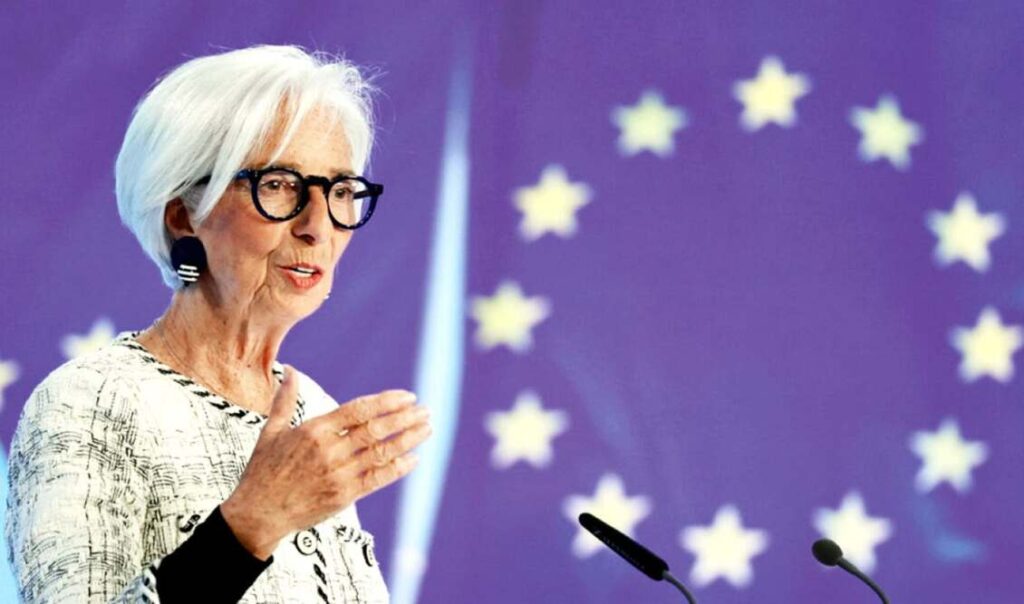
The resignation of European Central Bank (ECB) President Christine Lagarde in February 2027 — roughly eight months before the end of her term — comes as little surprise. The possibility of an early departure from the ECB’s top post had been signaled well in advance, with the timing of her decision reportedly linked directly to France’s upcoming presidential election in April.
Meanwhile, the succession process is already underway, with an informal battle for the ECB’s leadership having been quietly unfolding for months. The leading candidates include Spain’s Pablo Hernández de Cos and the Netherlands’ Klaas Knot. According to German Chancellor Friedrich Merz, a final decision on who will take over the presidency is expected before the end of the year.
Christine Lagarde’s departure: the backstory and the French elections
Reports that emerged over the winter indicated that Lagarde had been approached about taking the helm of the World Economic Forum (WEF) — known as the Davos Forum — at the Swiss resort where the organization holds its annual summits each January.
Subsequent reports suggested that Lagarde had been planning to step down before the French elections, so that the selection of her successor would not be influenced by the electoral outcome or the potential rise of the far right.
Lagarde herself had previously denied any intention of running in the French elections. However, at the press conference she gave last Thursday following the ECB’s governing council meeting, she expressed a desire for greater freedom to speak publicly on issues beyond monetary policy. As she explained, her role as ECB President required her to maintain a neutral stance on a wide range of political and economic matters.
The ECB as an anchor of stability in an uncertain environment
At a time when the European economy is under significant pressure from the wars in the Middle East and Ukraine, as well as intensifying competition between the United States and China, the ECB’s role as an anchor of stability has taken on even greater importance.
The ECB ranks among the most independent central banks in the world, with its core mandate centered on ensuring price stability. Under Lagarde’s leadership, it successfully navigated the inflationary shock of 2021–2022 and gradually brought inflation back toward the 2% target.
Key milestones of Lagarde’s tenure
Christine Lagarde’s tenure as ECB President, which began on November 1, 2019, was defined by a succession of crises and major shifts in monetary policy. As the first woman to lead the eurozone’s central bank, she was tasked with managing a global pandemic, an energy crisis triggered by Russia’s invasion of Ukraine, and the most severe inflation surge in the euro’s history.
The first major test came in March 2020, with the outbreak of the COVID-19 pandemic. The ECB launched the Pandemic Emergency Purchase Programme (PEPP), starting with an initial envelope of €750 billion that was eventually expanded to €1.85 trillion. The programme played a critical role in stabilizing financial markets and maintaining favorable financing conditions across the eurozone.
Another landmark moment came in 2021, when the ECB revised its monetary policy strategy, adopting a symmetric 2% inflation target — replacing the previous formulation of inflation “below, but close to, 2%.”
The greatest challenge, however, arrived in 2022, when soaring energy prices and the economic disruption caused by the war in Ukraine drove inflation to record highs. In July 2022, the ECB raised interest rates for the first time in eleven years, launching the fastest monetary tightening cycle in its history. From July 2022 to September 2023, key interest rates rose by a cumulative 450 basis points.
Despite criticism over the delayed start of rate hikes in 2022, the restrictive monetary policy contributed to a gradual easing of inflationary pressures. In June 2024, the ECB began cutting rates, initiating a new cycle of monetary easing. This process continued into 2025, with the deposit facility rate falling to 2% in June, as inflation returned close to the central bank’s medium-term target.
A significant chapter of Lagarde’s tenure was also the advancement of the digital euro project. Under her leadership, the ECB launched the exploration phase in 2021 and moved into the preparation phase in 2023, aiming to strengthen Europe’s strategic autonomy in the payments landscape. However, the final decision on whether to issue a digital euro remains pending.
Lagarde took the reins of the ECB without a formal academic background in economics. Nevertheless, the overall assessment of her tenure is that she rose to the demands of the role — managing successive crises, securing consensus within the bank’s governing council, and drawing effectively on her extensive political experience.
Her departure marks the end of an era during which the ECB moved from extraordinary economic support measures to rapid interest rate hikes, and then to a gradual easing of monetary policy. Throughout this journey, maintaining price stability remained her overriding priority.
The challenges facing Lagarde’s successor
The environment of easing inflationary pressures was, however, disrupted by the war in Iran, pushing eurozone inflation back onto an upward trajectory. Although the new wave of price increases is milder compared to the one four years ago, it represents a significant challenge for the next ECB president.
The resurgence of inflationary pressures led the ECB to resume interest rate hikes in 2026, with the deposit facility rate reaching 2.5% by October. This development underscores the difficult task awaiting the central bank’s new leadership: keeping inflation in check without placing an excessive burden on economic activity.
Adding to these challenges is the crisis in the French government bond market, which is intensifying concerns about the fiscal stability of the eurozone’s second-largest economy.
The two frontrunners for the ECB presidency
The two leading candidates to succeed Lagarde both bring substantial experience in central banking.
Pablo Hernández de Cos is the General Manager of the Bank for International Settlements (BIS) and previously served as Governor of the Bank of Spain. Klaas Knot, for his part, served as President of the Dutch central bank from 2011 to 2025.
The next ECB president will be called upon to navigate a complex economic and geopolitical landscape while safeguarding the credibility and independence of the central bank. They will also need to strike a careful balance between addressing inflationary pressures and protecting economic activity — at a time when the European economy is confronting significant headwinds.