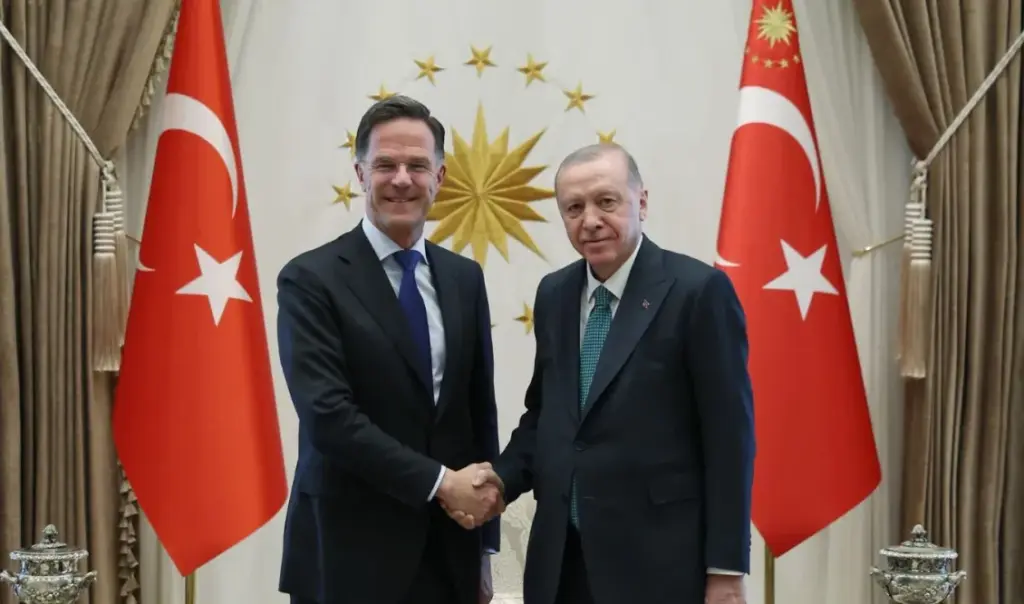
NATO Secretary General Mark Rutte is emerging as Turkey’s most steadfast ally within the Atlantic Alliance — a position widely seen as repaying the firm support Ankara gave him during his bid for the top NATO post. Just recently, standing alongside U.S. President Donald Trump, Rutte enthusiastically backed Turkey’s defense buildup, seemingly unconcerned by Ankara’s revisionist posture toward Greece. Recognizing Turkey’s geostrategic role in the volatile Middle East, Rutte has consistently championed Turkey’s defense industry and advocated for its inclusion in Europe’s SAFE defense mechanism.
Read also: F-35s for Turkey: Trump’s latest statements trigger alarm in Athens
How Petros Vamvakas interprets Trump’s and NATO’s stance
Petros Vamvakas, Professor of International Relations at Emmanuel College in Boston and Director of the Institute for Eastern Mediterranean Studies, spoke to parapolitika.gr about the influence Mark Rutte exerted on President Trump’s decision to bolster Turkey’s defense capabilities. According to Vamvakas, Rutte’s position was evident from the outset — something clearly illustrated by the statistical charts about Turkey he presented in the Oval Office. He notes that both Trump and Rutte are focused on the region’s future and the role Turkey is poised to claim. “In the aftermath of the conflict with Iran, every situation in the region is being dramatized and the roles of both Israel and Turkey are being redefined. Rutte and the Americans are trying to keep Turkey within their sphere of influence — to make sure it doesn’t slip away,” he observed.
What NATO’s policy means for Greece — and Turkey’s casus belli threat
How does Greece fare in all of this, given that its allies are turning a blind eye even to Turkey’s standing casus belli threat? After all, it was just days ago that Greek Defense Minister Nikos Dendias felt compelled to remind the international community that Greece is “the only country on the planet Earth facing a declared act of war threat from a neighbor — the casus belli.”
According to Vamvakas, “one of the tactical choices Greece has made is to align itself with Israel throughout this entire war process.” He warns that “this is Greece’s greatest risk. If there is a realignment in the region, Greece could find itself in a very difficult position. I think we need to remain very clear-headed right now to see exactly what will unfold in the region, as many analysts suggest. Greece’s relationship with Turkey is something we will need to watch very closely in the coming weeks and months” — all the more so since “Turkey will assert its role in the region. Let’s not forget that before the war with Iran, Mr. Trump effectively handed Turkey Syria.”
US-Israel relations and the implications for Greek strategy
Assessing the broader picture, the Boston-based professor argues that the balance of power in the region has fundamentally shifted following the U.S.-Iran conflict. “Iran is the winner of its confrontation with America. It emerges as an emboldened Iran. But this has repercussions across the entire region — for the Gulf states, for Israel, and for Turkey as well. We saw Mr. Trump openly claim that it was he who restrained Mr. Erdoğan from entering the war on Iran’s side — though I’m not entirely sure how accurate that claim is. I simply cannot imagine Turkey joining a war between Iran, America, and Israel on Iran’s side. That would be completely at odds with the strategic and tactical course Turkey has followed for decades. What Turkey will now try to do is elevate its position and act as a counterweight to both Iran and Israel in the region. I think this is something that should not frighten us, but it should make us more conscious and alert.”
A key factor in shaping the new regional balance of power, Vamvakas argues, will be the evolving relationship between the United States and Israel — a relationship that all signs suggest has become deeply strained. “A consensus has formed in America, a current of opinion running against Israel, and here we have Greece still directly tied to Israel, while Turkey is emerging at this moment as a major regional player. For us — for Greece — I think the situation is dangerous right now, and I think it calls for a cool head. Greece is exposed. It’s not just obvious — it’s something all analysts are noting: there is a serious disruption in US-Israel relations. We see it even at the domestic political level in America, when in three primary elections in New York, three candidates who are opposed to Israel win — in a city where Israel’s allies and the Jewish lobby are powerful. That signals a complete shift in the tide. Greece, therefore, is exposed by its choice to serve as Israel’s key ally in the region.”
Against this backdrop, Greek diplomacy faces the challenge of navigating Turkey’s growing military empowerment. According to Professor Vamvakas, Greece needs to develop a “Plan B,” seriously considering a tactical shift, as traditional alliances can no longer be taken for granted. NATO’s Secretary General’s drive to strengthen Turkey’s role within the Alliance — in the name of cohesion — presents a challenge that Greece must manage carefully, ensuring that its own national interests are not sidelined in the name of allied unity.