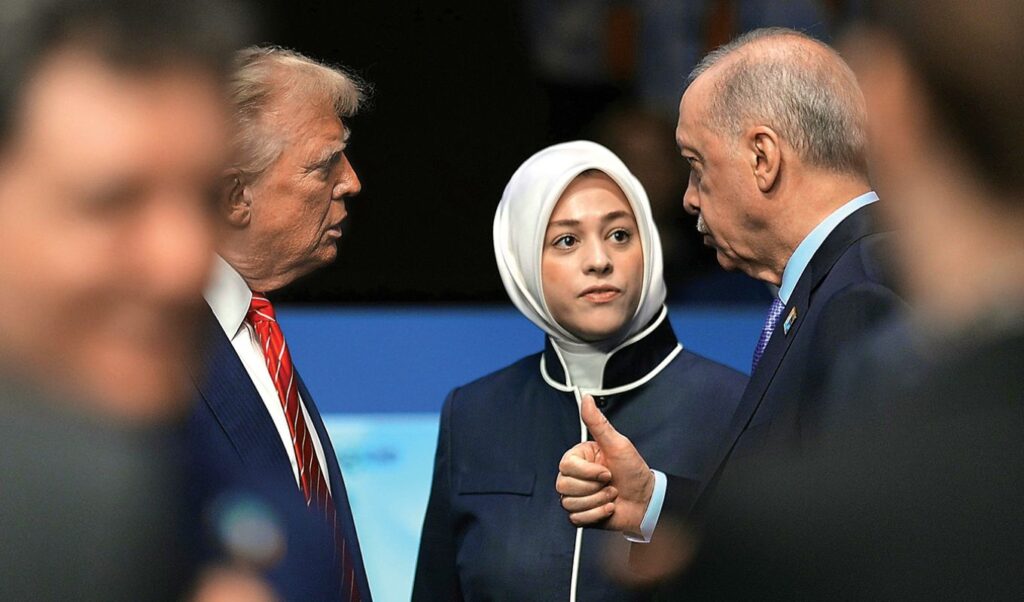
The latest public statement by U.S. President Donald Trump in favor of Turkey — coming just two weeks before the crucial NATO Summit in the Turkish capital — has brought a significant geopolitical issue back to the forefront for the Eastern Mediterranean: the possibility of Ankara’s reinstatement into the fifth-generation F-35 fighter jet program. Trump’s remarks, combined with statements from senior American officials about reviewing the relevant file, signal that Washington is once again seeking to strategically upgrade its relationship with Turkey, despite the unresolved issues that continue to linger between the two countries.
Trump’s message to Netanyahu
Seasoned analysts believe the key word here is: Israel. Ahead of the NATO Summit and his meeting with Recep Tayyip Erdoğan, Trump appeared to pursue two goals simultaneously: to publicly elevate the Turkish president and achieve a degree of diplomatic appeasement while the F-35 issue remains frozen — and to send a clear message to Benjamin Netanyahu, with whom Trump has recently been openly at odds. Israeli military operations in Lebanon, despite the ceasefire, risk unraveling the Iran deal that the American president worked hard to secure. Erdoğan, by contrast, has been following the White House’s line — something Washington duly appreciates. It is telling that Trump said of Erdoğan: “I like him. He’s a friend of mine. He stayed out of the war. He’s not the biggest friend of Israel, as you know. But I asked him to stay out, and he did. Erdoğan is a great leader. A strong man, with a great military.”
The fact that the leader of the free world heaped praise on a leader who openly threatens a NATO member state — Greece — understandably raises serious concerns in Athens. So do his comments about the F-35s. “I’ll probably do something that will make him very happy,” Trump said characteristically, when asked whether he planned to travel to Turkey for the NATO Summit bearing “gifts” for Erdoğan — a question directly linked to the F-35s and the F110 engines that Ankara is seeking to acquire for its domestically developed KAAN fighter jets.
The political will is there
Even more significant, however, are the statements made by U.S. Vice President JD Vance, who confirmed that the American government is currently examining whether the legal and political conditions have been met to reactivate Turkey’s participation in the program. “We are going through all the necessary review stages and confirming that the prerequisites have been fulfilled,” he noted, implying that the political will exists — provided Ankara complies with the U.S. legal framework. This reference points directly to the Russian S-400 anti-aircraft missile systems, which led to Turkey’s exclusion from the F-35 program back in 2019.
Despite periodic discussions over the years, the issue had remained frozen, with the sanctions stemming from the CAATSA law blocking Ankara’s ambitions. However, authoritative sources have made clear to this publication that even if Congress eventually gives the green light, it would take at least five years before Turkey could receive the fighter jets.
In the meantime, Greece is set to make significant operational advances, with the country due to receive its first fifth-generation fighter aircraft in 2028. It is worth noting that Greece has already agreed to procure twenty F-35s from the United States, with an option for an additional twenty. In any case, Athens is monitoring developments closely. Government sources emphasize that the strategic partnership between Greece and the United States is at its highest level in recent years — a reality reflected both in the bilateral defense agreement and in the enhanced American military presence at key installations in the country.
“The Greek-American relationship has strong institutional and strategic foundations that are not affected by individual, circumstantial developments,” the same sources note. Nevertheless, the upcoming NATO Summit is expected to serve as a critical test of balance for the Alliance’s southeastern flank as a whole. Athens is heading into the summit with the aim of keeping lines of communication with Ankara open, while not losing sight of the longstanding disputes that persist in the Aegean and the Eastern Mediterranean. Diplomatic observers believe the Greek government will seek to highlight the country’s role as a factor of stability and security in the region, while underlining that Alliance cohesion requires full respect for international law and good neighbourly relations.
The Ankara-Cairo flirtation is paying off
At the same time, policymakers in Athens are watching with growing concern the intensifying rapprochement between Turkey and Egypt, which — after years of cold relations — appears to be entering a phase of substantive deepening. A series of high-level contacts, the reactivation of bilateral cooperation mechanisms, and strengthened military communication channels all indicate that Ankara and Cairo are working to build a more functional relationship. It is indicative that the two sides jointly conducted the “Anatolian Eagle” military exercise together with Azerbaijan, while a quadrilateral meeting was also convened in Cairo among the foreign ministers of Egypt, Turkey, Pakistan, and Saudi Arabia — a meeting Athens had not been informed of in advance. In the wake of that meeting, Greek Foreign Minister Giorgos Gerapetritis held a telephone conversation with his Egyptian counterpart.
According to reports, the two ministers discussed the possibility of a bilateral meeting in Cairo in the near future. The Greek-Egyptian strategic relationship remains strong and multidimensional; however, Egypt’s gradual reconciliation with Turkey is seen by some as limiting the scope for an exclusively aligned geopolitical partnership between Cairo and Athens. “For us, Egypt is indispensable, for a number of reasons — the most important of which is Libya,” experienced diplomats told this publication.
Published in Parapolitika