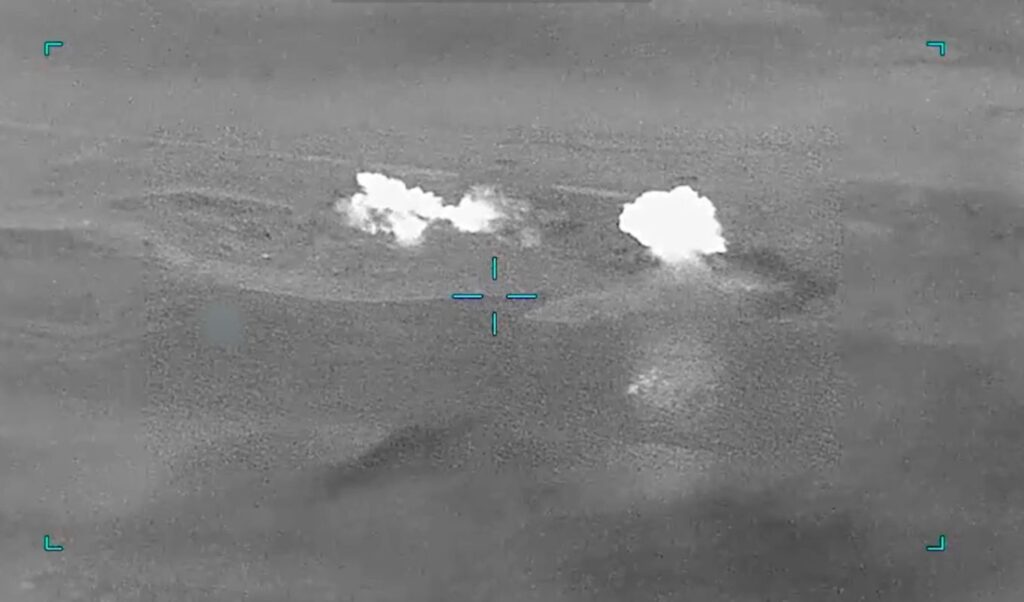
The United States launched a new round of strikes against Iran Saturday night into Sunday, while the Islamic Revolutionary Guard Corps (IRGC) retaliated by striking American military installations in Kuwait and Bahrain. Both sides are trading accusations of violating the fragile ceasefire signed on June 17, with US President Donald Trump threatening to annihilate the Islamic Republic.
American fighter jets strike ten locations across Iran
Late Saturday night, US Navy and Air Force fighter jets struck ten locations across Iran, targeting military surveillance infrastructure, communication systems, air defense installations, drone depots, and mine-laying capabilities, according to a statement from US Central Command (CENTCOM), the military command responsible for the Middle East region.
Explosions were reported in the Sirik area of southern Iran, with state broadcaster IRIB reporting that a telecommunications tower had been hit, citing information from an Iranian military official. IRIB also reported that projectiles struck a village on Qeshm Island, with no reports of casualties.
According to CENTCOM’s statement, following the previous American strikes — carried out in retaliation for Iran’s attack on the cargo vessel Ever Lovely — “Iran had the opportunity to honor the ceasefire agreement but chose not to do so.” The statement highlighted that Iranian forces had attacked the Panama-flagged tanker Kiku with kamikaze drones as it sailed near the Strait of Hormuz, carrying more than two million barrels of crude oil.
U.S. Navy and Air Force fighter jets conducted strikes tonight on 10 Iranian military targets at multiple locations in and near the Strait of Hormuz for Iran’s drone attack on M/T Kiku. pic.twitter.com/Z0TLZRqmF6
— U.S. Central Command (@CENTCOM) June 28, 2026
Iran’s Revolutionary Guard strikes back
In the early hours of Sunday, Iran’s Islamic Revolutionary Guard Corps announced it had launched missiles and drones against American military installations in Kuwait and Bahrain in retaliation for the new US strikes on Iranian territory. “The ceasefire violation is contrary to Article 1 of the Islamabad Memorandum of Understanding (MoU) and will lead to the complete suspension of all diplomatic processes,” the statement read, according to Press TV.
‼️ WSJ just dropped new satellite images showing Iran smashed our Fifth Fleet base in Bahrain.
Pentagon claimed -> minor damage. Reality…?
$400 million dollars in wrecked buildings and headquarters.
They hid how bad it really got‼️ pic.twitter.com/Yg9o42yiyU
— Coyote of Wallstreet (@YoteOfStreet) June 28, 2026
The Revolutionary Guard claims to have “destroyed eight significant US Armed Forces facilities at Ali Al Salem Air Base in Kuwait and the Fifth Fleet base at Salman Port in Bahrain.” “Any hostile attack, regardless of pretext, even against insignificant targets (…) will receive a merciless response,” the statement emphasized. Kuwait’s armed forces confirmed the missile and drone attacks on their territory. In Bahrain, air raid sirens sounded and authorities urged residents to remain calm and seek safe shelter.
Trump: If we finish the job militarily, Iran will no longer exist
US President Donald Trump issued stark threats against Iran in the wake of the new American strikes on the Islamic Republic. “American aircraft just struck Iranian missile and drone storage facilities, as well as coastal radar positions, for once again violating the ceasefire agreement” between Washington and Tehran, Trump wrote in a post on his Truth Social platform.

“There may come a time (…) when we will be forced to finish militarily the job we began with great success,” the US president added, warning that “if that happens, the Islamic Republic of Iran will no longer exist.”
Hezbollah pushes back as Netanyahu celebrates
On another front of the conflict, the leader of the pro-Iranian Hezbollah called the agreement signed by Lebanon and Israel — with US mediation — a “grave mistake.” “The Washington framework agreement is humiliating, shameful, and represents an abandonment of national sovereignty,” said Naim Qassem, accusing the Lebanese government of “legitimizing” the occupation of Lebanese territory through the deal.
Lebanese President Joseph Aoun spoke by phone with his American counterpart Donald Trump and assured him that Beirut “will shoulder its responsibilities” regarding the implementation of the agreement. Israeli Prime Minister Benjamin Netanyahu welcomed the framework agreement, calling it a “blow” to Iran and Hezbollah. “We have reached a historic agreement for the State of Israel, following direct negotiations” with Lebanon, Netanyahu said during a press briefing. “This is a blow we have delivered to Iran and Hezbollah,” he stressed.
For his part, Israel’s far-right National Security Minister Itamar Ben-Gvir denounced the agreement as a “major mistake.” As he stated, the Lebanese government includes Hezbollah ministers and “we cannot trust Lebanon to seize” the organization’s weapons, which “only Israeli soldiers” will destroy.