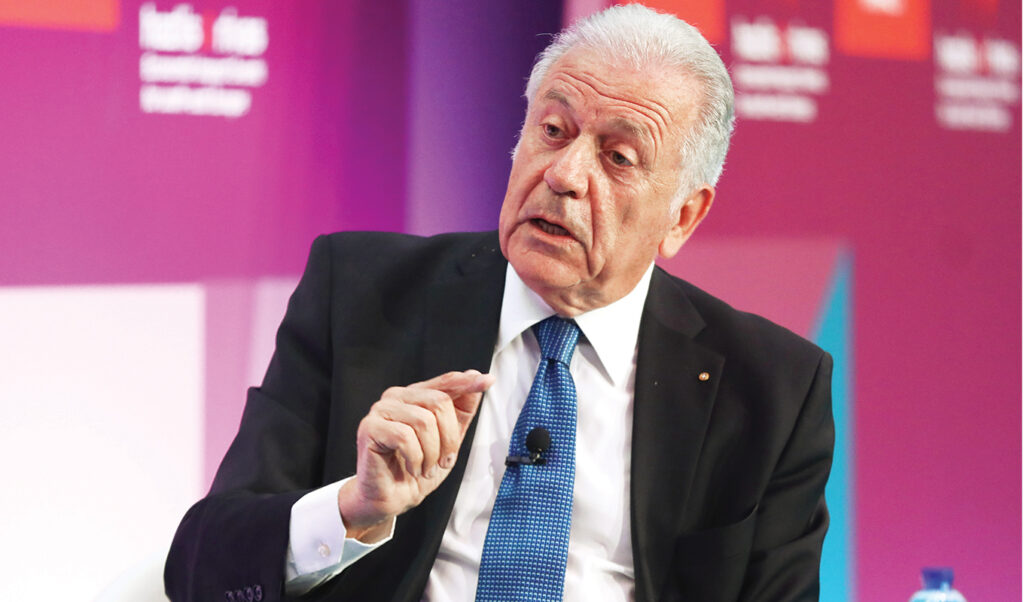
The next major chapter in the high-profile Qatargate scandal will not be written in Brussels, but in Athens. Following the submission of a request to lift the parliamentary immunity of Dimitris Avramopoulos — after Belgian authorities issued an arrest warrant against him — the Greek Parliament is now called upon to decide whether to open the door for investigations to continue against the former European Commissioner and current New Democracy MP.
Qatargate: Request to lift Dimitris Avramopoulos’s immunity reaches Greek Parliament
The request is expected to be examined first by the Parliament’s Ethics Committee before being brought before the Plenary for a final decision. In any case, Dimitris Avramopoulos has stated that he will consent to the lifting of his immunity, and all indications suggest the high-profile case will be placed in the hands of judicial authorities. According to the details contained in the arrest warrant, Belgian authorities are charging the former Commissioner with participation in a criminal organization, public corruption, and money laundering. When mapped onto Greek criminal law, these charges correspond to membership in a criminal organization, bribery, and money laundering.
The “suspicious” NGO
Dimitris Avramopoulos’s name has been linked to the case through his involvement in the NGO Fight Impunity, which was founded by former Italian MEP Antonio Panzeri. The former Commissioner had joined the organization’s board of directors following his departure from the European Commission. Belgian authorities believe that this particular organization was at the center of an influence network that allegedly operated in favor of third-country interests within European institutions. In this context, investigators are examining the relationships, funding, and contacts of individuals who participated in or collaborated with Fight Impunity.
Avramopoulos himself categorically rejects any involvement and dismisses the charges as unfounded, arguing that his participation in the NGO was entirely legal and had received the required approvals from the relevant bodies of the European Commission. He has also stated that he was never bribed nor did he take part in any illegal activities, and that he is prepared to cooperate with judicial authorities to prove his innocence.
The Avramopoulos case represents the latest development in the Qatargate scandal, which erupted in December 2022 and grew into the most serious corruption case to have engaged the European Parliament in recent decades. The investigation began when Belgian authorities carried out a series of raids on homes and offices in Brussels, uncovering suitcases and bags containing large sums of cash. At the center of the case was the then-Vice President of the European Parliament, Eva Kaili, who was arrested along with her partner, Francesco Giorgi. Also included in the same case file was former MEP Antonio Panzeri, who later entered into a cooperation agreement with Belgian authorities. According to the indictment, Qatar allegedly attempted to influence decisions and votes in the European Parliament through an organized network of individuals with access to European decision-making centers. Morocco was subsequently added to the scope of the investigation, with Belgian authorities examining potential similar interference.
There is no evidence whatsoever to justify what was presented as a monumental success by the Belgian secret services — MICHALIS DIMITRAKOPOULOS, LAWYER FOR EVA KAILI
Dimitrakopoulos to Parapolitika: “There is no evidence to justify what was presented as a great success”
The case sent political shockwaves through Brussels. Nearly four years after the first revelations, the case file remains open, with Eva Kaili’s lawyer, Michalis Dimitrakopoulos, stressing to Parapolitika that there is no evidence whatsoever to justify what was presented as a major success for Belgian authorities.
In his statement to Parapolitika, Mr. Dimitrakopoulos said: “We have now reached 42 months — that is, three and a half years — since the day Belgian intelligence services brought to the fore the alleged corruption scandal within the European Parliament, which became known as Qatargate. Today, it is becoming clear that there is no evidence to justify what was at the time presented as a monumental success for the Belgian intelligence services. On December 9, 2022, those intelligence services raided the home of Greek MEP and then-Vice President of the European Parliament, Ms. Eva Kaili, under the pretext of a flagrant offense, and proceeded to arrest her on account of cash found at the shared residence with her partner. Legal wiretaps at the home of Mr. Panzeri — the former Italian MEP — conclusively establish that the money belonged to Mr. Panzeri (his voice can be heard saying so) and that a small amount belonged to her partner, derived from his legitimate work. For so many years they have tried to substantiate charges — in vain, because no criminal acts exist. The first and principal investigating judge, Mr. Michel Claise, was revealed to have a son who was a business partner with the son of a Belgian MEP who was a close associate of Panzeri — a woman who was never called by that investigating judge, despite her name having appeared in the case file from the very beginning. Eva Kaili’s partner brought to the attention of judicial authorities an audio document in which the chief investigating officer of the Belgian Police involved in the Qatargate case admits that he knows Panzeri ‘lied’ — including about Eva Kaili’s involvement — in order to secure favorable treatment for himself. After all this time, the case file is gathering dust in the drawers of the courts, investigating judges come and go, and now they are attempting to implicate new political figures with nonexistent evidence. If evidence existed, there should already be a court ruling — that is what common sense dictates.”
Published in Parapolitika