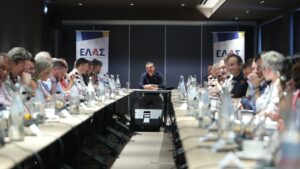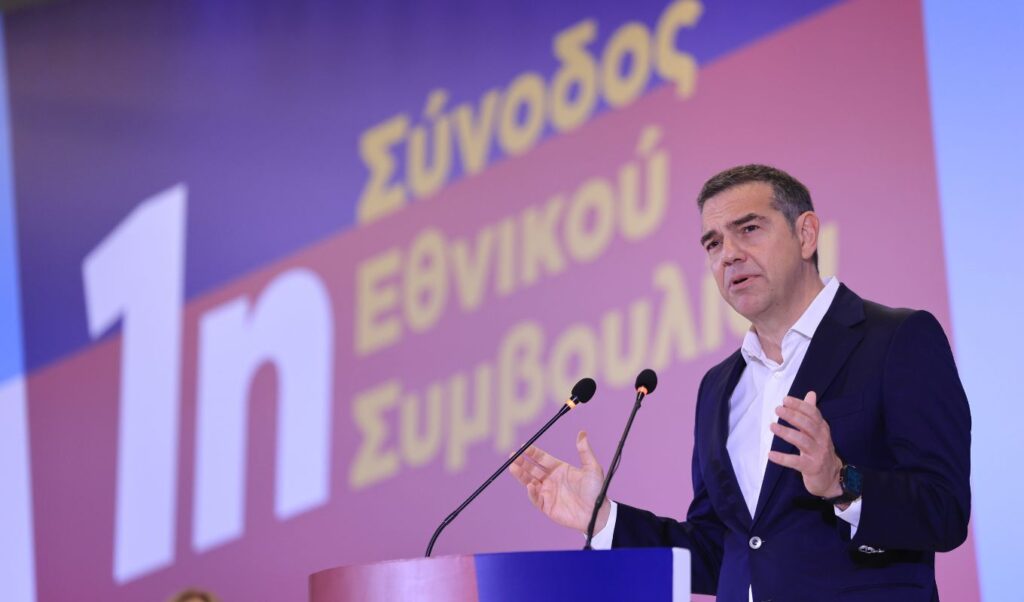
With the rallying cry that “the 1% cannot live at the expense of the 99%” — a sentiment now resonating across the globe — Alexis Tsipras officially launched his informal pre-election campaign on Saturday during a session of his party’s National Council. Attendees left with a notably positive impression, as speakers brought substantive contributions grounded in their respective areas of expertise.
Tsipras and his political vision: the “New Metapolitefsi” slogan and what he’s promising
The former prime minister, speaking both last Friday to his party’s policy coordinators and on Saturday at the National Council, placed ethics at the heart of political life. “In the face of corruption, we respond with a new political vision, a new patriotism,” he declared, invoking the phrase “moral revolution” as a defining theme.
He went on to outline five flagship policy proposals that have already gained traction across Greek society, while explaining how he intends to fund them — through the creation of a “National Convergence Fund,” the taxation of the wealthiest 1%, the activation of a national property registry that the current government has kept “on ice,” and the involvement of banks, which he argued must stop operating solely as profit-generating machines for their shareholders.
Under the banner of a “New Metapolitefsi” — a rebirth of Greece — Tsipras spoke of a new era of transformative change aimed at restoring citizens’ trust in democracy, justice, and public institutions. His vision centers on a shift in governance: a state that truly serves its people, a society where meritocracy triumphs over nepotism, and where integrity ultimately defeats corruption.
Five key interventions
After reaffirming that “in the face of corruption, we respond with a new political vision, a new patriotism” — calling it a “moral revolution” — Tsipras outlined five “flagship interventions that citizens across the country have embraced,” designed to bring immediate relief to society:
“1. Free public transport for everyone. Because getting around the city is a right, not a privilege.
2. Electricity bills 30% cheaper for households and businesses. Because energy costs are draining the income of every household.
3. Housing as a right — once again. Through a public housing body and social management of mortgage loans. Because shelter is a right for all.
4. An end to the national university entrance exams — a new admissions system. Because young people don’t deserve this psychologically exhausting and outdated university entry process.
5. Decent pay in education and healthcare. Because it is a disgrace — for our country and our society — that the teacher who educates our children and the doctor who operates on us are paid poverty wages.”
As Tsipras emphasized, these are five interventions “that can be implemented from the very first day of our governance. Five moves that send a clear message to society: that politics can immediately change everyday life. That the state can stand beside its citizens. That the economy must serve society — not the other way around.”
The former prime minister also pushed back against the ongoing attacks from both the government and opposition parties regarding his coalition’s proposals — and in particular, the question of how they would be financed. He announced the creation of a “National Convergence Fund,” a new national development instrument “with the steady goal of bringing Greece in line with the most advanced European economies.” He also stressed that the property registry — which the Mitsotakis government has left “frozen” — would be put into operation under his leadership.
He made clear that his coalition does not want the country to move in a piecemeal fashion. Instead, they seek “a national strategy that transcends electoral cycles — one that ensures continuity in major investments, leverages each region according to its comparative advantages, and generates new wealth.”
“Only in this way can we fund a strong welfare state. Only in this way can we genuinely raise wages. Only in this way can we support the younger generation,” he said — while stressing that economic growth is not an end in itself, but a means toward building a more just society.