New Democracy is steering political debate toward the economy — an arena where it believes it holds a clear advantage over the opposition — while the ruling party is simultaneously stepping up its regional tour schedule, signaling the start of an unofficial and extended pre-election campaign period. Kyriakos Mitsotakis visited Nea Smyrni on Friday, and today he is touring Aigaleo, once again turning his attention to Attica — a region home to nearly half the country’s population and traditionally the bellwether of Greek elections.
Read also: New Democracy continues regional tours focused on economy and household support — Alexis Tsipras emerges as key political rival
Mitsotakis: Maximos Mansion summit on supermarket prices, tours in Aigaleo and Thessaly
On Tuesday, the cabinet is set to convene to discuss the latest reforms coming before Parliament this summer — as well as the appointment of the new president and prosecutor of the Supreme Court (Areios Pagos). The following week, from July 6 onwards, the tour schedule turns to Thessaly — a politically and electorally demanding region for New Democracy. It is the area that was devastated by the severe storm Daniel nearly three years ago, the region that found itself at the center of farmers’ protests six months ago, and one that still lives under the long shadow of the deadly Tempi train disaster.
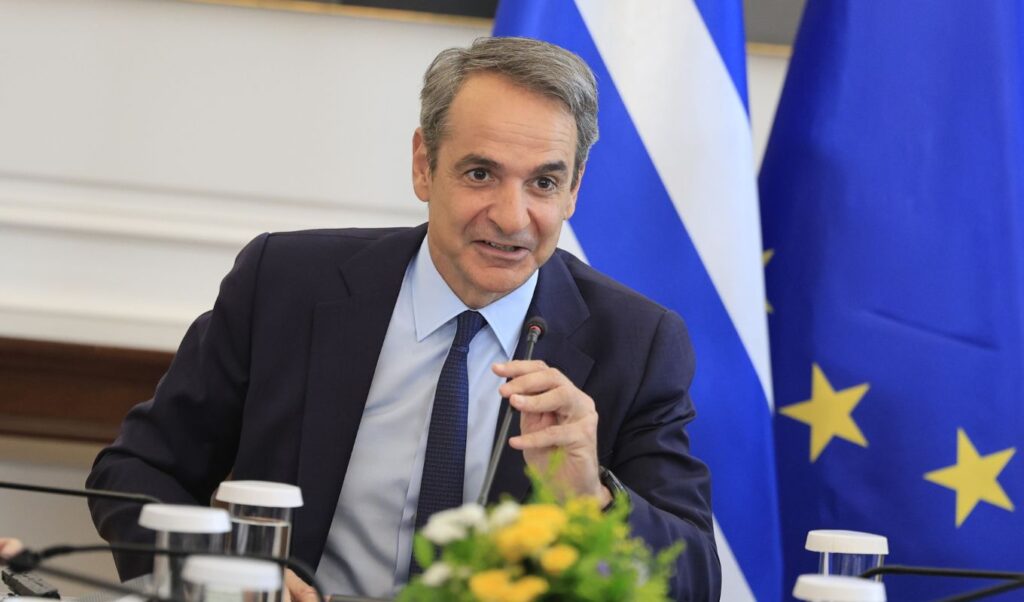
Today, the Prime Minister has convened a summit at Maximos Mansion with the participation of Deputy Prime Minister Kostis Hatzidakis, Development Minister Takis Theodorikakos, and representatives from industry and retail, with the aim of bringing all sides to the table to find a realistic solution for reducing supermarket prices — and beyond. Expected to attend are the president of the Federation of Enterprises and Industries (SEV) Spyros Theodoropoulos, the president of the Greek Food Industries Association (SEVT) Ioannis Giotis, and the president of the Supermarket Association of Greece Ioannis Masoutis.
Speaking on SKAI television, Minister Theodorikakos noted that the discussion is taking place “at the highest level,” with the goal of achieving price reductions on basic consumer goods. “What the government is critically asking for right now is for prices on essential products to come down and for an agreement on these price reductions to be reached, so that citizens — the average Greek family — can feel the difference when they go shopping at the supermarket,” he stressed.
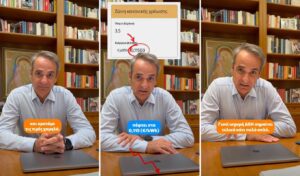
Government and party officials have meanwhile completed the first round of regional tours in the Peloponnese, leading with the strong performance of the economy and newly passed legislation, including: the expansion of eligibility for the out-of-court debt settlement mechanism; the option to restructure debts in up to 72 installments for liabilities unsettled through the end of 2023; an increase in the bank account garnishment exemption to €1,600 for all debts owed to the state and banks; and a special financial support payment of €150 per dependent child for families, with expanded income eligibility criteria. Above all, however, the government is keen to communicate the solution reached — following a ruling by the Supreme Court — for borrowers who had been covered under the Katseli Law, who will now see a significant reduction in their monthly loan repayment installments. According to government estimates, more than 100,000 citizens will see their monthly payments drop sharply — in many cases by as much as approximately €300 per month.
“Private debt is perhaps the most complex social legacy of the crisis. It is measured in insecurity, in postponed life decisions, in people who feel that the past continues to define their future,” said Finance and National Economy Minister Kyriakos Pierrakakis in a statement to the Athens-Macedonian News Agency (ANA-MPA). He added: “Our job is to break this vicious cycle with solutions that create real second chances. Every intervention we make on private debt serves our obligation to reduce burdens, restore possibilities, and give people back a sense of horizon. The true measure of economic policy’s success is the number of citizens who feel they are regaining control of their lives. And that, ultimately, is the most meaningful form of progress for society.”
In the seven-year government performance review published by the Prime Minister yesterday, the economy takes center stage — with wage, income, and pension increases highlighted throughout. “The consistency that connects commitments to results that make citizens’ daily lives a little better is what builds trust,” Mitsotakis said, adding: “This is what we want to be our greatest competitive advantage. Every day we strive to be a government that proves in practice that it delivers on nearly all of its commitments. Nine out of ten of our pre-election pledges from 2023 have already been fulfilled or are on track to be implemented. And that is the best indicator of credibility.”