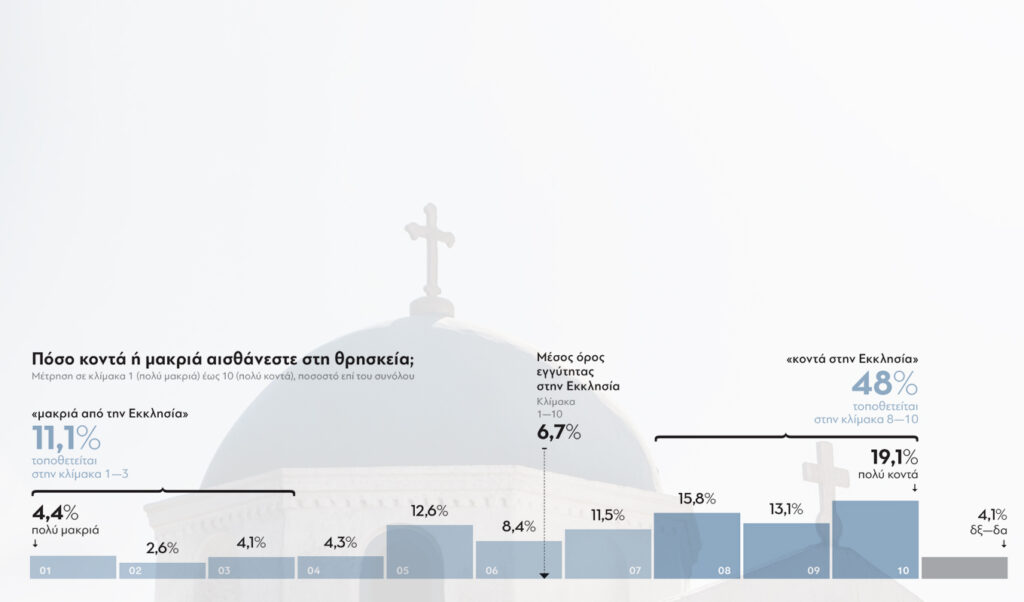
There is a quiet shift that doesn’t make the headlines. Greeks, as the latest wave of MRB Hellas “Trends” survey (June 2026, n=2,000) shows, continue to describe themselves as “close” to religion: an average score of 6.7 out of 10, with 48% placing themselves between 8 and 10 on the scale.

MRB survey: Less church attendance, more personal relationship with religion
At the same time, just 11.4% attend church every week, and 6 in 10 go at most once or twice a year. Faith hasn’t disappeared — it has simply changed address. It has moved from “my parish” to “my personal life.” Some 56.8% believe in the existence of angels, yet only 45.2% believe in the Second Coming. The modern Greek holds on to the guardian angel while leaving the divine judge behind: choosing comfort over accountability. And here lies the finding that turns the cliché on its head: 67.7% simultaneously identify as European citizens — a figure higher than any individual religious belief. Tradition and modernity are not in conflict; they simply no longer intersect.


What the data reveals about center-right and left-wing voters
The center-right is simultaneously the most pro-European group in the sample (82.7%) and among the most religiously devout (71.1%). The quadrant of the “devout Eurosceptic” remains empty. Euroscepticism, where it exists, is secular and left-leaning. The left concentrates both the lowest metaphysical belief (31.9% believe in angels) and the lowest European identification (50.1%): a double distance — from the Church and from Brussels.

How education shapes religious belief and European identity
At the other end of the spectrum, a university degree secularizes metaphysical belief (72.1% among primary school graduates vs. 46.8% among university graduates), but not identity — which, on the contrary, is strengthened (68.2% vs. 73.4%). What emerges, ultimately, are two forms of “low-intensity belonging”: religion as cultural memory and security without accountability, and Europe as a framework of stability when rational needs arise. Both offer a sense of security, and neither demands strict discipline — angels are not the Last Judgment, and Europe is a space where people feel they can push back when needed. That is precisely why the two coexist without friction. The home icon and the blue flag with its stars are not competing for the same shelf. They share it.
The evolution in citizens’ values and perceptions
Greek identity in 2026 does not feel the need to choose between the icon and the EU flag. The two symbols coexist without functioning as rivals. Religion continues to serve as a point of reference, but primarily as an element of cultural memory, family continuity and personal comfort, rather than as a strict system of rules and discipline. Equally, Europe is not experienced as an ideological proposition, but as a framework of stability, security and participation in a broader community. These are two distinct but complementary forms of identity.
The first draws from history, tradition and the collective experiences of previous generations. The second is linked to contemporary needs, future prospects and the country’s place in an ever-changing European and international environment. Neither, however, demands exclusive loyalty, nor does either require the rejection of the other. This is one of the key conclusions to emerge from MRB’s “Trends” survey, which tracks shifts in citizens’ values and perceptions.
The findings confirm that the Greek of 2026 continues to maintain a meaningful relationship with religion, but on different terms than in the past. Faith appears to be moving from the realm of obligation to that of personal choice and existential exploration. Within this context, a picture emerges that at first glance seems contradictory. At the very same time that religious identity continues to hold a significant place in citizens’ lives, 67.7% say they feel like European citizens.
One might assume these two dimensions are in conflict. Yet the data points to a different conclusion. Greek society no longer perceives its national, religious and European identities as competing choices.

Published in Parapolitika