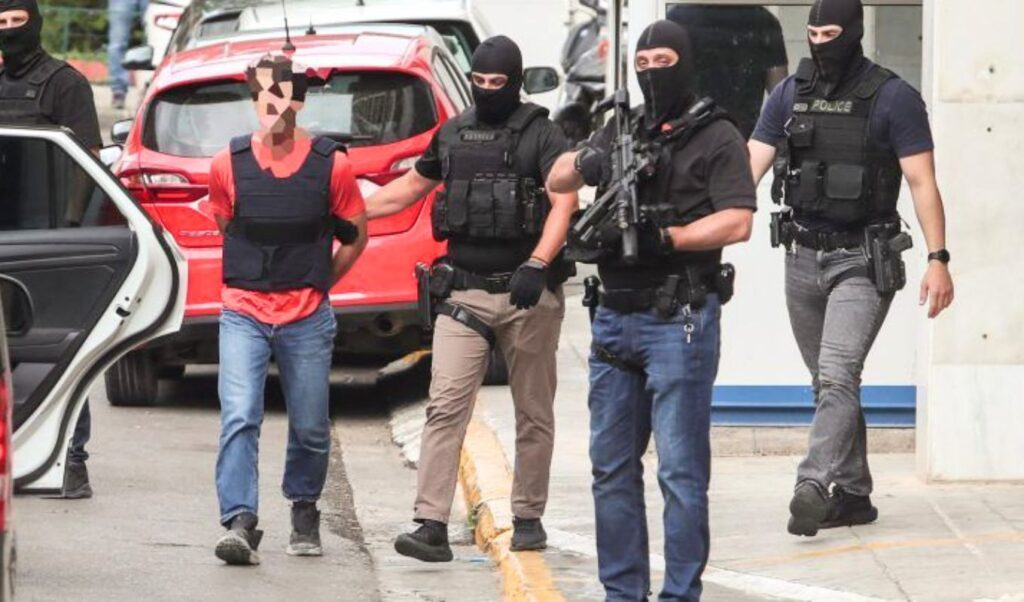
Authorities consider the Marfin case to be exceptionally solid, with Star TV’s main evening news broadcast shedding light on how investigators were able to identify the individuals who were recently ordered into pre-trial detention — using available photographs from the now-distant year of 2010.
Marfin: How authorities identified the suspects 16 years later
According to Star News, forensic laboratories determined the following:
- A distinguishing mark on the forehead of one of those arrested, which was partially visible in photographs taken on the day of the incidents, was conclusively matched when investigators later found a subsequent photograph clearly showing the suspect’s full face.
- The same methodology was applied to the eyes, nose, and even the ears. Police forensic laboratories carried out this biometric identification process for every individual who was arrested.
Investigators are so confident in their findings that they describe the evidence as “indissoluble.” Furthermore, during the initial examination of the digital evidence seized from one of the arrested individuals, homicide detectives discovered photo archives spanning multiple years — 2007, 2008, and 2009 — but with a conspicuous gap: no photographs from 2010, the year of the Marfin tragedy. The archive then resumes normally from 2011 and 2012.
Marfin: What the suspects claimed in their depositions and the roles attributed to them
Both defendants stated in their depositions that they have no connection whatsoever to the Marfin crime. Both also claimed that while they were present at the May 5, 2010 demonstration, they had no involvement in the violent incidents or the deadly attack on the bank. According to the police investigation, one defendant is attributed a central executive role in the attack, primarily in the shattering of the bank’s glass facade. He is also alleged, per the investigation, to have participated in a subsequent attack on another bank branch shortly afterward. The second defendant is alleged to have played a coordinating and directing role, without any specific physical act being attributed to him directly. Nevertheless, both defendants denied any involvement before the examining magistrate, insisting they are innocent and have no connection to the arson that claimed the lives of three bank employees — one of whom was pregnant. According to sources, judicial authorities determined that, given the particularly grave nature of the acts attributed to them, the manner in which they were carried out, and the extreme brutality involved, both defendants are considered suspects likely to reoffend.
Immediately following the pre-trial detention ruling, Thanasis Kampagiannis, attorney for one of the defendants, emphasized among other things that in this case it has become apparent that “it is not perpetrators who have been identified, but backpacks,” adding that if the evidence remains as it stands, the case will collapse at trial. Dozens of young supporters had gathered outside the courthouse to show solidarity with the two detainees.
Marfin: “They looked like a hit squad,” says the photojournalist who captured the tragedy
The man who photographed the tragic moments of the fire at Marfin Bank recounted what he witnessed that day. Photojournalist Ilias Provopoulos was positioned on the mezzanine level of the Ianos bookstore when, shortly before the violence and fire broke out, he photographed the faces of the two groups alleged to have carried out the attacks on the bookstore and the bank. He also documented the harrowing moments at the Marfin building and the desperate attempts of employees to escape the flames. “We were on the mezzanine of Ianos watching the demonstration unfold. And suddenly, certain individuals appeared whom we had never seen before. That was the instinct that made me click the shutter,” he recalled, going on to describe the photographs he published.
Among the images: two photographs of the Marfin building engulfed in flames — one showing the exterior walls, and another showing two employees desperately calling for help from a balcony, one of whom was Maria Karagianni, seen in a subsequent frame being rescued by a firefighter. Further images show the demonstration march passing directly in front of the burning Marfin building, with protesters visible amid the smoke, while another photograph captures a man preparing to leap to the adjacent building.
The suspicious movements before the attack
Describing the atmosphere on the streets of Athens in the moments before the deadly attack, the photojournalist recalled: “It was the largest demonstration ever held in Athens, and in a way it had been calm before what happened at Marfin occurred. The notorious troublemakers had provoked an incident and the police fired tear gas — that’s why they moved into Ianos.” He then focused on the group of approximately 12 individuals alleged to have carried out the two attacks, describing their striking appearance: “Suddenly these two groups merged at the junction of Lada and Edouard Lo streets, wearing what looked like uniforms. They caught my attention because they were dressed alike — black clothing and backpacks, heads covered, and the other half in joker-style khaki. I would say they looked like a hit squad.”
Regarding the outbreak of the fire and the rescue operation, Ilias Provopoulos noted that the fire brigade arrived on the scene very quickly, but that accessing the bank building was extraordinarily difficult due to the massive crowds. “The fire brigade arrived in 8 minutes. There were so many people that it was impossible to get there any faster. There was also a problem with the ladder because of the trees and the trolleybus cables. They had to maneuver the ladder into position, and that’s how they managed to bring the two women down.”