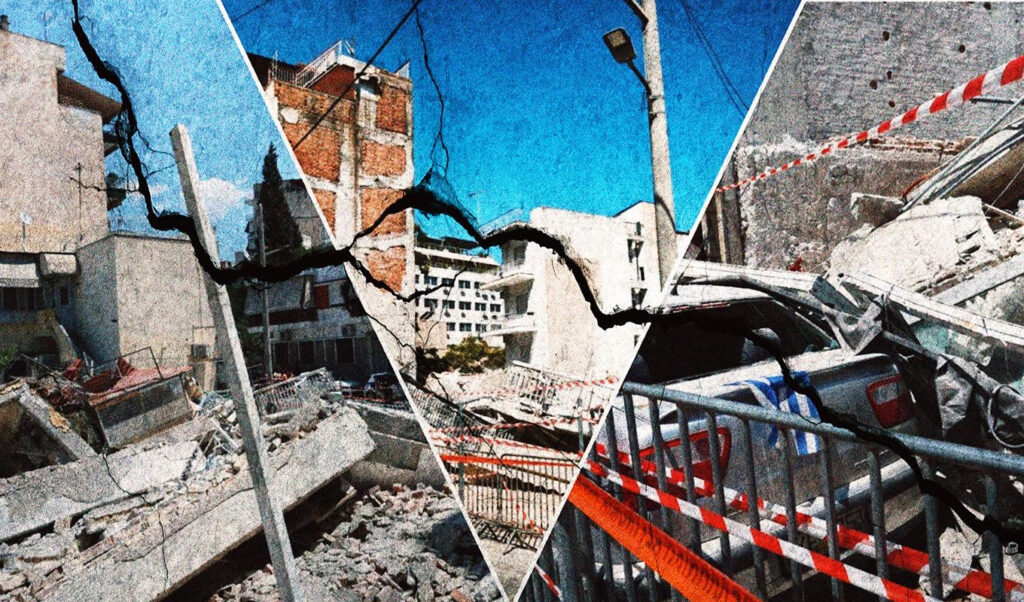
One week after the building collapse at 22 Alkminis Street in Petralona, those affected continue to live in anguish and uncertainty. The building collapsed on the afternoon of Tuesday, June 30, while construction work was underway on an adjacent building being erected nearby. Miraculously, there were no casualties. However, there are people who lost their homes, storage units, personal belongings, and professional equipment — without, as they claim, receiving any meaningful information or support from the responsible authorities to this day.
Petralona: A harrowing testimony one week after the building collapse
Among those affected is Ria Tsapa, who together with her father rented a storage space in the building’s basement. Her father kept his work tools and professional equipment there, worth approximately €25,000, while she had stored part of the equipment she uses for her dance school — including ballet barres, mirrors, and Pilates props.
At the time of the collapse, she was abroad. As she describes to parapolitika.gr, she initially received a series of notifications from the alarm system and the security cameras installed in the storage unit. She was not immediately alarmed, assuming her father had entered the space and forgotten to deactivate the alarm. Shortly after, she says, it was her godfather who sent her the first news reports circulating about the collapse — though at that point there were no photographs or details available.
Her first thought was the enormous financial loss and the fact that her father had essentially been left without the tools of his trade. Very quickly, however, the shock deepened far beyond that. She realized that her own father could have been inside that basement at the moment it came down.
Petralona: “I went into shock when I realized my dad could have been inside”
“The first shock was about all my things and the tools, because my father was left without work. But then I realized he could have been inside. That’s when the real shock hit me. I’ve already lost my mother — my father is all I have left. If I had lost him too, I couldn’t have handled it. There’s no way I could have,” she says, visibly shaken.
The warning signs before the Petralona building collapse
What makes her account even more alarming is that, according to what she describes, there had been warning signs in the days leading up to the collapse. Her father had noticed that the storage room door was no longer opening and closing properly. Then he began to notice cracks appearing in the walls. On the very last night before the collapse, he found that the entire basement was covered in cracks.
“In the last three or four days, he was complaining to me that the door wouldn’t open or close properly. Then he started connecting it to the building being constructed next door. He told me the apartment block had probably started to tilt. Then he began noticing cracks forming. And on the last night, before that day had even dawned, he noticed that the entire basement was full of cracks,” she recounts.
“People slept in their homes that last night”
Her anguish goes far beyond the loss of property. What haunts her most, she says, is the thought that her father could have been inside the storage unit at the moment of the collapse — and that dozens of people had been sleeping in their apartments just hours before it happened.
“People slept in their homes that last night. Twelve hours earlier, it could have collapsed while they were all asleep. It could have happened in their sleep. Has anyone actually stopped to think about that?” she asks pointedly.
“At any other moment, my father could have been in the storage unit, or someone else could have been in the building. They were all lucky it happened when it did,” she adds.
“Nobody has contacted us”
Despite the scale of the disaster, one week on she says there has been no meaningful communication from the responsible authorities whatsoever. The only contact they have had, she explains, was with the police, where she and her father went to give formal statements.
“My father and I went to the police to give formal statements. After that, nobody has contacted us. Not one responsible person to say ‘we will help you, we will keep you informed.’ Even just a phone call saying ‘we’re with you and we’ll update you as soon as we know more.’ Nothing. Not even from the municipality,” she states.
“The €3,000 figure is laughable”
The €3,000 financial aid announced for those affected is, in her view, wholly inadequate to cover even a fraction of the real needs of those who lost their property. “They’re talking about €3,000. It’s a laughable amount. I’m grateful it’s being offered, but it doesn’t help in any meaningful way. People who have no home cannot buy a stove, a fridge, clothes, or beds with €3,000. They need food, money for rent, for moving costs, for everything. In our case — and we’re talking about someone’s livelihood — my father has suffered roughly €25,000 worth of damage. He can’t replace his tools with €3,000,” she notes.
As she explains, they still don’t know the condition of their equipment, since they are not permitted to access the site. Investigations and the necessary procedures must first be completed, and only then — if deemed safe — can items be gradually retrieved. “I want to be optimistic and believe we’ll be able to recover some things, even in poor condition. But we can’t take them now. The investigations have to be done first, everything has to be cleared, and then, if it’s considered safe, an excavator will come and they’ll hand over whatever can be found,” she clarifies.
Beyond compensation, she is calling for a thorough investigation into the circumstances that led to the building’s collapse and for meaningful oversight measures to be put in place, so that nothing like this can happen again.
“This concerns all of us”
“It’s not just about the compensation we’re entitled to receive. It’s about making sure this never happens again. It could be your home, your garage, your storage unit, your parents’ home, your sister’s or brother’s home. This concerns all of us,” she stresses.
She makes clear that she is not opposed to the construction of new buildings or the regeneration of neighborhoods. On the contrary, she says, it is a positive thing for new apartment blocks to be built and old ones to be renovated. But everything must be done safely. “It’s great to build new buildings and renovate old ones. But it has to be done safely, with proper studies and proper inspections. You can’t set out to do one good thing and end up causing ten bad ones,” she points out.
In closing, she calls for stricter supervision of construction sites, with checks in place to ensure that work proceeds in line with the approved permit, the engineering study, and the actual on-site conditions as they evolve. “There needs to be an inspection team that monitors new construction sites and verifies that the work is progressing according to the plan, the permit, and the conditions on the ground. Conditions can change, and sometimes the construction approach needs to change with them. All of this needs to happen to prevent something similar in the future,” concludes Ms. Tsapa.