Amid two active war fronts — in Ukraine and the Middle East — and following a period of intense U.S. scrutiny over European allies’ operational capabilities and political resolve, the 32 leaders of NATO member states have convened today in Ankara for a critical Summit.
Read also: NATO Summit: Greece on the front line of collective defense — Kyriakos Mitsotakis to attend
The three key issues on the NATO Summit agenda
The gradual increase of national defense spending to 5% of GDP, the development of the defense industry, and support for Ukraine are the three core items on the leaders’ agenda. Discussions are set to begin this evening over dinner in the Turkish capital, continuing tomorrow morning during the Summit’s formal working sessions.
Trump and Erdogan: F-35s and the balance of power in the Eastern Mediterranean
Athens is closely watching the meeting between Donald Trump and Summit host Recep Tayyip Erdogan, given the White House’s push to move forward with the sale of F-35 fighter jets to Turkey — a move that faces opposition in Congress — as well as the potential equipping of Turkey’s domestically produced KAAN fighter jets with American-made engines.
Gerapetritis: Why Turkey’s return to the F-35 program depends on Congress
On the subject of the F-35s, Foreign Minister Giorgos Gerapetritis responded yesterday to a related parliamentary question, noting that “the restrictions provided for under U.S. legislation remain in force, and lifting them requires a new decision by Congress. Therefore, at this stage, there is no question of lifting the existing prohibitions.”
He further emphasized that back in 2019, Greece was excluded from both the F-35 program and the F-16 upgrade program, while Turkey was still part of the F-35 program. Today, the situation is reversed: “Greece has already secured the procurement of twenty fifth-generation F-35 fighter jets — the best available in terms of air defense — with an option for an additional twenty.” He also provided a concrete timeline, stating that “the first F-35 jets will be delivered to Greece and become operational in November 2029.”
Netanyahu’s intervention on the F-35s and Turkey’s KAAN jets
Notably, speaking on Fox News, Benjamin Netanyahu publicly voiced his opposition to any U.S.-Turkey deal involving F-35s or engines for the KAAN jets. “I don’t think they should be given the F-35s or the engines for their fighter jets,” the Israeli Prime Minister said, arguing that such a move would “upset the balance of power in the Middle East, which is ultimately guaranteed by Israel’s air superiority and also by America’s posture in the region.”
Greece arrives at the NATO Summit “with the confidence of a strong and reliable ally”
Greece, according to government sources, “approaches the Summit with the confidence of a strong and reliable ally — one that not only consistently upholds its commitments, but stands at the forefront of Alliance members already delivering on the targets agreed upon in The Hague.” Officials stress that Greece “has already exceeded the Defence Investment Pledge agreed in 2025 and ranks among the top five NATO countries to have achieved, as early as 2026, the target of 3.5% of GDP in core defense spending, along with the additional 1.5% target.”
The figures speak for themselves: “Greece’s core defense expenditure for 2026 is estimated at 3.6% of GDP, up from 2.75% in 2025 and 2.74% in 2024. Through its twelve-year, €25 billion Armed Forces modernization program, Greece maintains and strengthens its place in the hard core of Alliance members that systematically exceed NATO’s defense spending commitments. The other countries to have already surpassed The Hague target are Poland, Estonia, Latvia, and Lithuania.”
Mitsotakis’ vision for European defense and NATO’s role
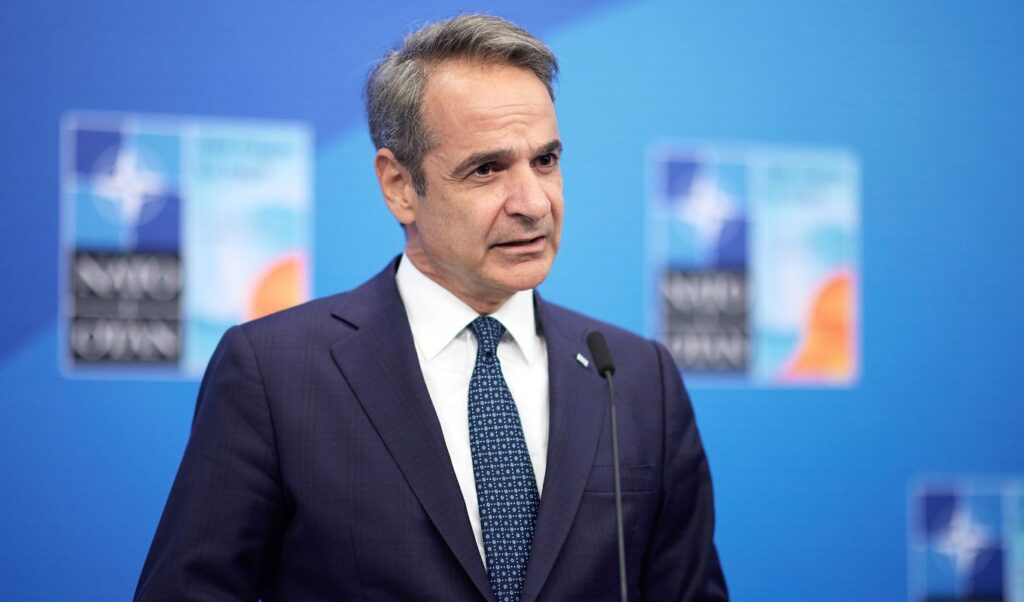
The same sources highlight that Kyriakos Mitsotakis “was among the first European leaders to champion the need for Europe to invest more and more effectively in its collective defense, to strengthen the European defense industrial base, and to shape a stronger European pillar within NATO.” They also note that he “has repeatedly stressed that the European Union must support this effort through new European financing instruments, including joint borrowing for defense.”
Greece’s position, as government sources make clear, remains firm: a more defense-capable Europe does not compete with the United States — it becomes a stronger, more credible partner, ultimately contributing to a stronger NATO.
Why Mitsotakis will not meet Trump or Erdogan in Ankara
No bilateral meeting between Mitsotakis and Erdogan is scheduled on the sidelines of the Summit. When asked during the regular press briefing whether the Prime Minister would meet with Donald Trump in Ankara, government spokesperson Pavlos Marinakis was unequivocal: “No. And in fact, this particular Summit is not the right setting for such a meeting. In any case, the schedules are far too tight to allow for it.”