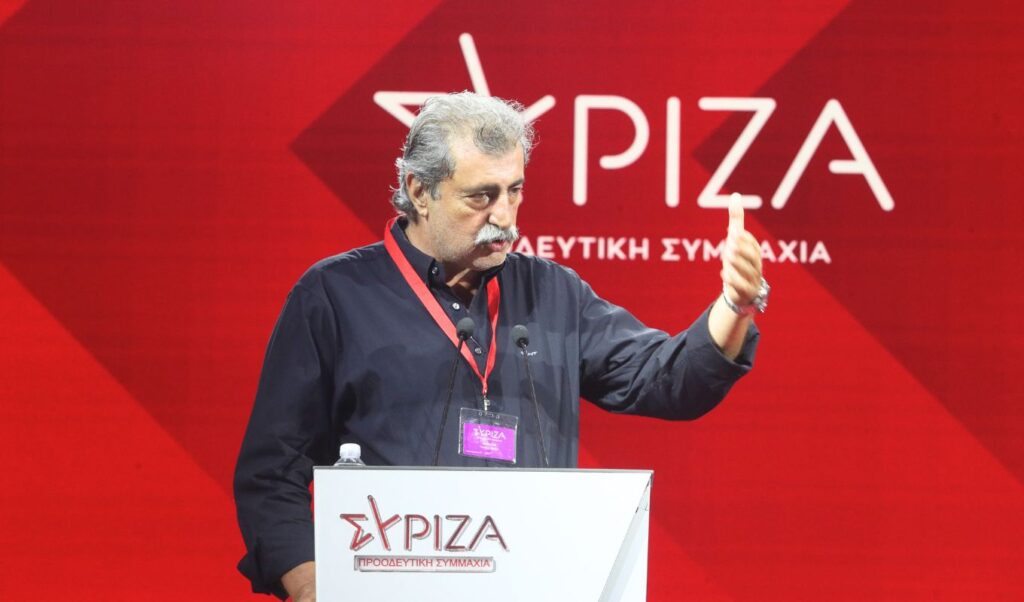
Most members of parliament from SYRIZA’s parliamentary group have declared they are ready to leave the party if it falls under the control of Pavlos Polakis, ahead of Saturday’s critical Central Committee meeting. The Chania MP’s persistent challenge to party leader Sokrates Famellos — as he openly bids for the party’s leadership — has caused significant alarm among both parliamentary group officials and Central Committee members.
The message being sent by the party’s MPs also targets those who have appeared to align themselves with Polakis — namely Nikos Pappas and Rena Dourou. However, sources indicate that even on this front there is considerable uncertainty, as both figures believe Polakis’s move is doing more to rally Central Committee members around the current party leader than to facilitate any real change in direction.
Backlash from within SYRIZA
Sources also report that there is already pushback from members who signed the petition calling for the Central Committee meeting to be convened. As they explain, their intention was simply to clarify the previous decision taken on June 6th — not to trigger a challenge to Famellos or push for the election of a new party leader.
Nikos Pappas and Rena Dourou continue to advocate for collective leadership, though it remains unclear whether Polakis would be willing to participate in such a structure. What does seem almost certain is that Sokrates Famellos would not accept it.
Ultimately, the central question running through the entire crisis is who currently holds the majority within the party. Those loyal to the party leader are confident that, even accounting for any potential defections, Famellos retains the majority on the Central Committee. The minority faction, on the other hand, believes the balance of power has shifted — with Nikos Pappas on Tuesday formally requesting the full membership list of the Central Committee. In a letter addressed to party leader Sokrates Famellos and the Deputy Secretary of the Central Committee, Anastasia Sapouna, Pappas demanded access to the list of Central Committee members. He also called for a meeting of the Political Secretariat — apparently to determine what position the party leader intends to take at the upcoming Central Committee session.
Party insiders were quick to point out, however, that the minority faction failed to gather the 70 signatures required to formally call a Central Committee meeting. “In reality, they only managed to collect 65. They made up the numbers by adding signatures from a second document, which had entirely different content,” said sources close to the party leader. They emphasized that the Central Committee meeting is going ahead because Sokrates Famellos himself believes certain matters need to be clarified.
Tellingly, Giannis Boulekos — who had signed the second document alongside seven others — stated in an interview: “I don’t want anyone to leave. But it would be politically ethical for those who wish to join Alexis Tsipras’s party to do so before the Central Committee session. Imagine someone coming to the Central Committee meeting, voting on a political decision, and then the very next day signing up as a member of another party. Is that honest?”
Polakis calls the situation inside SYRIZA “unprecedented in political history”
On Tuesday, Pavlos Polakis gave an interview in which he described the current state of affairs inside SYRIZA as “unprecedented in political history,” launching a direct attack on parliamentary group leader Sokrates Famellos. The Chania MP was sharply critical of the leadership’s choices, stating: “It is unprecedented to have a party leader and a Central Committee decision declaring support for another party. This has never happened before. The mandate that President Famellos received from the party congress was to rebuild and reconstitute SYRIZA and the broader progressive space — with SYRIZA playing a central role. Not to say we’re shutting up shop and moving on.”
Referring to Saturday’s Central Committee meeting, Polakis stressed that it “must produce a decision with a clear political framework — one that affirms SYRIZA is not dissolving itself, is not surrendering, and is not stepping aside. It is a historic party with policy positions, developed political thinking, cadres, and a base of supporters, and it should be calling on progressive forces to unite around a shared programmatic agreement. Second, a key element of any such Central Committee decision must be my reinstatement to the parliamentary group. From that point on, reversing the previous self-dissolution decision automatically means that President Famellos must resign.” He then reiterated: “In the subsequent election of a new parliamentary group leader, I am once again declaring my candidacy.”