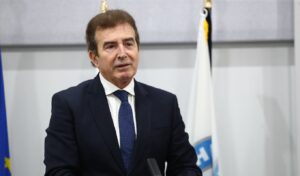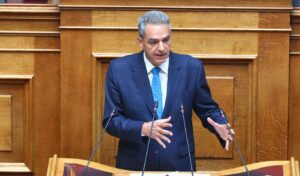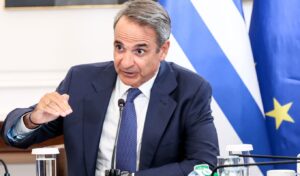
More party figures from PASOK are expected to be announced by the end of the week as new members joining the Greek Left Alliance (ELAS). These figures come from regional areas across the country and are set to play a significant role in shaping the party’s organizational network throughout Greece.
Alexis Tsipras: Peristeri grassroots tour and Economist conference speech
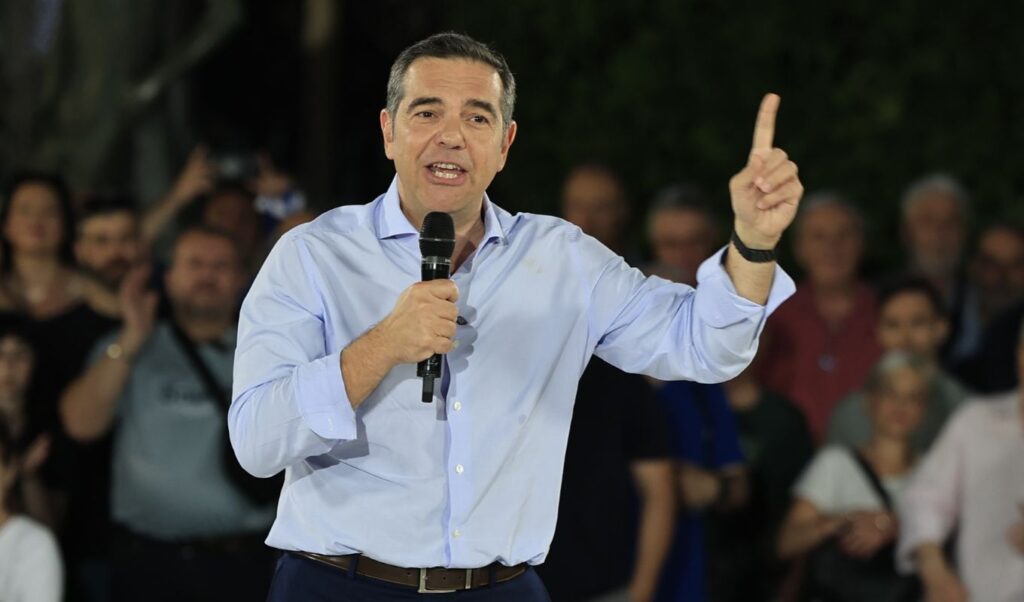
Meanwhile, Alexis Tsipras is expected to address the Economist conference on Friday, where he will speak on foreign policy and energy issues. The day before, Tsipras will conduct a grassroots tour in the Peristeri district of Athens, meeting with local residents to discuss the everyday challenges they face.
Greek Left Alliance attacks government over fake news and seven-year track record
On Monday, party spokesperson Theoni Koufonikola, Economics spokesperson Fragiskos Koutentakis, and Labour spokesperson Dionysis Temboneras held a press conference on what they described as “seven years of lost opportunities” under New Democracy, directly challenging the government’s claims of misinformation. In her opening remarks, Koufonikola outlined the reasons that made it necessary to set the record straight following the government’s official review — citing hard data that demonstrates the Kyriakos Mitsotakis government has consistently underperformed compared to the Alexis Tsipras administration, despite the latter having governed during the austerity memorandum period.
The ELAS party spokesperson stated: “The Mitsotakis government falls short of the Tsipras government’s performance. But we are here today not because we enjoy contradicting the Prime Minister. We would have wished the progress were real. We would have wished inequalities had not deepened so sharply. We would have wished the cost of living were not spiralling out of control. We would have wished that private interests were not profiting unchecked at the expense of our fellow citizens. We would have wished there were not so many corruption cases — more, I believe, than under any other government since the restoration of democracy. But that is not the reality. We are here, therefore, because we believe in a culture of absolute transparency.”
She elaborated further: “First, our vision is tied to a society that has access to every dimension of political, economic, and social reality — one that cultivates and applies critical thinking. A society that holds political figures, who are obligated to serve it, fully accountable.”
“Second, because it is essential to substantively map everything that has taken place from 2019 to the present day. A government review is indeed a very important tool — an evaluation tool, if you will — that will allow us to understand what was done right and what was not. Third, we are here because fake news and distortions must gradually disappear from political discourse — however utopian that may sound to some. It is a fundamental necessity if we genuinely want to take a bold step forward. Scientific thinking must not be subordinated to partisan or broader political manipulation. It must maintain its autonomy, and we have an obligation to contribute to that.”
“Fourth, we are here because we must identify the areas that need support, care, and greater restoration. Given that resources are not inexhaustible or unlimited, targeting them correctly is of vital importance to us.”
Koutentakis: Debunking the government’s figures on debt, growth, and employment
Economics spokesperson Fragiskos Koutentakis highlighted what he called “shocking inaccuracies and fake news” embedded in the government’s official review. Using specific data, he systematically dismantled the government’s attempts to paint an overly flattering picture of its economic record.
“Let me start with public debt, for example. They claim public debt stood at 209.4% of GDP and is now at 146% of GDP — a reduction of 67 percentage points. A great achievement! But let’s begin at the beginning: the 209% figure was the debt level in 2020, not 2019. They’ve chosen the year that suits them to make the reduction look more impressive and present it as an accomplishment. While in every other metric they compare 2019 with 2025, for debt they inexplicably compare 2020 with 2025. If we make the obvious comparison — 2019 with 2025 — the reduction is not the impressive 63 percentage points they claim, but the far less impressive 37 percentage points.”
On labour market data, the ELAS economics spokesperson added: “They claim we have 5.2 million employed workers. In which country? Certainly not in Greece. Greece has 4.2 million employed workers — already one million fewer. That’s simply wrong. Someone might argue it was a typographical error, but let’s continue. Something that is repeated constantly by the Prime Minister himself, by the government spokesperson, and by virtually every government representative who appears in public, is the claim that they increased employment by 600,000 jobs — 600,000 new jobs. Very frequently stated. And yes, it is untrue. From 2019 to 2025, total employment has increased by 400,000 — and obviously, 400,000 is not 600,000, nor is it the 563,000 cited within the review itself. Yet another attempt to embellish reality with false figures.”
On exports, Koutentakis explained: “They cite exports of €98 billion. First of all, this is in nominal terms, at current prices. I’ll simply share the figure we present in our own analysis: from 2019 to 2025, exports grew by 8.7% in real terms, at constant prices. Good? Fine. But do you know how much imports grew? By 25%. So imports are growing at three times the rate of exports — which is precisely why the current account deficit and the trade balance deficit have widened so dramatically. This is a different kind of distortion from the previous one. That one involved cherry-picking a base year to change the optics. This one is simply about throwing out a number while suppressing all the related figures that provide context. And as for the claim that exports have grown as a share of GDP — they haven’t grown at all. They are marginally lower than in 2019: 39.6% of GDP in 2019, 39.5% of GDP in 2025. Imports, meanwhile, have risen from 41% to 44% of GDP. I mention this in direct response to the narrative about improved competitiveness.”
“Now the next one is truly tragicomic. GDP per capita, they say, was €17,000 in 2019 and has become €23,500 in 2025 — a 36% increase in nominal terms. They don’t say that last part. But comparing GDP per capita in nominal terms is completely meaningless in any universe, precisely because it incorporates price increases. If you want to compare GDP per capita, you compare it in real terms. If we do that, the increase is not nearly as impressive — it’s 12.7%. One third of the increase the government’s review claims.”
“Reducing the tax burden is one of the government’s central narratives. They claim to have made 83 — I don’t remember the exact number — tax cuts. Let me make a point here: you don’t count tax cuts and tax hikes by the piece. The tax burden is measured in amounts, in euros, or as a percentage of GDP. Tax revenues — from both indirect taxes such as VAT and direct taxes such as income and property taxes — have all increased from 2019 to 2025. VAT revenues alone have risen by €8 billion, up 53% compared to 2019, and are now approximately 1.5 percentage points of GDP higher than in 2019. The tax burden, in other words, when measured correctly — not by counting how many tax cuts were introduced — has actually increased.”
Temboneras: “Never before so many scandals since the restoration of democracy”
Labour spokesperson Dionysis Temboneras stated that “never before have so many scandals been concentrated within such a short period of governance since the restoration of democracy in Greece.”
“We made an effort to catalogue the scandals as well as the New Democracy figures implicated in corruption cases. Take note: not one, not two, but we found more than 44 ministers, MPs, secretaries-general, parliamentary candidates, and party officials from New Democracy who are embroiled in serious and significant corruption cases. I won’t even begin with the most recent scandal — because a scandal it most certainly is, particularly regarding national security, involving Mr. Dokos — let’s hope he’s not the one who will be picking up the phone at 3 in the morning if, touch wood, something happens. But before that we had the wiretapping scandal, where the surveillance of ministers, the chief of the armed forces, the chief of police, and even the leader of the official opposition resulted in the equally unprecedented spectacle of watching, in a live broadcast, private individuals blackmailing the Prime Minister.”
“The common thread running through all these scandals — the cover-up of the Tempi train disaster, the OPEKAEP scandal, the leak and conviction of Ms. Asimakopoulos over the overseas voters’ email data, the direct contract awards — is the clientelist executive state. It is a state that ultimately celebrates the self-evident, shirks its responsibilities when social need comes knocking at the door, yet becomes highly authoritarian through police overreach in order to impose its will. It is a state that is enormously greedy when it comes to controlling institutions and the media, yet completely indifferent when it comes to the social needs and the needs of its citizens. To illustrate the point, we made an effort — which you can also find in the printed document we have distributed — to document the scandals of the past seven years. Not because we want to engage in scandal-mongering or because we want to criminalise political life in this country, but primarily because we must expose the conditions of opacity, lack of accountability, and clientelist mentality that pervade the New Democracy government.”
“The truth is — and I will close with this — that we ourselves, in the process of compiling this catalogue, quickly came to realise that never before have so many scandals been concentrated within such a short period of governance since the restoration of Greek democracy. Everyone, of course, is entitled to their own view and may judge for themselves whether the Mitsotakis government — the 2019–2027 government — is the worst this country has ever seen. But no one, in our view, can dispute — based on the dozens of scandals we have catalogued — that it is without question the most corrupt. You can therefore draw your own conclusions, having now seen the full picture of what we are presenting today.”
“In conclusion, then, we say that this country has potential and can indeed look to the future with optimism and far better prospects. The Greek Left Alliance is here to give citizens the opportunity to choose and to answer a very specific political dilemma: corruption and stagnation, or integrity and progress.”