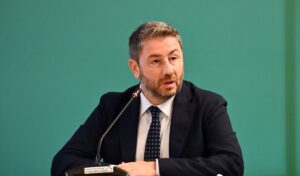
PASOK MEP Nikolas Farantouris responded to criticism over his wife’s secondment to the Permanent Greek Representation in Brussels, speaking on Parapolitika 90.1’s show “Εκείνη κι Εγώ” with Thanasis Fouskidis and Stella Gkantona. “There may be some who want women to go back to their kitchens,” he pointedly remarked to those questioning the legality of the secondment. Farantouris also commented on a new poll placing PASOK in third place and addressed the outcry from Greek fishermen over Turkish violations of Greek territorial waters.
Farantouris on his wife’s secondment: “Everything is transparent”
When asked about the backlash triggered by his wife’s secondment to the Permanent Greek Representation in Brussels, Farantouris defended the legality of the process. He explained that his wife has “an independent 22-year career in the public sector, through ASEP (Greece’s Supreme Council for Civil Personnel Selection),” that the Permanent Representation employs 400–500 seconded staff from Greece, and that in December 2025 a position for specialized personnel was publicly advertised for negotiations on the multiannual financial framework — a position to which she applied and was selected based on her qualifications. “Everything is transparent, everything is merit-based and, of course, legal,” he stressed, suggesting the matter gained traction because some are trying “to attack me through my wife.”
Response to Katrinis’ criticism
When asked about criticism levelled by his PASOK colleague Michalis Katrinis, Farantouris said he is “fully” represented by the party’s official position — not by the individual statements of individual members. He defended his wife as “a woman, a mother of three children, a working professional and a public servant,” adding: “There may be those who believe that the wife of an MP should not hold a key position in public service. There may even be those who want women to go back to their kitchens.”
“If someone believes that a woman should be treated unfavourably simply because her husband works in the public sector, I think we are going back to the 1960s,” he said pointedly. Farantouris noted that it is “inappropriate to try to attack a political opponent through a woman.”
Comments on the polls
Commenting on an Interview poll showing New Democracy in first place with 26.8%, Alexis Tsipras’ party in second with 15.3%, and PASOK in third with 11.1%, Farantouris questioned the sheer frequency with which such surveys are published, noting that “all this noise feeds other agendas” and expressing doubt as to whether a truly established trend is being captured. He said he is confident he belongs to “a party that goes to the polls with a steady pace, a coherent presence, and a governmental, programmatic agenda that no other opposition party possesses.”
Asked whether the rise of Tsipras’ party is temporary, Farantouris expressed his belief that, on the road to the ballot box, the “fundamental dilemmas” will come to the fore: whether citizens want to continue the policies that have, in his view, led the economy, society and national affairs into dead ends — or whether they are looking for an alternative government proposal, which he believes only PASOK can offer.

“The responsibility of all of us”
When it was suggested that the low consolidation of support for both New Democracy and PASOK may reflect the party’s failure to convince voters of a credible alternative, Farantouris conceded: “Indeed, I will agree with you — this is a responsibility we all share.” He stressed the need to “embed in every corner of the country” the party’s positions on the economy, society, non-performing loans, the cost of living and energy, and expressed the view that internal party disputes that “muddy the message” must be avoided.
“There is no free-for-all within PASOK”
Asked whether greater discipline around the party leader’s line is needed, Farantouris replied: “I do not believe there is a free-for-all within PASOK — on the contrary, I believe there is cohesion.” He acknowledged that there may be differing views, “but that is democracy,” reminding listeners that there are congress and statutory decisions that define how the party communicates. He recalled that the last party congress drew delegates from across the country and that approximately 100,000 people had voted only a few months prior, describing them as “the members throughout Greece who can carry our message.”
Turning to national issues, Farantouris spoke about his participation in the General Assembly of the Panhellenic Federation of Fishermen and a visit to the Rentis wholesale market, where, as he put it, “people are crying out in desperation and nobody is listening.” He described how hundreds of fishermen are abandoning the islands because Turkish fishing vessels are entering Greek waters, noted that tonnes of cod caught in Greek waters and sold as Turkish arrive in Nea Michaniona every month, and reported that in recent days six Turkish trawlers appeared off the coasts of Tinos and Serifos, “driving away” Greek fishermen.