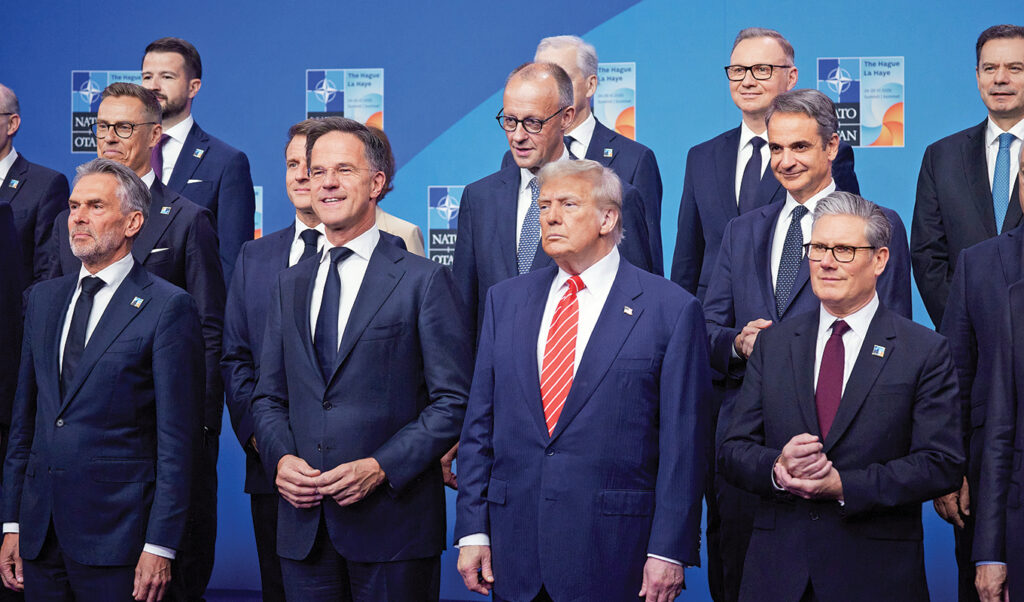
The NATO Summit taking place in Ankara is expected to mark another critical milestone in the Alliance’s ongoing effort to adapt to shifting geopolitical realities. With the war in Ukraine and the Middle East continuing to fuel instability, and with transatlantic relations entering a new phase, a fundamental reassessment of member states’ priorities appears inevitable.
For Turkey, the Summit carries particular symbolic weight — this will only be the second time in history that the country hosts NATO’s most significant political gathering, following the Istanbul Summit of 2004.
Diplomatic circles in Athens believe that Ankara will seek to leverage its role as host country to the fullest, aiming to amplify its international standing. Turkish leadership appears determined to present the country as an indispensable pillar of NATO’s southeastern flank, a key communication channel with the Middle East, and a nation with increasingly significant defense industrial capabilities. Greece’s diplomatic establishment has not failed to notice the favorable international climate currently surrounding Ankara — though all are well aware that this is largely a product of Turkey’s host-country status.
Restoration of relations
This dynamic is also tied to broader efforts to repair relations between Ankara and Washington. Particularly telling were recent statements by Turkish Foreign Minister Hakan Fidan, who claimed that the CAATSA sanctions imposed on Turkey following its purchase of Russian S-400 missile systems are now in the process of being lifted. Speaking on CNN Türk, the top Turkish diplomat cited a shared political will between the two governments to fully restore bilateral relations, noting that technical procedures are already underway. He also linked this development to the potential resumption of F-35 fighter jet sales to Turkey, describing it as an administrative decision that could follow the lifting of sanctions — while carefully distinguishing this issue from the more complex question of Turkey potentially returning to the program as an industrial partner. Leading analysts, however, believe these statements are primarily aimed at creating a positive atmosphere ahead of the Summit — and little more. Fidan himself attached particular importance to the NATO meeting, stating that U.S. President Donald Trump’s decision to travel to Ankara came following direct personal communication between Trump and Recep Tayyip Erdoğan.
Expectations and agenda
Athens, for its part, assesses that this year’s Summit is unlikely to carry the strongly political character of last year’s gathering, when all attention was dominated by Trump’s pressure on European allies to dramatically increase defense spending. Instead, the focus is expected to shift toward evaluating each country’s progress in meeting its commitment to significantly raise defense expenditure — the so-called “5% target” — taking into account both fiscal capacity and the operational needs of each ally. According to reliable information obtained by this correspondent, Greece — based on current 2026 projections — is spending 3.66% of GDP on core defense expenditure, plus an additional 1.5% on supplementary spending.
The American president continues to keep the issue of allied burden-sharing high on his agenda. In a recent post, he argued that the United States continues to shoulder a disproportionate share of the Alliance’s defense burden, citing figures showing U.S. defense spending reaching $999 billion — far exceeding that of all other member states combined. His intervention brought back into sharp focus the longstanding American demand for a fairer distribution of responsibilities within NATO.
European defense
A prominent place on the Summit’s agenda is also expected to be given to discussions on strengthening the European pillar of the Alliance. Greece is among the countries that argue Europe must enhance its defense capabilities and achieve greater operational autonomy — without, however, this effort leading to a substitution of the American presence or a weakening of the transatlantic bond. Athens maintains that a stronger European defense can function as a complement to NATO rather than a competitor.
Another significant item on the agenda will be what is known as the defense industrial base — the Alliance’s overall capacity to produce military equipment. The issue goes beyond simply increasing defense budgets; it concerns the ability of member states to rapidly, adequately, and consistently produce the necessary military hardware. The experience of recent years has demonstrated that surging demand for ammunition, air defense systems, and weapons platforms cannot be met through greater spending alone, unless accompanied by a corresponding boost in defense industry production capacity, better supply chain coordination, and closer cooperation between governments and private companies.
Special attention is also expected to be paid to developments in the Middle East, as foreign ministers from Gulf states have been invited to the Summit — though without the participation of heads of state or government. The goal is to exchange views on regional security, assess the consequences of ongoing conflicts, and explore opportunities for closer cooperation between the Alliance and Arab nations.
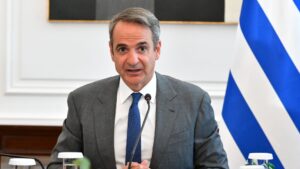
The Greek delegation will include, alongside Prime Minister Kyriakos Mitsotakis, Defense Minister Nikos Dendias, Foreign Minister Giorgos Gerapetritis, and Deputy Foreign Minister Alexandra Papadopoulou. A bilateral meeting between Mitsotakis and Erdoğan has not been formally scheduled, though no one is ruling out the possibility that the two leaders — or their ministers — may hold a brief one-on-one on the sidelines of the Summit.
Published in Parapolitika