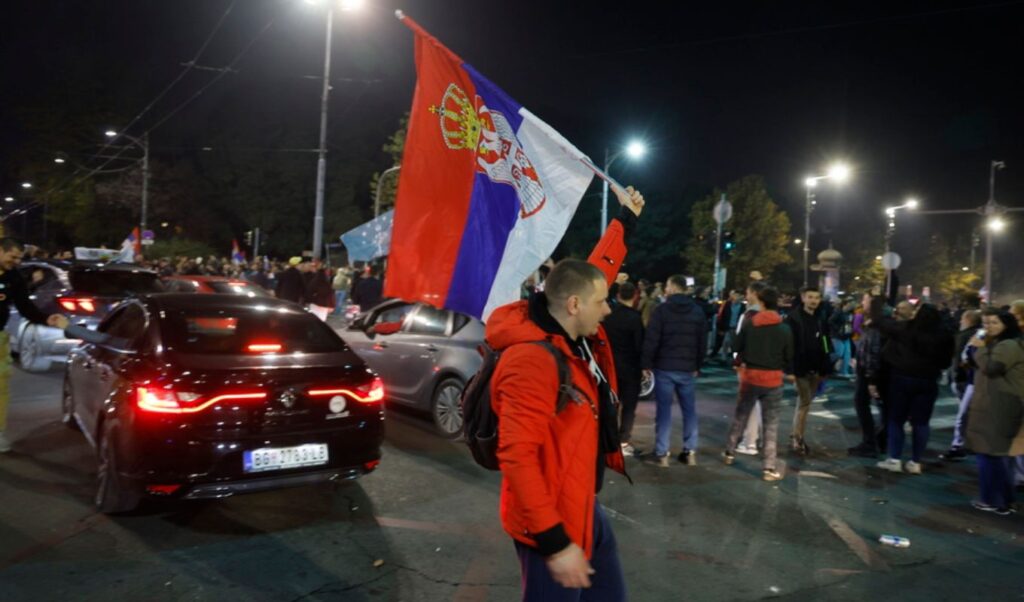
A historic political upset has taken place in Serbia, as the “Student List” movement ended Aleksandar Vučić’s 14-year political dominance, winning the snap parliamentary elections held on Sunday (25/5). This was something truly unprecedented — a movement that started in university halls, grew in the streets, and has now entered the political arena, with ending corruption as its central rallying cry.
According to data released by IPSOS covering 96% of ballots counted, the “Student List – Students Win!” coalition received 52.9% of the vote, securing 140 out of 250 parliamentary seats. The “United Serbia – Aleksandar Vučić” coalition received 38.8% and 104 seats. The remaining seats were distributed among minority parties (3 seats for Hungarians, 2 for Muslims, 2 for Albanians). No other party managed to surpass the 3% threshold required for parliamentary entry. The Socialist Party of Serbia, founded by Slobodan Milošević, will be represented in parliament for the first time in its history.
Read also: Serbia: Historic upset in parliamentary elections – Vučić defeated, Student List scores landslide victory (Images)
Serbia: Who is the Student List — and why Bodiroga’s election matters
Two features stand out as particularly remarkable: this is a leaderless movement with no traditional party machinery, and it is a “List” that fielded no student candidates whatsoever. The students made it clear from the outset that they were not looking for a new leader “around whom a new personality cult would be built.” Accordingly, the 250 individuals who made up the ballot — of whom 140 were elected — were not students, but figures drawn from the worlds of culture, education, economics, sport, and beyond. They are people “entrusted with carrying part of the struggle we have been waging in the streets” for nearly two years — ever since the collapse of the canopy roof at the Novi Sad railway station on November 1, 2024, which claimed 16 lives, as the Student List has repeatedly emphasized.
Among the most prominent names on the list is former basketball star Dejan Bodiroga, once a player for Panathinaikos and now president of Euroleague Basketball, who won his seat. Also elected were Dejan Šoškić, economist and former Governor of the National Bank of Serbia; Mirjana Nikolić, Rector of the University of Arts in Belgrade; and Estela Radonić Živkov, Deputy Director of the Institute for the Protection of Cultural Monuments of Serbia.
Dejan Šoškić’s name is being floated as a potential prime minister. He has spoken openly about the economic reforms he would introduce, while having been subjected to intense criticism from pro-Vučić media outlets, as the BBC has noted.
How the Student List selected its candidates
“Each faculty was allocated a number of positions proportional to its size, totaling 250” — matching the total number of seats in the National Assembly. The list also complies with gender equality standards, ensuring a “balanced composition” of male and female candidates. Their selection was based on “a list of requirements” that individuals had to meet before even being considered. “We wanted people who had supported us from the very beginning, who have an impeccable political record, and who would represent us in the best possible way,” said Aleksa Popović.
Following the elections, students do not expect their representatives “to be infallible, or to have an answer to every question,” the movement’s statement reads. More importantly, they expect them “to be accountable for their actions, to listen to the people they represent, to explain their decisions, and to understand that a seat in parliament is not a reward, a privilege, or the beginning of a political career,” the students warn. “The mandate belongs to the citizens, and whoever takes it on must know to whom they are answerable.”
Born from tragedy
The movement’s origins trace back to November 1, 2024. On that day, the canopy roof of the railway station in Novi Sad collapsed, killing 16 people. The accident — at a station that had undergone renovation works — triggered outrage and raised urgent questions about the quality of public infrastructure projects, contracting procedures, and the accountability of state officials.
The initial protests focused on demanding clarity about the circumstances of the tragedy. They soon took on a broader political character, however. Students called for the release of documents related to the station’s reconstruction, for accountability, for the protection of protesters from attacks, and for increased funding for universities.
In November 2024, an attack on students participating in a silent protest in Belgrade led to the occupation of university faculties. Within weeks, the mobilizations had spread across a large portion of Serbia’s higher education institutions.
The government maintained that it had responded to the protesters’ demands. The students disputed that any substantive answers had been given. The standoff gradually evolved into a broader confrontation over corruption, judicial independence, and the exercise of political power.
In March 2025, one of the largest rallies in the country’s modern history took place in Belgrade. An independent counting group estimated attendance at between 275,000 and 325,000 people, while the Interior Ministry provided a significantly lower figure. The gap in estimates reflects just how fiercely contested the political significance of the protests had become.
The Student List’s political program
Within the framework of an 11-point program, the student movement seeks:
- The elimination of corruption through the establishment of a dedicated police unit to apprehend those responsible
- The removal from the Interior Ministry of all those who violated rules during the crackdown on protesters, or who have links to organized crime
- Reform of Serbia’s distorted media landscape and the liberation of the public broadcaster from political control
- An end to the appointment of party loyalists to leadership positions in state-owned enterprises
Vučić and the Serbian Progressive Party, which he leads, deny allegations of corruption and of attempting to exert influence over the media.
Relations with Russia remain an open question
Under Vučić, Serbia pursued a balancing act — maintaining close political and energy ties with Russia while simultaneously pursuing European integration and attracting Chinese investment. Belgrade has not aligned itself with Western sanctions against Moscow following Russia’s invasion of Ukraine.
The student movement has not presented an equally detailed alternative strategy in this area. Russia remains a significant partner for Serbia, particularly in the energy sector and in traditional diplomatic relations, while China is a major investor. The new political leadership will therefore face practical and economic constraints if it seeks to shift Serbia closer to the EU.
The result represents a serious blow to Vučić, who maintained his relationship with Moscow while presenting himself as a defender of Serbian national interests. Nevertheless, it would be premature to interpret the Student List’s victory as a definitive break with Russia.
At the same time, on the other two burning issues — EU membership and Kosovo — the Student List defers to the Constitution. It is worth noting that the first article of Serbia’s Constitution defines the country as a democracy “based on the rule of law and social justice, the principles of civil democracy, human rights and minority rights, and a commitment to European principles and values.” Regarding Kosovo, the constitutional charter states that it constitutes “an integral part” of Serbia — though further clarification on this issue is expected in the period ahead.