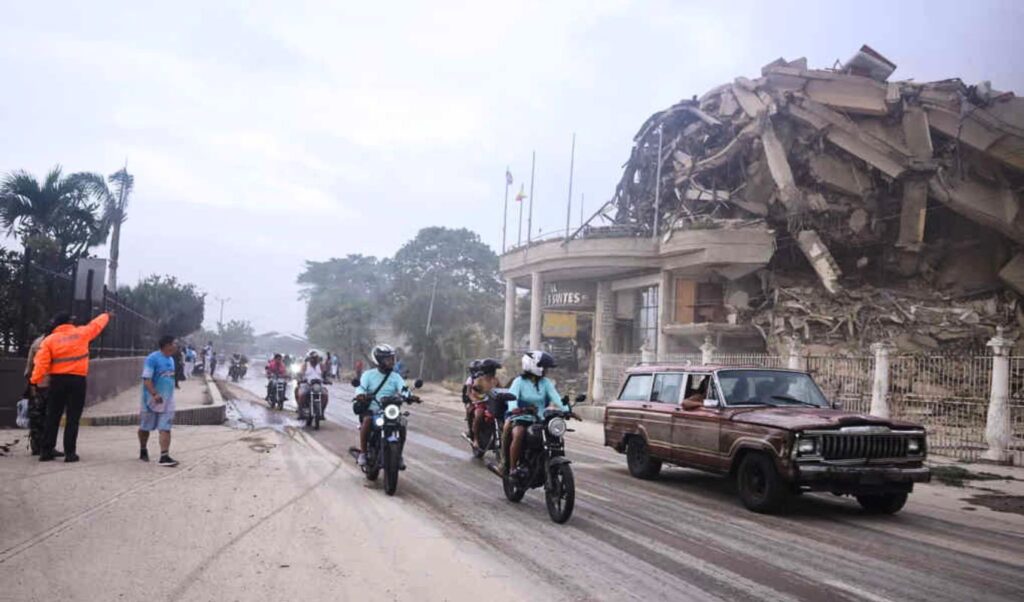
The recent double strike that hit Venezuela within seconds of each other has brought the nightmare of “seismic twins” back into the spotlight. This is the same devastating phenomenon that Turkey experienced so tragically in 2023, demonstrating just how unpredictable and deadly the chain activation of fault lines can be.
Two deadly seismic strikes within less than sixty seconds were enough to turn the scientific world’s attention to Venezuela. Experts are now closely examining a rare yet extraordinarily threatening geological phenomenon known in seismology as an “earthquake doublet.”
Late on Wednesday evening (June 24), a magnitude 7.2 earthquake struck near San Felipe in northwestern Venezuela. Just 39 seconds later, a second and even more powerful magnitude 7.5 earthquake followed, southeast of the neighboring city of Yumare.
Venezuela’s acting president, Delcy Rodríguez, declared a national state of emergency as the tremors caused widespread damage and triggered tsunami warnings across several regions.
According to authorities, 50,000 people are reported missing, more than 230 have been confirmed dead, and survivors remain trapped in the rubble as rescuers and volunteers race to save them. Footage emerging from the rescue operations has been deeply harrowing.
How the earthquake doublet “chain reaction” works
The term “earthquake doublet” describes the occurrence of two major earthquakes of similar magnitude that strike almost simultaneously in the same geographic area. As the United States Geological Survey (USGS) notes, the minimal time and spatial gap between the two tremors points to an exceptionally complex interaction between different fault systems.
Unlike ordinary aftershocks, the second earthquake in such a sequence is not simply a weaker echo of the first.
Scientists explain that the first tremor can release stress on one fault while simultaneously increasing pressure on a neighboring one. If that second fault is already close to its breaking point, the additional stress — or even the seismic waves from the first earthquake — can trigger a new, powerful rupture. As a result, two distinct but interconnected earthquakes can occur within seconds, minutes, hours, or even days of each other.
Why the phenomenon is so dangerous, according to scientists
Earthquake doublets are considered particularly dangerous because they extend the duration of intense shaking and expand the affected area.
In simple terms, buildings already weakened by the first earthquake may collapse during the second, and the same applies to infrastructure that has been compromised.
At the same time, doublets significantly complicate rescue operations, as structures that remained standing after the first tremor may suddenly collapse, endangering both trapped survivors and rescue teams.
The Venezuela case
The USGS officially classified the Venezuelan seismic sequence as an “earthquake doublet.”
According to the agency, the magnitude 7.5 earthquake was the main event in a powerful double seismic sequence that began just 39 seconds earlier with a magnitude 7.2 foreshock.
Notably, the same region had experienced a similar phenomenon back in September 2025, when two earthquakes of magnitude 6.2 and 6.3 struck the states of Zulia and Lara.
The Turkey case that shocked the world
One of the most striking and catastrophic examples of an earthquake doublet was recorded in Turkey on February 6, 2023.
A magnitude 7.8 earthquake struck southern Turkey, and approximately 9 hours later a second major earthquake of magnitude 7.5 to 7.6 followed, roughly 90 kilometers to the north. The two earthquakes caused unprecedented destruction across 11 provinces, leaving tens of thousands dead and causing massive material damage.
From past to present: Historical records of the doublet phenomenon
The devastating double tremor in Venezuela is far from unique. The doublet phenomenon has left its mark on other highly seismically active zones around the world. A notable historical example is southern California in 1987, when the Superstition Hills area was struck by two powerful earthquakes approximately 11 to 12 hours apart, originating from two intersecting fault lines.
In Iran in 2012, two earthquakes of magnitude 6.4 and 6.2 struck East Azerbaijan Province within minutes of each other, causing hundreds of deaths. A similar event occurred in 2021 in Hormozgan Province, where two powerful earthquakes struck approximately 90 seconds apart.
In 2023, the Herat region of Afghanistan experienced a series of devastating magnitude 6.3 earthquakes within just a few days, demonstrating that certain fault systems can be activated sequentially rather than through a single isolated event.