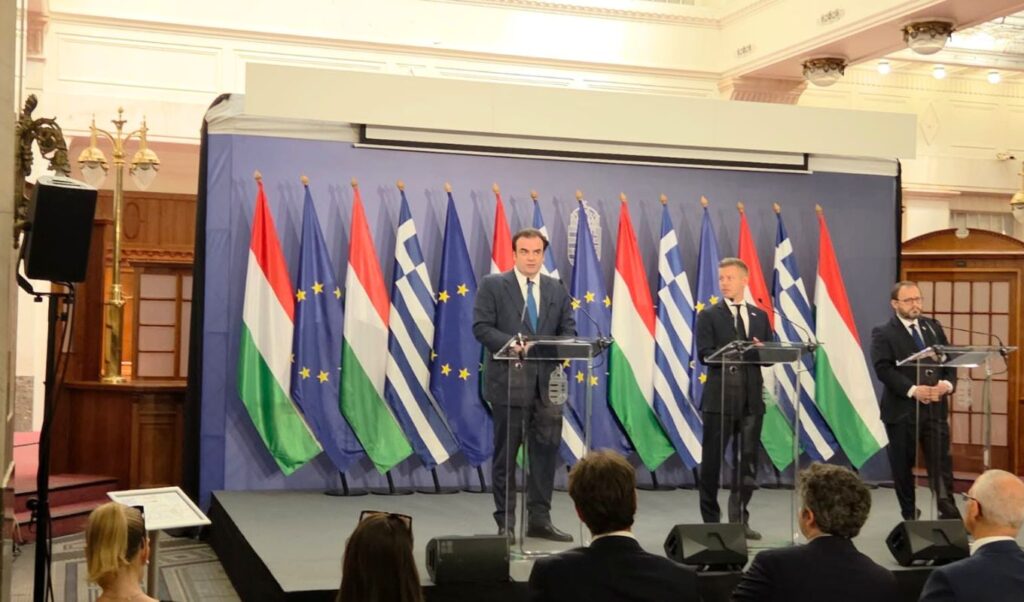
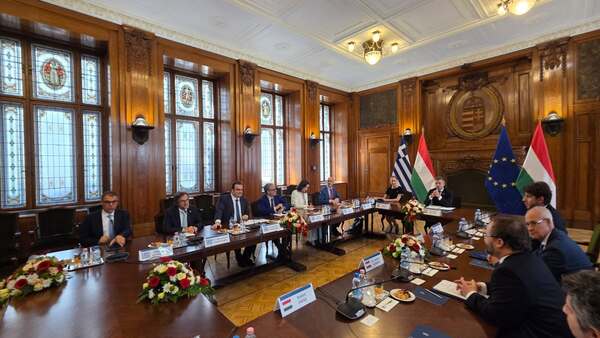
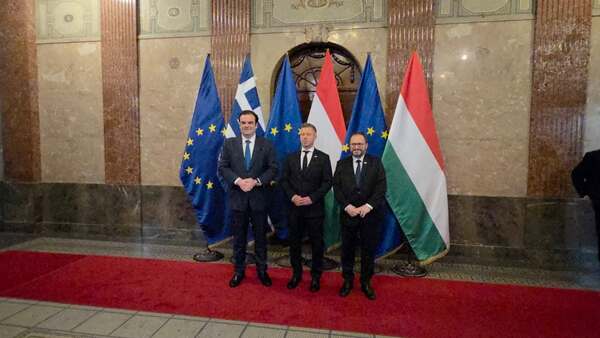
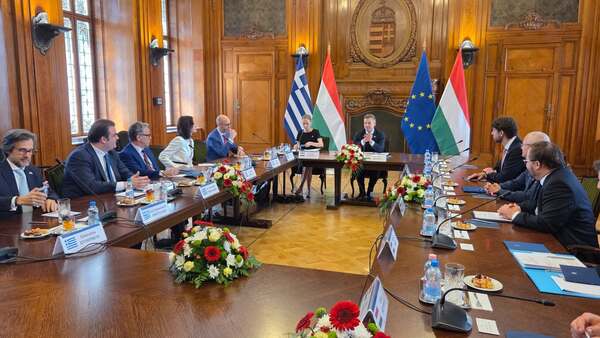
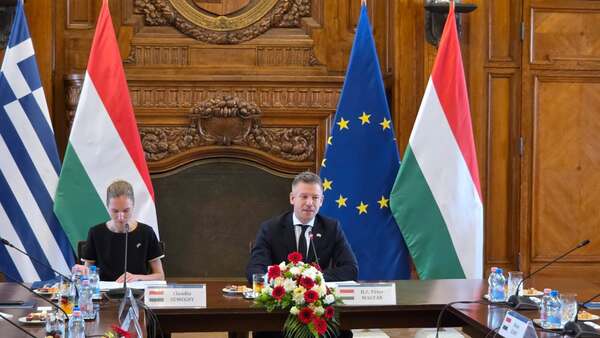
Greek Minister of National Economy and Finance and President of the Eurogroup, Kyriakos Pierrakakis, met today (26/6) in Budapest with Hungary‘s Prime Minister Péter Magyar and Finance Minister András Germán. The meetings provided an opportunity to discuss current economic developments in Europe, the challenges facing economic competitiveness, and the prospects for further economic convergence within the European Union.
Read also: Kyriakos Pierrakakis travels to Hungary for meetings with Magyar and Germán
Pierrakakis voices support for Hungary’s European path
The visit comes at a time when Hungary’s new government is actively pursuing closer alignment with the European core and has made the country’s gradual preparation for Eurozone membership a strategic priority. In his capacity as Eurogroup President, Pierrakakis expressed political support for Hungary’s European trajectory, while signaling the Eurogroup’s readiness to back the Hungarian government with technical expertise and guidance on the next steps toward convergence. A press conference followed the conclusion of the meetings.
Pierrakakis’ full statement
At the press conference, Kyriakos Pierrakakis made the following statement: “Prime Minister Magyar, Minister Germán, thank you warmly for your kind reception and hospitality. It is a great pleasure to be here today, as you noted, Prime Minister, in this truly impressive and beautiful building. Your government assumed office only a few weeks ago.
Since then, we have seen clear messages and concrete initiatives that confirm Hungary’s commitment to Europe. My visit today is dedicated precisely to this cooperation — for the benefit of the Hungarian people and Europe as a whole. As a Greek, I take particular pride in recalling that in 2003, in Athens, at the foot of the Acropolis, Hungary’s Treaty of Accession to the European Union was signed.
That moment symbolized the unwavering conviction that Europe’s strength lies in its unity, its diversity, and its shared future. Later today, I will have the opportunity to visit the Hungarian Parliament — one of the most impressive parliamentary buildings in Europe. It is not only an architectural masterpiece but also a powerful symbol of Hungary’s national identity and its place in European history.
Today we had a substantive and highly productive discussion about the European and global economy, as well as the challenges and opportunities that lie ahead. We discussed the need to strengthen Europe’s competitiveness, energy security, deeper financial market integration, and the mobilization of investment required for Europe’s long-term prosperity.
Hungary, under your leadership, is changing course.
Hungary is moving from the periphery of European growth toward the core of European decision-making. And this shift is not only about Hungary — it is about Europe’s own new era. Great historical decisions acquire their true meaning when they translate into greater security, more opportunities, and stronger confidence for citizens. That, I would say, is the real added value of Europe.
I also welcome Hungary’s ambition to deepen its economic and monetary integration into Europe, and its commitment to fulfilling the conditions for future membership of the euro area, as the Prime Minister has just outlined.
The path toward euro adoption is demanding, but also deeply transformative. And it is, as you very rightly noted, a journey. A journey that requires meeting specific economic criteria, but also entails building institutional credibility and trust.
Joining the Eurozone places a country within a space of greater stability, strength, and strategic security. The recent accession of Bulgaria, as well as that of Croatia before it, demonstrates the enduring appeal of the common currency. As the second most important currency in the world after the dollar, the euro maintains a strong international presence.
I would add, however, that the euro is much more than a currency. It is a community of stability, trust, responsibility, and shared prosperity. It reflects a shared commitment to economic resilience and the conviction that European states are stronger when they act together. When a country seeks to join the euro area, a fundamental truth becomes clear.
In an unstable world, stability becomes a strategic asset and credibility becomes a source of power. Joining the euro follows a process based on clear rules and is directly linked to meeting the convergence criteria. I encourage the Hungarian authorities to continue implementing sound economic policies and advancing the necessary institutional reforms, so as to meet the relevant criteria and allow their country to thrive as a member of the Eurozone.
The Eurogroup stands ready to support Hungary, as it does every candidate member state, on the path toward euro adoption. As was highlighted in today’s discussion, the unlocking of Recovery and Resilience Facility funds is a top policy priority for the Hungarian government.
Thanks to the government’s intensive efforts, the National Recovery and Resilience Plan was submitted last week and has already been placed on the agenda of the July 10th Council meeting for approval.
This development is tangible proof of the new Hungarian government’s dedication to advancing the reforms identified as key milestones, particularly those aimed at strengthening the rule of law. Our economies thrive when they are grounded in a stable political and institutional environment.
The reforms required under the Recovery and Resilience Facility are a necessary precondition for a country to become an attractive investment destination and for citizens to feel confidence in the economy.
The European Union recognizes and encourages every credible reform effort, wherever it takes place. We particularly welcome the measures being advanced by the Hungarian government to strengthen the anti-corruption framework, improve transparency in the management of public funds and public procurement, and enhance the participation of social partners and stakeholders in the legislative process.
In this context, I would like to add that I fully support Hungary’s efforts to fulfill the agreed milestones, so that the full disbursement of Recovery and Resilience Facility funds becomes possible once all agreed conditions are satisfied. In a period of significant geopolitical and economic transformation, Europe must remain ambitious about its future.
In the Eurogroup, economic policy is a tool of collective power. It is the means by which the euro area transforms cooperation into stability, trust into growth, and shared will into shared prosperity. Europe must shape this new era by safeguarding its sovereignty, defending its interests, protecting its citizens, and charting its own future. To achieve this, greater strategic cohesion, deeper integration, and stronger collective action are required.
That is the spirit I look forward to reinforcing through my future cooperation with my Hungarian counterparts. Prime Minister, Minister, thank you once again for your warm hospitality.”
In response to a question from ERT: “What support can the Eurogroup provide to accelerate the process of a country joining the euro area, with the aim of strengthening the cohesion and strategic autonomy of the European Union?”, Kyriakos Pierrakakis replied: “As you know very well, for a country to join the Eurozone it must meet the so-called Maastricht criteria, that is, the convergence criteria.
These relate to long-term interest rates, exchange rate stability, inflation, and the country’s fiscal position. In addition, a country must participate for two years in the Exchange Rate Mechanism (ERM II) in order to demonstrate that it can operate smoothly without excessive exchange rate fluctuations.
How can the Eurogroup support this effort? First and foremost, through the expertise it can offer. But to be honest, I always recall the words of a great French statesman: politics is the management of symbols.
In that sense, in my capacity as President of the Eurogroup, my presence here today in Budapest and in Hungary also carries a symbolic dimension. It is a clear message of support for the ambitious path that the Prime Minister and his government have charted.
I believe I speak for many people across Europe — not only in Brussels or in Athens — when I say that we feel a wind of change is blowing from Hungary. We are here to support this ambitious endeavor.
One could focus on the timeline. I will not comment on the timeline. What I will comment on is the ambition. And we want to support that ambition. How? Through knowledge and expertise.
As you know very well, both the European Central Bank and the European Commission participate in the Eurogroup. At the same time, within the framework of the inclusive Eurogroup, not only Eurozone countries participate, but also member states that have not yet adopted the euro. My good colleague, Mr. András Germán, already participates in the work of the inclusive Eurogroup, which makes this cooperation even more straightforward.
We all have the opportunity to learn from one another, to exchange views, and above all, to draw on the expertise and experience of this shared journey. The message I conveyed both in private to the Prime Minister and the Minister, and publicly, is simple: we are here to support you.
We understand that at the end of the day, this is a sovereign decision, belonging to a sovereign government and the sovereign people of Hungary. Within that framework, however, we are all members of the broader European family. And as members of that family, we want to assure you that we will be present, offering every possible support you may need in order to meet the demanding milestones that have been set.”