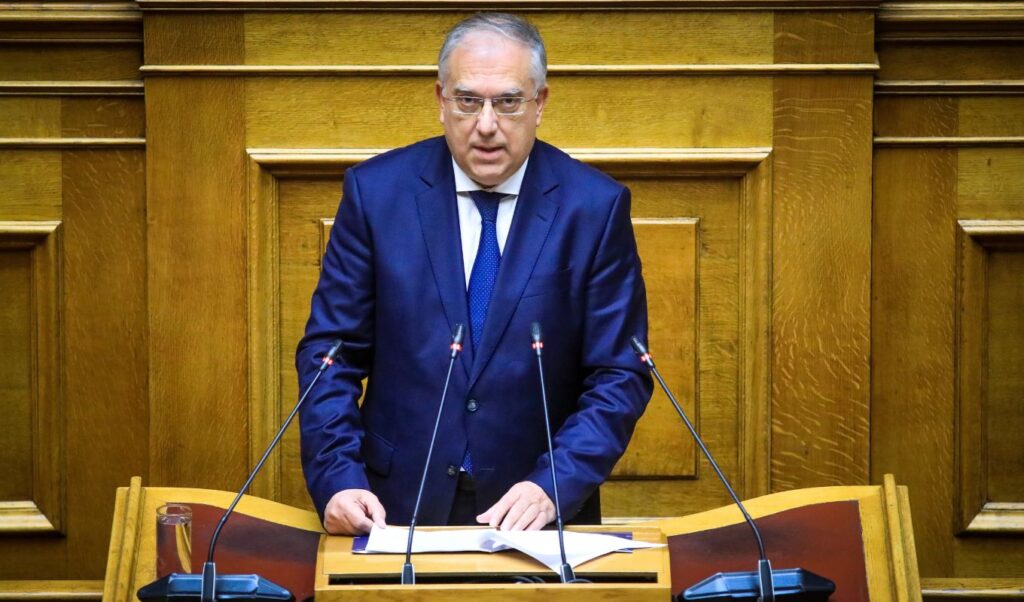
Greece’s Minister of Development, Takis Theodorikakos, outlined the government’s measures aimed at curbing price gouging and stabilizing the market during an interview on radio station SKAI 100.3. He emphasized that the government has taken “highly interventionist measures that no Greek government — or any other European country — has ever implemented before,” noting that the profit margin cap extends across the entire supply chain: supermarkets, wholesalers, and the food industry.
Read also: Theodorikakos reveals: A national social agreement with supermarkets is coming — price cuts on essential household goods
Theodorikakos: Profit margin cap drives price cuts on 2,000 products
According to the Minister of Development, the implementation of the profit margin cap has already delivered tangible results for consumers. Since the measure took effect, prices have fallen on 2,000 product lines, with an average reduction of 5%. As he explained, businesses made these cuts to avoid exceeding the previous year’s profit margin — a threshold that, if breached, would trigger automatic fines. “So the measure we introduced has delivered results,” Theodorikakos stressed.
He noted that the government does not intend for the measure to be permanent, as it believes in “a free, fairer, and healthily competitive market.” However, he added that responsible businesses must contribute to the collective effort: “They need to step up and reduce their average profit margin right now, because everyone must recognize that there is a significant segment of society that is struggling enormously.”
Social agreement on the supermarket basket
Regarding Monday’s meeting chaired by the Prime Minister, attended by representatives from industry and retail, the Minister of Development noted that discussions are taking place “at the highest level,” with the goal of achieving price reductions on essential consumer goods. “What we are critically asking for as a government right now is that prices on basic products come down and that an agreement is reached to reduce those prices — so that ordinary citizens, the average Greek family, can actually feel the difference when they go shopping at the supermarket,” he said.
On the fuel price cap, Theodorikakos stated that “the international price of oil is approaching where it was before the war began. We are heading toward a definitive de-escalation of the conflict. The Ministry of Development’s measure capping profit margins on fuel expires on June 30th, and we do not plan to renew it,” adding that he had discussed the matter with Prime Minister Kyriakos Mitsotakis as well as Finance Minister Kyriakos Pierrakakis.
He went on to address the inspections carried out by the Independent Authority for Public Revenue Supervision and Consumer Protection, noting that they are ongoing and extend beyond the retail shelf to cover the entire supply chain. “Everything and everyone is being monitored. The Independent Authority already has major wholesale companies under review,” he stressed, pointing out that the Authority recently imposed a €3 million fine on a major multinational corporation. He also emphasized that beyond financial penalties, the reputational damage caused to a company when it breaks the law carries significant weight in itself.
Criticism of Tsipras over tax policy
When asked about Alexis Tsipras and his tax policy proposals, the Minister of Development raised the question of political credibility, stating: “I would first expect a clear account of the four years he governed Greece, when the middle class was crushed under brutal overtaxation.”
He added that “trust in politics is hard to earn and easy to lose,” and underlined that the current government is pursuing a policy that reduces tax evasion, has delivered 83 tax cuts, and is enabling both debt reduction and support for the middle class, families with children, young people, and pensioners.
Finally, addressing the political choice facing voters at the next election, he said it would come down to “whether we continue with New Democracy and Kyriakos Mitsotakis, achieving even better results for a more productive economy and a Greece that remains secure — or whether we return to the experiment that Mr. Tsipras embodied through his time in government from 2015 to 2019.”