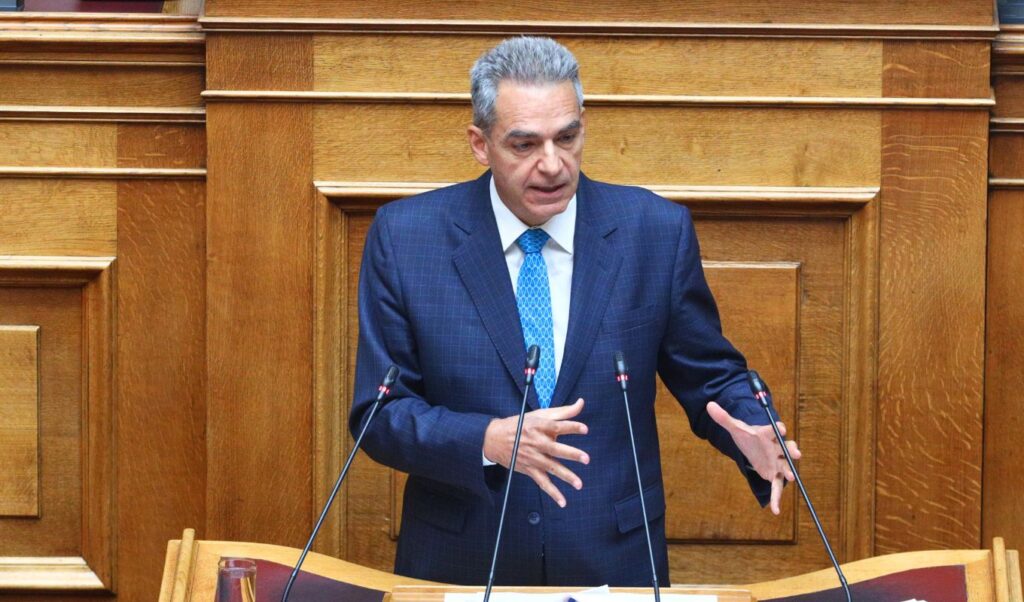
New Democracy MP and Professor of International Law and Foreign Policy, Angelos Syrigos, in an interview on Tuesday (25/8), assessed that there are currently no signs of serious tension that could lead to an armed incident with Turkey. He also stressed that the two main areas of confrontation with Ankara will be the planned “Blue Homeland” law and the Greece-Cyprus electricity interconnection cable.
The “calm waters” period did not mean the disappearance of disputes
Angelos Syrigos, in an interview with ERT, emphasized that “in terms of serious tension that could create a military incident, there are currently no such signs,” clarifying that the so-called “calm waters” period did not mean that Greek-Turkish disputes had disappeared. He noted that the easing of tensions mainly concerned a reduction in violations of Greek airspace — violations which, however, have begun to resurface. He also referred to a Turkish drone overflight above a Greek island on July 30, pointing out that these moves paint a picture of a return to Turkish provocative behavior. “The Turks are going back to the behavior they had before 2023,” he noted characteristically.
The two main areas of confrontation with Turkey
The New Democracy MP made particular reference to Turkey’s declaration of two maritime parks, arguing that these initiatives are part of Ankara’s broader strategy to assert claims over maritime zones. According to the Ministry of Foreign Affairs, the Turkish decisions concern areas extending beyond Turkish territorial waters, encompassing international waters and portions of the Greek continental shelf.
Syrigos pointed out that, for now, Turkey’s announcements are not accompanied by specific regulations detailing what exactly will be protected, which activities will be prohibited, or what restrictions will apply to fishing. He compared Turkey’s claims to someone attempting to claim a public road as their own private property: “It’s like someone whose yard borders a public road deciding that the road is also their yard.” He warned, however, that the absence of specific enforcement measures does not mean Ankara will not attempt to follow through on its moves. At the same time, he underlined that “experience shows that when Turkey takes a step, it will take the next ones too. The timing is unknown,” he noted, linking developments to the planned “Blue Homeland” law.
Analyzing the reasons behind increased Turkish activity, Angelos Syrigos stated that Ankara is irritated by the strengthening of defense cooperation between Greece, Cyprus, and Israel, as well as by Chevron’s involvement in hydrocarbon exploration south of Crete. As he argued, these developments practically challenge Turkish ambitions tied to the Turkey-Libya maritime memorandum. In his assessment, a key source of Turkish irritation is also the Greece-Cyprus electricity interconnection project, particularly following a French company’s involvement in its planning. “Right now, the two areas of confrontation with Turkey will be the ‘Blue Homeland’ law and the cable,” he assessed.
On the Cyprus issue
Referring to the Cyprus issue, Syrigos noted that it remains a defining factor in Greek-Turkish relations, without, however, considering it the immediate field of escalation at this particular juncture. “Cyprus is the matrix of Greek-Turkish problems since 1955,” he said, adding that “a bad solution to the Cyprus issue means a continuation of bad relations with Turkey in perpetuity.”
A strong military and strong alliances
Speaking about Greek strategy, Syrigos argued that there is a longstanding convergence among the major political forces around two core pillars: strengthening the armed forces and building strong international alliances. “There is a timeless common line shared by all major parties for dealing with Turkey: a strong military and strong alliances,” he said characteristically.
He stressed that in his assessment, the Greek Armed Forces are currently in their best state of equipment and readiness since 1974, and that the air and naval balance is a factor Turkey takes into account in its planning. “These are factors Turkey considers when shaping its policy,” he noted, adding that any domestic political disagreements concern mainly tactical matters and not the fundamental national strategy.
On Iran’s threats and Ambassador Barrack
Regarding Iranian threats and the possibility that areas such as Cyprus, Souda Bay, or Bulgaria could be targeted, Angelos Syrigos assessed that the likelihood of a missile strike is “extremely limited.” He emphasized that geographic distance and available air defense systems significantly reduce such a risk, and that decisions on the deployment of defensive assets are made based on threat assessments and operational data.
In closing, when asked to comment on reports about the future of US Ambassador to Turkey Tom Barrack, he did not confirm everything being said, but noted that “if something like that happens, my assessment is that we won’t be too upset about it.”