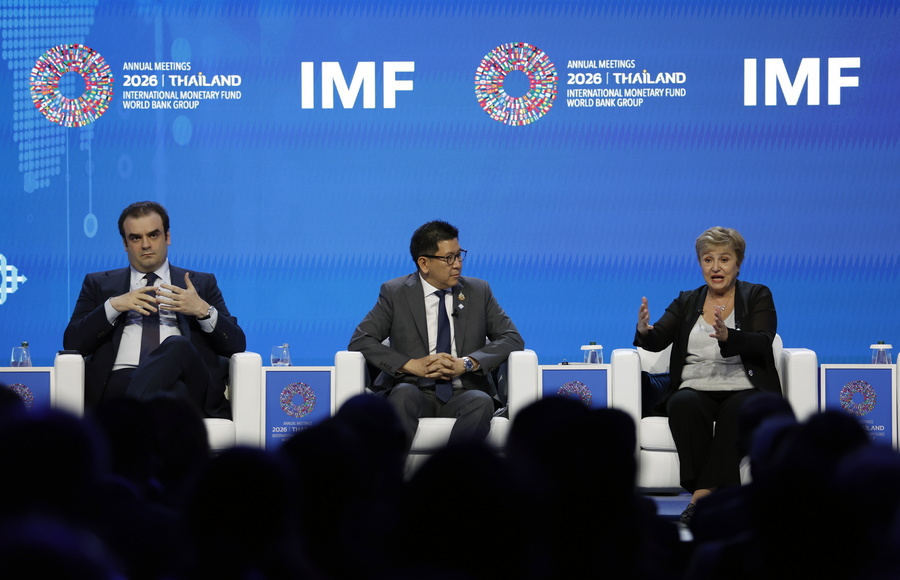
Kristalina Georgieva lavished praise on Greece — and held nothing back. The IMF Managing Director’s enthusiasm carries considerable weight, as she essentially expressed what amounts to Greece having lifted a burden from the International Monetary Fund’s shoulders. “Greece is now part of the solution and not part of the problem,” as reported by ERT. The relationship between the IMF and Greece has been extensively analyzed — even documented in film — but today the organization uses Greece as a model: a country that exited its bailout programs and repaid its loans ahead of schedule. Georgieva spoke about Greece’s new role, as the country now funds capacity-building programs and provides technical assistance to other nations. “Greece has learned so much and now wants to share that knowledge with others,” she said, concluding with a “bravo” for the Greek initiative. The praise couldn’t have been more official, as it was delivered in the presence of Kyriakos Pierrakakis at the IMF Annual Meetings in Bangkok. According to the Managing Director, Greece “now contributes to the transfer of expertise to states facing high debt and reform challenges.”
Pierrakakis: “We try to positively surprise”
Witness to the IMF chief’s unusually warm words was Kyriakos Pierrakakis himself. The Eurogroup President and Finance Minister stressed that the outlook for the Greek economy is positive. He also noted that the IMF’s assessments align with the forecasts outlined in the draft 2027 budget. According to these projections, public debt is expected to reach 130.6% of GDP in 2026 and fall further to 128.7% in 2027, while the country continues to record strong primary surpluses.
“Typically, the IMF is the one that puts forward the more conservative estimates, while we try to positively surprise. We intend to do the same next year,” he said. As reported by ERT, Pierrakakis noted that Greece is proving that fiscal consolidation is a necessary prerequisite for achieving growth.
“We are not in a state of alarm”
“I come from a country that in the past received support from this organization. And today we are a country that offers support to its citizens and businesses, during a period in which we face significant challenges heading into winter, due to the energy crisis you just mentioned,” he added. When asked about developments in the French economy, Pierrakakis emphasized that European institutions are closely monitoring the situation, noting that “we remain on alert, but not in a state of alarm.” “We are watching developments carefully, but we are not in a state of alarm, because we know that the fundamentals are strong. If there is one word that defines Europe, it is resilience. And I believe we have demonstrated that through a series of crises,” he said.
“Obviously, we are now operating in a high-yield bond environment. If we compare 2026 to 2016, the average yield on a ten-year bond was 1.1% in 2016. Today it stands at 4%. It is 5.4% for the United Kingdom, 5.2% for the United States, 4.9% for France, and — notably — 4.4% for Greece. We all know that markets scrutinize countries’ fiscal trajectories. And obviously, in a high-yield environment, this takes on much greater significance,” he added.
“Part of the same conversation and the same equation”
Pierrakakis also noted that “in Europe, from an overall perspective, banks are today far better capitalized than in the past. We have a different institutional framework than the one we had in 2010. And, obviously, we have a fiscal framework that states are implementing or, even when they deviate from it, they return to balance. In this environment, I am confident that the fiscal path proposed by the French government will be implemented. Therefore, we are all part of the same conversation and the same equation. We see differentiation in bond yields. We do not see fragmentation in Europe.”
He further stressed that Greece could serve as an inspiration in fiscal management. “In the Eurogroup, particularly ten or fifteen years ago, the focus was on fiscal matters. These obviously remain the foundation,” but “if we look at the statistics today, there are five countries in Europe recording a fiscal surplus in terms of overall balance. One of them is Denmark, with the other four — Greece, Cyprus, Ireland, and Portugal — having been in adjustment programs in the previous decade. That was a lesson that emerged from a collective trauma. Ideally, however, fiscal consolidation should not be the result of a traumatic experience. It should come from inspiration.”
“The environment in which we operate today is more demanding. We only need to look at bond markets, as I mentioned earlier. We have geopolitical fragmentation. We have increased energy costs. We have fiscal pressures in Europe. The average fiscal deficit ten years ago was 1.7%. Today it is 3.5%. There are increased needs for social spending. There are increased needs for investment — all those investments that must be made. And there is also Artificial Intelligence, which is not only a technological force. It is also a macroeconomic force. States are now competing with technology companies for capital. In this environment, we must deliver results. Obviously, there is a significant challenge. The inspiration that I believe Greece can offer in this context,” he added.
“The inspiration we can draw is this: put your public finances in order. Markets are watching your fiscal trajectory. And particularly in a high-yield bond environment, they are scrutinizing it even more closely. But this must happen simultaneously with the implementation of reforms,” he further emphasized.
Pierrakakis takes center stage
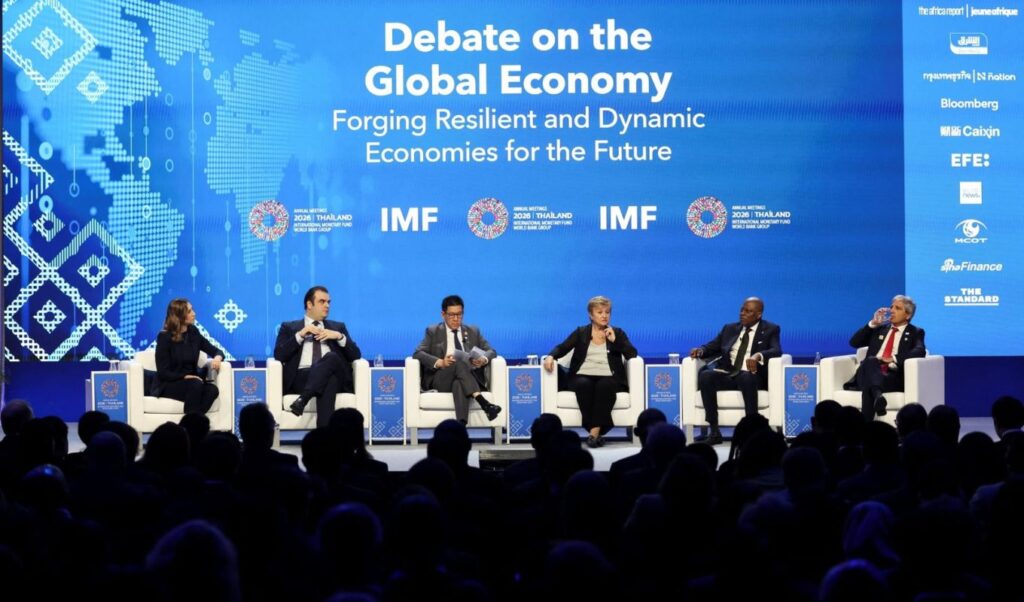
It is worth noting that Kyriakos Pierrakakis participated alongside IMF Managing Director Kristalina Georgieva in the IMF’s flagship panel discussion on the global economy, titled “Debate on the Global Economy: Forging Resilient and Dynamic Economies for the Future,” held as part of the IMF and World Bank Annual Meetings in Bangkok. Also participating in the panel were Thailand’s Deputy Prime Minister and Finance Minister Pichai Chunhavajira, Argentina’s Economy Minister Luis Caputo, and Central Bank of Nigeria Governor Olayemi Cardoso. The panel was moderated by Bloomberg journalist Lisa Abramowicz.
As Eurogroup President, Kyriakos Pierrakakis will also participate in the G7 Finance Ministers and Central Bank Governors meeting, as well as the European coordination meeting that will precede it. The discussions are taking place at a time when international economic cooperation is becoming increasingly critical in addressing shared challenges and maintaining market confidence.