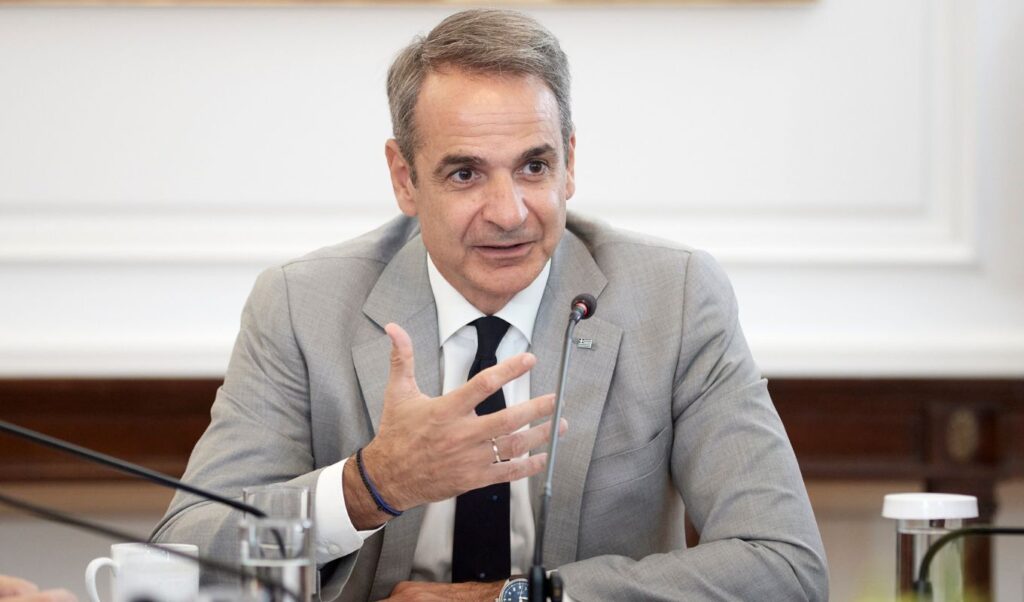
Prime Minister Kyriakos Mitsotakis returned to his regular Sunday review after a two-week break during the August holiday period. In a lengthy post, the Prime Minister outlined the most significant developments of recent weeks, covering everything from wildfires and the economy to energy, agriculture, and new government initiatives.
He opened with the topic of wildfires, noting that more than 500 forest fires had broken out since the beginning of August, bringing the total to approximately 2,700 since the start of the fire season. He explained that powerful, prolonged winds had severely hampered firefighting efforts, and that in certain areas — such as Boeotia and Western Attica — there were periods during which even aerial assets were unable to operate.
Mitsotakis emphasized that, despite the difficult conditions, the total area burned in Greece this summer was lower compared to previous years and to other Mediterranean countries. He also referenced the evacuation operations, noting that at least 1,000 people were safely removed by sea from active fire fronts. He paused to acknowledge the human losses, expressing his condolences to the families of the victims and confirming that on-site inspections in the affected areas are ongoing in order to process compensation payments and state aid as quickly as possible.
On the economic front, the Prime Minister announced that Greece will proceed with an additional early repayment of €13 billion in public debt during 2026. Combined with the €36 billion already repaid ahead of schedule since 2019, Greece is recording the fastest debt reduction in the entire European Union. He also referenced a recent upgrade of Greece’s economic outlook by Japanese rating agency R&I.
The Ministry of Education’s new FinStart initiative
Mitsotakis also highlighted the launch of FinStart, a new Ministry of Education initiative targeting approximately 40,000 primary and secondary school students. The program aims to equip young people with basic financial literacy skills, while also raising awareness about the risks of the digital economy and online fraud. The Prime Minister further referenced the Greece-Cyprus electricity interconnection, following an agreement for French investment group Meridiam to become the majority shareholder in the Great Sea Interconnector company, with fellow French firm Nexans set to undertake the construction and laying of the cable.
In the same review, Mitsotakis referred to the new Spatial Planning Frameworks for Tourism and Renewable Energy Sources, which have now entered into force. He also addressed Turkey’s reaction to the announcement of the Renewable Energy Spatial Framework, reiterating that Greece operates in full accordance with international law and will not allow threats or unlawful claims to dictate its decisions. In the primary sector, he referenced water management projects in Lasithi, Crete, following the signing of the relevant contract, as well as the new digital platform myAGRO, through which applications for 2026 agricultural subsidies will be submitted. He stressed that the goal is for support payments to reach the rightful beneficiaries accurately and on time.
The Prime Minister also addressed a new regulation targeting so-called “energy tourists” — consumers who switch energy providers while leaving unpaid bills behind — and announced the legal enshrinement of the “Right to Be Forgotten” for people with a history of cancer. Under the new law, five years after completing treatment and with no relapse, a prior cancer diagnosis may no longer be used in insurance contracts linked to loans or other credit agreements.
In closing, Mitsotakis paid tribute to three prominent figures in Greek intellectual and public life who passed away in August: Konstantinos Tsoukalas, Stelios Ramfos, and Stefanos Manos. He described each as offering a distinct perspective on modern Greece — Tsoukalas analyzing the contradictions of Greek society within its international context, Ramfos seeking answers in the country’s deeper historical roots, and Manos pursuing practical solutions to Greece’s long-standing challenges.
He concluded by congratulating Greek athletes for their remarkable achievements throughout August, across athletics, swimming, rowing, sailing, shooting, and gymnastics, personally naming each athlete: Tentoglou, Karalis, Petrounias, Roussou, Mitropoulou, Iakovakis, Christou, Siskos, Mouselimis, Chiotis, Alexiou, Mouratidou, Triantou, Samaras, Theodorakopoulou, Gerochrystos, Markantwnakis, Baxevanakis, and Nikolantwnakis.
“This was the first post-summer review,” the Prime Minister said in closing, wishing everyone a happy Sunday.
Kyriakos Mitsotakis’ full post:
After a short two-week August break, we’re back today with our regular review. I hope most of you managed to rest a little during these days, to spend time with your loved ones and, even briefly, to step away from the daily routine.
A great deal happened during these two weeks — both positive and difficult — and I want to talk about all of it today. I’ll begin with the wildfires, which are, unfortunately, a reality that all of Europe now faces, particularly during the summer months. As I have said before, climate change does not start fires.
But it does make the conditions far more dangerous when fires do break out. We experienced this firsthand this year, with very strong winds that lasted — according to the National Observatory — for 20 days at exceptionally high speeds, unusual even by Greek summer standards, significantly complicating firefighting efforts. In some cases, such as in Boeotia and Western Attica, there were periods when even aerial assets could not fly.
Despite these difficult conditions, the area burned in Greece this summer is smaller — both compared to previous years and relative to other Mediterranean countries. Firefighting forces and volunteers had to contend with more than 500 forest fires since the beginning of August, and 2,700 since the start of the fire season. The state mobilized swiftly: at least 1,000 people were evacuated in time by sea from active fire fronts, while as many homes and businesses as possible were saved.
Tragically, however, lives were lost, and that overshadows everything else we might say about what happened during these days. Our thoughts are first and foremost with the families of those who perished, and with all those who watched their properties destroyed or threatened. On-site inspections in the affected areas continue, so that compensation, allowances, and support payments can be made to those entitled as soon as possible. We will stand by the people who have been affected, for as long as it takes.
I’ll leave the topic of wildfires here — I will return to it at the end of the fire season — and move on to the other developments of these past two weeks.
There is a significant development on the economic front: during 2026, we are proceeding with yet another early repayment of public debt, amounting to €13 billion. Adding this to the €36 billion already repaid ahead of schedule since 2019, we are recording the fastest pace of debt reduction in the entire European Union.
We are finally leaving behind the era in which Greece was the most heavily indebted state in the EU27. Reducing our debt is not some abstract concept — if you’ll allow me to say so, it is an act of national liberation. The faster we reduce this debt, the more room the state has to breathe. And when the state is not suffocating under the weight of its obligations, it can better support its citizens, offer businesses better borrowing conditions and, ultimately, create the conditions for shared prosperity. Above all, it is a matter of justice for future generations. We cannot burden our children with debts accumulated in the past. Markets recognize this effort: another credit rating agency, Japan’s R&I, has upgraded Greece’s economic outlook from stable to positive, estimating that — despite inflationary pressures driven by tensions in the Middle East — strong growth rates will be sustained in 2026, thanks to structural reforms and our fiscal policy. We press on, and I will certainly have more to say on this from the Thessaloniki International Fair podium in two weeks.
Recognizing that sound money management is a skill best acquired early, a new program — FinStart — will roll out gradually from the new school year through the Ministry of Education, targeting approximately 40,000 primary and secondary school students. The aim is for young people to gain basic and, above all, practical knowledge: to better understand the economic environment around them, to learn to manage their finances responsibly, and to make more informed decisions. Particular emphasis is placed on the risks of the digital economy, equipping students to recognize scams and traps that all of us encounter with increasing frequency. The goal is not, of course, to turn children into economists. The goal is to make them informed citizens — to give them, from an early age, a handful of basic tools that will serve them throughout their lives.
Another important development concerns the Greece-Cyprus electricity interconnection — specifically, the agreement for leading French investment group Meridiam to become the majority shareholder in the Great Sea Interconnector company, bringing fresh financial and technical firepower to the project, while fellow French firm Nexans takes on the demanding task of constructing and laying the cable. This agreement is a strong vote of confidence in our energy infrastructure. The project will finally end Cyprus’s energy isolation by connecting the island to our grid; it is yet another way in which Greece is cementing its role as the region’s primary energy hub, gaining greater security and a stronger strategic position, while opening the door to more clean renewable energy. Once again, we demonstrate that our country attracts serious international investors to major projects.
Back in May — specifically on 24 May — I spoke to you in our review about the new Spatial Planning Frameworks for Tourism and Renewable Energy Sources, which were then in public consultation. Today, this important reform moves from planning to implementation: both Frameworks have entered into force, and together with the corresponding Industrial Spatial Framework — due to be finalized within days — they introduce, for the first time, unified and clear rules governing where and under what conditions each type of activity may be developed across the country.
For tourism, this means that not all parts of the country can be treated in the same way. Some areas have already come under immense tourism pressure and require greater protection, while others still have significant room to grow. The same principle applies to renewable energy, where stricter limits are being set for sensitive areas — from small islands and Natura 2000 sites to forests and archaeological zones. Together with the Industrial Spatial Framework, we now have a cohesive plan for how we want this country to develop over the coming decades. Because growth without rules ultimately benefits no one — not local communities, not the environment, and not those who want to invest with clear knowledge of what is and is not permitted.
A note here: the announcement of the Renewable Energy Spatial Framework once again prompted a reaction from Turkey, with the recycling of unfounded claims about “grey zones.” Our position is clear and unchanged: Greece operates in full accordance with international law, exercises its sovereign rights, and will not allow threats or unlawful claims to determine its decisions. We consistently pursue dialogue and good-neighborly relations with Turkey. But dialogue does not mean capitulation. And it certainly does not mean we will stop doing what we consider right and necessary for our country.
Let us turn to Crete and an equally necessary intervention. Water management projects in Lasithi are now entering the implementation phase, following the signing of the relevant contract. These involve two independent irrigation networks — at the Chochlakion reservoir and the Agios Ioannis Ierapetra dam. The first section, in the Municipality of Sitia, is expected to be operational within the next 18 months, with the full project completed within 42 months. These interventions are of critical importance given that the Mediterranean is on the front line of the climate crisis. The era of plentiful and wasteful use of water resources is over. We must manage water — not only in Crete, but throughout Greece — intelligently and prudently. In our times, every cubic meter of water carries strategic value, all the more so for the primary sector, which I will address next.
The new digital platform myAGRO (myagro.aade.gr) is now the designated portal for submitting applications for 2026 agricultural subsidies. The process is being simplified, the submission of handwritten lease agreements is being abolished, and — most importantly — support payments are now linked to real, cross-verified data. Two changes are of direct relevance to farmers themselves. Those who submit their applications by 15 September are expected to receive an advance payment by 31 October, while the remaining applications will be processed by 30 November. In addition, farmers will have more options for who can assist them with their application, as submissions can now also be filed on their behalf by agronomists, veterinarians, foresters, accountants, and accounting firms. myAGRO is the practical continuation of the reform we introduced to agricultural payments — a reform we have discussed at length in recent months. The objective is now very specific: to ensure that support reaches, accurately and on time, those who are truly entitled to it.
As August draws to a close, let me also address a form of “tourism” we have no wish to encourage: so-called “energy tourism.” This has nothing to do with holidays — it refers to the practice of certain consumers leaving unpaid bills behind as they hop from one energy provider to another, exploiting gaps in the current system. A new regulation from the Ministry of Environment and Energy is now closing this loophole.
Suppliers will be able to flag overdue debts to HEDNO, and once a consumer accumulates three such flags, they will be unable to switch provider until they have paid or restructured their debt. I should stress that this measure does not create obstacles for anyone facing genuine financial hardship who is making a good-faith effort to meet their obligations. What it does put an end to is an abusive practice that allowed strategic non-payers to leave the bill — literally and figuratively — with responsible consumers.
I now turn to a matter I raised two years ago, in April 2024. At that time, we took an important first step toward establishing the “Right to Be Forgotten” for people with a history of cancer, incorporating it into the Code of Conduct for insurance companies. Two years on, we are going a step further and enshrining it in law.
In practical terms: five years after completing treatment, and provided there has been no relapse, data relating to a prior cancer diagnosis may no longer be used in an insurance contract linked to a loan or other credit agreement. We chose a five-year window, even though the European Directive permits a period of up to 15 years. This is a very specific change, but one of genuine substance: a person who has put illness behind them should not find it waiting for them again, years later, when they try to move forward with their life. A just and longstanding demand now carries the force of law.
In August, we lost three remarkable figures from Greek letters, intellectual life, and public policy — each deserving of recognition, because together and individually they have shaped, in their own way, the fabric of our modern national identity. Konstantinos Tsoukalas, Stelios Ramfos, and Stefanos Manos have left us, each offering a different lens through which to view the same Greece.
Tsoukalas analyzed the contradictions of Greek society within its international context; Ramfos sought in the country’s deeper roots the explanation for its trajectory; and Manos pursued practical solutions to help us overcome our enduring weaknesses. Different starting points, different ideas — but a shared demand: to look at ourselves in the mirror without illusions and to decide what kind of Greece we wish to leave behind. For no society can move forward without first understanding itself deeply. All three contributed, each in his own way, to helping us look at our collective reflection with greater honesty and realism. We thank them for everything they gave us.
In closing, congratulations to our athletes, because this August brought many great Greek achievements in athletics, swimming, rowing, sailing, shooting, and gymnastics — following earlier victories in men’s and women’s water polo. Let us remember them by name: Tentoglou, Karalis, Petrounias, Roussou, Mitropoulou, Iakovakis, Christou, Siskos, Mouselimis, Chiotis, Alexiou, Mouratidou, Triantou, Samaras, Theodorakopoulou, Gerochrystos, Markantwnakis, Baxevanakis, and Nikolantwnakis. Congratulations to all of them