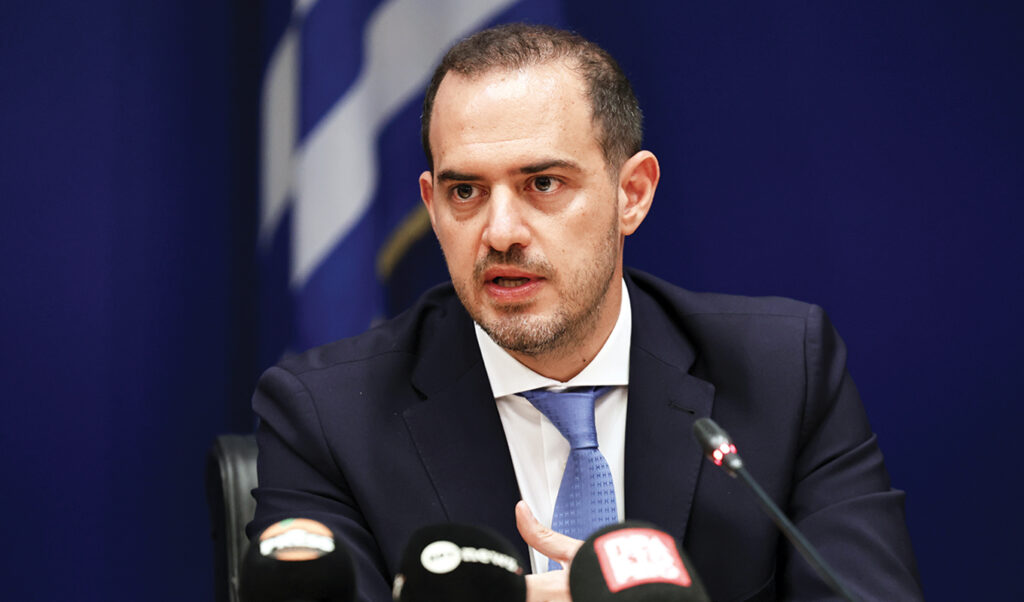
Attica will have a total of 1,700 buses by 2028, reveals Deputy Minister of Infrastructure and Transport, Giorgos Kotsiras, speaking exclusively to Parapolitika. The minister outlines the steps being taken to ensure reliable, high-quality mobility for all citizens and to strengthen safety across public transport networks.
Traffic congestion remains one of Attica’s biggest challenges. What is your plan for public transport — particularly for the metro and bus network?
Traffic congestion in Attica is a complex problem that requires cooperation between multiple ministries and local government, infrastructure projects, and a significant reinforcement of public transport. At the Ministry of Infrastructure and Transport, we are investing both in targeted road interventions and in the continuous upgrading of public transit services. The Skaramagkas Triple Junction — a project that had been pending for decades — is now moving into the implementation phase following the signing of the contract, and will make a substantial contribution to easing traffic flow, alongside the intervention at the Metamorfosi Junction on the Attiki Odos motorway. At the same time, public transport is being continuously strengthened. Attica currently has 1,076 new buses in service, with 125 new electric buses being gradually introduced, and our target is to reach 1,700 by 2028. Thessaloniki is also expanding its fleet with 50 new electric articulated buses. Simultaneously, work is progressing on upgrading rolling stock and infrastructure, hiring new personnel, and leveraging technology to improve the passenger experience. Our commitment is to deliver increasingly reliable and high-quality public transport services.
Three years after storms “Daniel” and “Elias”, when will the damage to the road and rail network be fully repaired — and what is the total cost of the restoration works?
The unprecedented destruction caused by storms “Daniel” and “Elias” required a comprehensive planning approach to restore infrastructure with greater resilience against extreme weather events. Rail and road works currently underway have a total budget of €1.35 billion, a significant portion of which is funded by the Recovery and Resilience Facility. Rail network contracts alone amount to €450 million. Works are progressing rapidly, with the aim of completing the restoration of the main line by the end of the summer.
We are implementing a comprehensive reform of the Greek railway system, in order to fully meet the needs of citizens and European standards of safety and reliability.
When will passengers be able to travel by train between Athens and Thessaloniki — and back — on a fully operational and safe line, with modern rolling stock?
Remote control and signalling systems are already operating across most of the Athens–Thessaloniki corridor and will be fully restored upon completion of the damage repair works caused by storms “Daniel” and “Elias”, along with the installation of the ETCS (European Train Control System). In parallel, the railway.gov.gr platform is already active on this route, enabling real-time train tracking with centimetre-level precision. The first new train to arrive in Greece in decades landed this month, a second is on its way shortly, and the remaining 23 are expected by the end of 2027, as part of the agreement with the FS Group. We are implementing a comprehensive reform of the Greek railway — with advanced safety systems, digital route monitoring, workforce development, and fleet renewal — with the goal of delivering a railway that fully meets citizens’ expectations and European safety and reliability standards.
New legislative provisions on electric scooters have been submitted to parliament. What are the key changes they introduce?
Road safety is a non-negotiable priority for the government and personally for Prime Minister Kyriakos Mitsotakis. In recent months, a series of serious road accidents involving electric scooters have been recorded, several of which involved minors. For this reason, we prioritised legislative action on scooters, establishing a stricter and more effective regulatory framework. Specifically, the new rules include a ban on electric scooter use by individuals under 17, mandatory insurance coverage, tougher penalties for dangerous violations, and heavy fines for businesses that sell, lend, or rent electric scooters to minors under 17. Greece has already made measurable progress in reducing fatal road accidents — and we are committed to continuing and strengthening that effort.
Among the five “landmark interventions” presented by Alexis Tsipras, the first is “free public transport for everyone.” How do you assess this proposal?
Real social policy in public transport is not about easy slogans. It means offering citizens more frequent services, shorter waiting times, new buses and trains, better infrastructure, and greater safety. International experience shows that universal free public transport does not, on its own, lead to a significant reduction in private car use. Moreover, nothing is truly free — the cost is ultimately borne by taxpayers. We are investing in upgrading public transport to make it continuously more attractive, more reliable, and more citizen-friendly.
Safety on public transport is a fundamental condition for public trust. What interventions are being implemented in this area?
The safety of passengers and workers is a constant priority for us. The “Ariadne” plan for the prevention and management of antisocial behaviour on public transport has strengthened the sense of security on buses, the metro, and the suburban railway. Over the past 16 months, nearly 284,000 inspections were carried out, resulting in over 3,000 detentions and 4,400 arrests. Our goal is to further strengthen the programme. The construction of reinforced security barriers in Thriasio, Thiva, and Zeugolatio will also contribute to the smoother operation of the suburban and intercity rail services. This intervention shields the rail network from illegal access and sabotage, benefiting the safety of passengers, workers, and local communities alike.
Published in Parapolitika