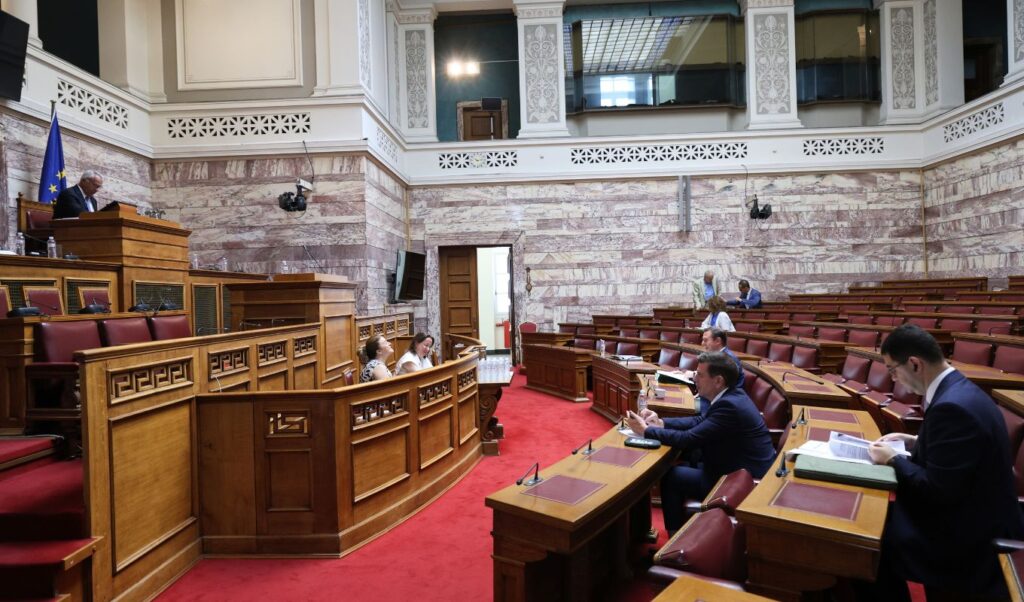
Objections to the introduction of an incompatibility rule between ministers and MPs — which would replace a sitting minister in parliament with the next runner-up candidate for as long as they serve in the Cabinet — were raised by a number of conservative ruling party MPs during today’s session of the Constitutional Revision committee. Characteristically, Yannis Kefalogiannis, New Democracy MP for Rethymno, argued that “I have submitted my views — this is a mistake. If one looks at other parliamentary systems, the British system, which is the cradle of modern parliamentarism, mandates a combined role of minister and MP.” For his part, Giorgos Kotsos, New Democracy MP for Karditsa, stressed that the minister-MP incompatibility rule “does not serve parliamentary credibility or governmental effectiveness.”
Objections were also raised by Charalampos Athanassiou, New Democracy MP for Lesvos, who argued that the potential institutionalization of an incompatibility rule should not distort the political system, expressing the view that such a provision would be better suited to presidential republic systems. Concerns over the minister-MP incompatibility rule were also voiced by Lefteris Ktistakis, MP for Boeotia.
“With the incompatibility issue, we are moving toward a different model of governance”
As the ruling party MP argued, “there have been comments, posts, and concerns about the role of MPs. I would like to remind everyone that MPs do not manage a single euro of public money. So if we assume that corruption problems exist where the money is, that is not happening in parliamentary offices.” He further noted that “we must also safeguard the reverse path — it cannot be considered that the work of a minister is incompatible with the role of an MP, while the opposite direction is treated as a blank slate.” He concluded by stating that “with the incompatibility issue, we are moving toward a different model of governance — I have not yet settled on whether that is necessarily a bad thing,” while also noting that in any case, the parliamentary implications of such a change would need to be carefully evaluated.