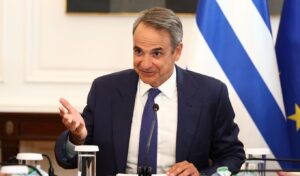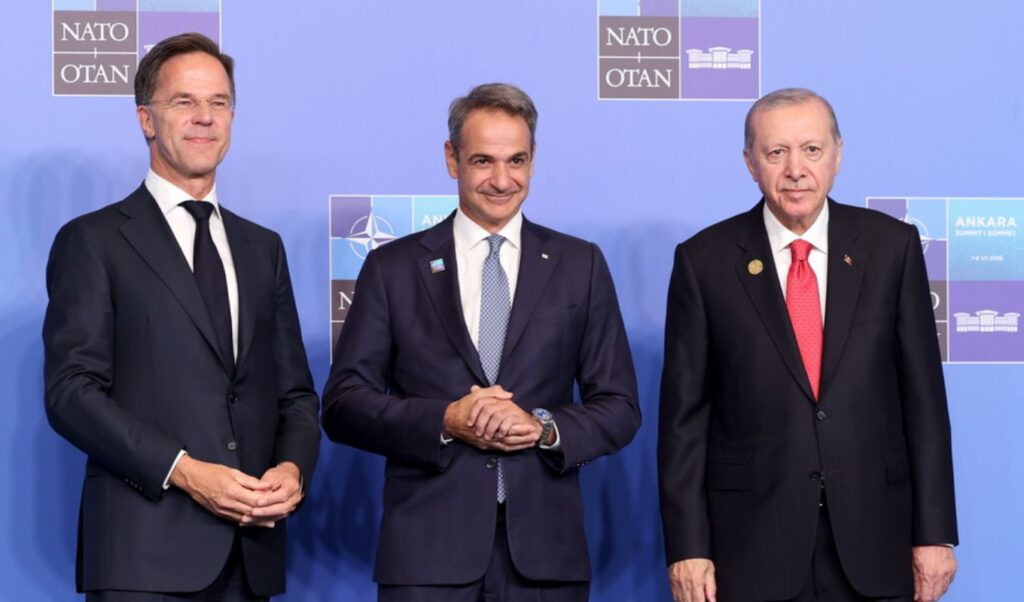
Greek-Turkish relations are entering a new phase, with Kyriakos Mitsotakis publicly raising the casus belli issue at the highest international forum attended by both countries. “The only thing I can say is that an Alliance must be grounded in the fundamental principle of good neighbourly relations,” the Greek Prime Minister stated upon arriving at the NATO Summit in Ankara, when asked about Donald Trump’s remarks that appear to pave the way for Turkey to acquire the F-35 fighter jets. He added, however, the following: “At a time when my country faces a casus belli from Turkey — should we exercise our lawful right to extend our territorial waters — I believe it must be clear that the sensitivities of all NATO members need to be taken into account. We are, after all, a defensive alliance, and I am confident that these outstanding issues can be resolved in the spirit of good neighbourly relations and cooperation.”
It is worth recalling that in his address to the United States Congress in May 2022, the Greek Prime Minister sent an indirect yet unmistakable message against the sale of American fighter jets to Turkey. “The last thing NATO needs, at a time when we are focused on helping Ukraine defeat Russia’s aggression, is yet another source of instability on the Alliance’s southeastern flank. And I ask you to keep this in mind when making decisions about defence procurement that concerns the Eastern Mediterranean,” he had said in a key passage of his speech. Just a few months later, the so-called “calm waters” policy began — a policy that has remained in place to this day, albeit with gradual “turbulence.”
Erdoğan’s reaction to Mitsotakis’ statements
Mitsotakis’ remarks caused visible irritation in Turkey, reflected both in media coverage and in the statements made by Recep Tayyip Erdoğan following the conclusion of the Summit. “The vast majority of my people don’t even know what the casus belli issue is. If you ask them, they won’t be able to tell you. That’s why I don’t think we should burden our people with these matters,” the Turkish President said, describing the Greek Prime Minister’s move as a “mistake.” He went on to add: “We made no comment about the defence systems Mr. Mitsotakis purchased. He can buy and sell whatever he wants. Turkey has the right to purchase them too.”
This came after Mitsotakis held a press conference in which he emphatically revived the issue of lifting the casus belli. He described it as “a historical anomaly” that, as he put it, “is inconsistent with the Athens Declaration, and with the positive climate we want to build as two neighbouring countries that, despite our differences, must learn to coexist peacefully and forge good neighbourly relations.” He also expressed his belief that other European leaders understand that such a threat of war is incompatible with the spirit of the Alliance. “I think the time has come to leave this behind us,” he concluded.
At the same press conference, the Prime Minister signalled that the Greek government does not consider it easy for the F-35 sale to Turkey to pass through Congress, nor does it wish to be seen as the primary obstacle to that sale. “It is not my place to comment on the choices of other countries, nor is Greece the one to dictate to the United States to whom it should or should not sell defence systems,” Mitsotakis said pointedly, adding: “I am simply making a factual observation — that at this moment there are significant legal obstacles under US law for Turkey to acquire the F-35s, because, let us not forget, the reason Turkey was removed from the F-35 programme was linked to its purchase of the S-400 system, a system that NATO and the United States consider to be directly incompatible with the F-35 programme itself.”
The Hatzivassiliou–Davutoğlu clash over Cyprus
It is also worth noting that, at the very same time these events were unfolding in Ankara, a heated verbal confrontation was taking place at the Economist conference in Lagonissi, between Greek Deputy Foreign Minister Tasos Hatzivassiliou and former Turkish Prime Minister Ahmet Davutoğlu. “This has been an invasion since 1974. You must accept reality,” the Greek Deputy Minister told his Turkish counterpart directly, after Davutoğlu had argued that Turkey’s presence in Cyprus is grounded in international law.