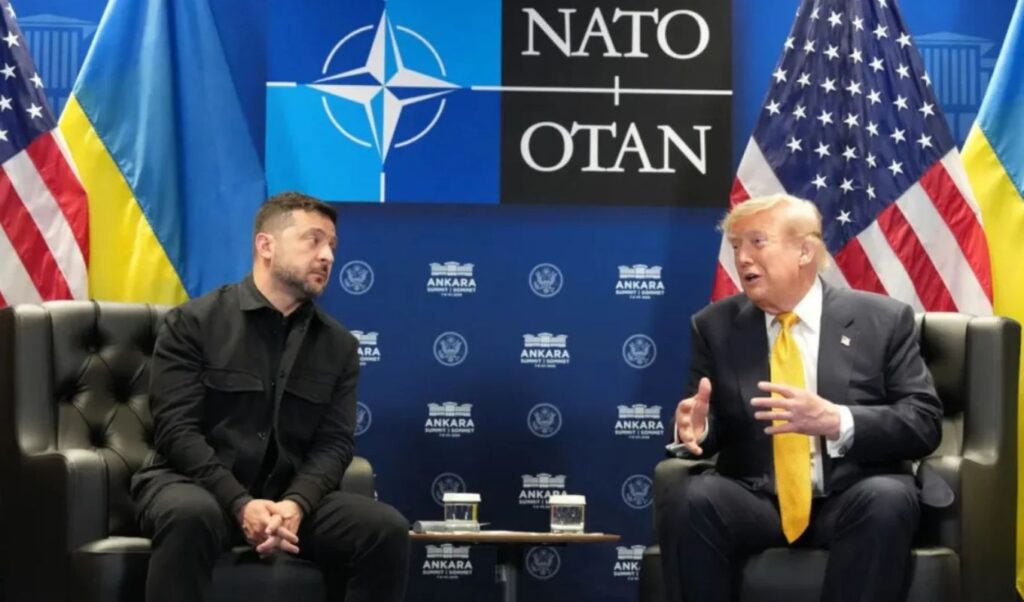
With commitments for at least €140 billion in military aid, plans for Patriot missile system production, and a push to strengthen the defense industry, Volodymyr Zelensky’s participation in the NATO summit in Ankara came to a close. Allies reaffirmed their long-term support for Ukraine, even as Moscow accused the Alliance of pushing Europe toward military escalation.
The final declaration of the NATO summit in Ankara reflects the Alliance’s strategic commitment to sustaining support for Kyiv over the long term — through financial assistance, military equipment, training, and expanded weapons production.
Member states pledged to provide €70 billion in military equipment, aid, and training for Ukraine in 2026, while also confirming they would maintain at least equivalent levels of support in 2027. The total commitment is therefore expected to reach at least €140 billion.
The aid is expected to come primarily from NATO’s European members and Canada, as the United States has significantly scaled back its financial support for Kyiv under President Donald Trump. Germany has already announced plans to support Ukraine with €11.5 billion in 2026.
In the text of the declaration, allies emphasized that they remain “united in their unwavering support for Ukraine in defense of its freedom, sovereignty, and territorial integrity.”
They also labeled Russia a “long-term threat” to the Euro-Atlantic community, stressing that support for Ukraine must be “fair, predictable, and sustainable over time.”
Ukraine as a “security provider” for NATO
The declaration makes specific reference to Ukraine’s role in Euro-Atlantic security, with allies noting that Kyiv now makes a significant contribution to the protection of the region.
This language reflects the deepening of the NATO–Ukraine relationship, despite the fact that Ukraine is not yet a member of the Alliance.
According to the final text, European allies and Canada now provide the bulk of assistance to Ukraine through bilateral and multilateral security arrangements.
NATO nations also welcomed the European Union’s decision to provide long-term financing for Ukraine through a €90 billion loan.
Trump: We’ll help Ukraine build Patriot missiles
Speaking about efforts to end the war, Donald Trump said that Volodymyr Zelensky wants a ceasefire, and suggested that “Putin wants the same.” He acknowledged, however, that the war between Ukraine and Russia is “not one of the easier ones” to resolve.
The US president described his relationship with Zelensky as “outstanding,” saying: “From the Oval Office to today, we’ve come a long way. But this isn’t the end — it’s a new beginning. Ukraine has a great future.”
Describing the push to end the war, he used the analogy of two children fighting in a park: “Two boys in a park who didn’t like each other and started fighting.”
Commenting on Ukrainian strikes against Russian oil refineries, Trump described them as an escalation that could, in his view, actually help bring the war to an end.
On the prospect of Ukraine producing Patriot missile systems, he said: “A little bird told me that we’re going to give them the right to build Patriots — we’ll show them how to make them. It’s technically very complex, but I think you’ll be able to do it, and quite quickly.”
Trump also said he would not rule out a visit to Ukraine, but only after the war ends. He suggested the US could close Ukrainian airspace, though he noted that following any agreement, such a step would no longer be necessary.
Zelensky: Cooperation with the US on drones
Volodymyr Zelensky thanked the United States for its support and for the PURL program, announcing that Kyiv and Washington are launching cooperation on a drone agreement.
He noted that the details of the deal would be discussed with Donald Trump. When asked by the US president whether he was prepared to travel to Moscow for negotiations, Zelensky replied: “That’s difficult — there are a lot of Ukrainian drones over there. It’s dangerous.”
New defense investments and ramp-up in weapons production
Beyond aid to Ukraine, NATO nations announced new defense procurement worth $50 billion. Allies committed to increasing the collective production capacity of the defense industry and to working more closely with industry partners to accelerate innovation.
Key investment priorities include enhanced troop deployment and support capabilities, long-range precision weapons, integrated air defense and missile defense systems, drones, advanced technologies, intelligence capabilities, military cloud solutions, and artificial intelligence.
NATO Secretary General Mark Rutte stressed that the focus now must be on implementation, stating: “The task before us is clear: to turn allies’ commitments into concrete results.”
Moscow’s reaction: “Irresponsible decisions that could lead to catastrophe”
Russia reacted sharply to the Alliance’s decisions, labeling NATO’s new commitments to Ukraine “irresponsible.” The Russian Foreign Ministry claimed that NATO member states had taken “irresponsible decisions that could lead to catastrophe.”
According to Moscow, these moves amount to the “militarization of the European continent.” Russian officials also accused European allies of preparing for “armed conflict with Russia,” further escalating tensions with the West.