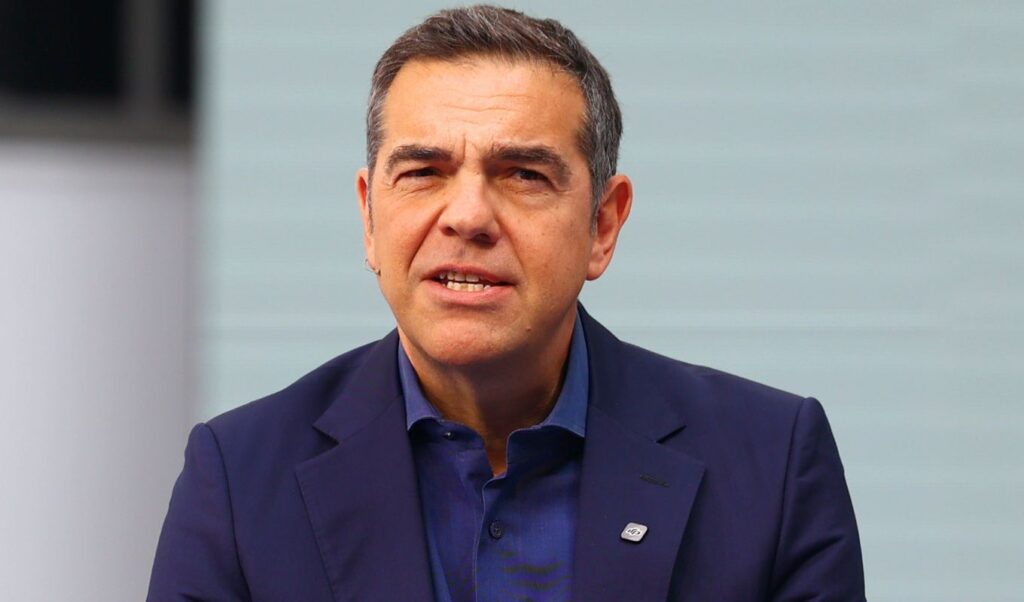
Former Greek Prime Minister Alexis Tsipras is expected to give strategic direction today at the first meeting with his party’s policy coordinators. According to sources, the former prime minister will outline how the 50 members of the leadership team should operate, highlighting the positions and views of ELAS (Greek Left), and will set the course on all key issues.
On Saturday, the National Council will convene, where the former prime minister is expected to formally launch the unofficial pre-election period, calling on all participating members to work with passion and dedication in their regions to secure victory. The party’s Secretary, Miltos Hatzigianakis, will also address the council, while members are expected to share their views.
Tsipras: His message on SYRIZA, political alliances, and the upcoming elections
Meanwhile, in an interview yesterday, Alexis Tsipras addressed the question of political alliances and explained his reasons for founding ELAS. “Many things are held against me, but no one has ever accused me of dishonesty,” he stated, making clear that “my goal is not to return to play the role of party leader, but to be genuinely useful to this country.” He added: “There was a need to fill a significant void in the political system and the broader progressive space. The early signs confirm this — they show a clear tendency to fill that gap. For three years, our country moved forward with a single dominant party and no strong opposition. And even with the best of intentions, the government became increasingly arrogant.”
When asked whether he was right to leave SYRIZA, Tsipras replied that “that historical chapter of SYRIZA has closed, and at that point I felt that my own chapter within it had closed too.” He was clear, however, that “I am opening a new chapter — with new faces but the same values, and with the need to unite broader forces. I want to be useful to democracy and to this country. We want to be a governing left, not a protest left.”
On the question of cooperation with SYRIZA, he said: “I’m not throwing a party and choosing who to invite. We are making a fresh start — within society, with society, and for society. From day one, I have been clear that no one is excluded, but under two conditions: first, this effort will not be born inside parliament — we want to start from within society, with new faces. If some members wish to resign their parliamentary seats, that is their choice. Second, there are no reserved positions for anyone. All members will be treated equally, but no seats are pre-allocated.”
He added that “it would have been the easy path for me — either to go back to where I came from, or to try to glue together the fragments of a space that did not fracture through any fault of its own.” On the prospect of working with SYRIZA specifically, he was characteristically direct: “This isn’t just about SYRIZA. Regarding pre- or post-election alliances: we were founded to fill a real and significant void — not to collaborate with forces whose own cycle has already run its course.”
“If we come first in the elections, we will seek to implement our programme. If not, we will go to a second round of elections to secure a clear mandate.” He noted that he maintains a social relationship with Socrates Famellos, holds no grudges against his former political allies, and clarified, regarding ongoing speculation, that “I did not come here to discuss Polakis’s problem with Famellos.”
On the issue of taxation — and in response to differing statements made by various ELAS members — Tsipras said: “The fiscal capacity of the Greek economy does not create a need to raise taxes in order to achieve our goals. The Greek economy is outperforming expectations by around €6 billion above its fiscal obligations. We will not tax middle- and lower-income earners, nor will we impose blanket taxes on higher earners. However, there must be a restoration of justice. Wealth is being concentrated in very few hands. If we want to address major challenges — such as the demographic crisis, hospitals, and schools — there must be redistribution from the powerful to society. This will not happen by taxing swimming pools or yachts. It will happen through a patriotic contribution — not a voluntary one — targeting the top 1%, the very wealthy, and the most profitable businesses. Greece taxes salaried workers more heavily than entrepreneurs. But before we talk about taxes, we need to grow the pie.”