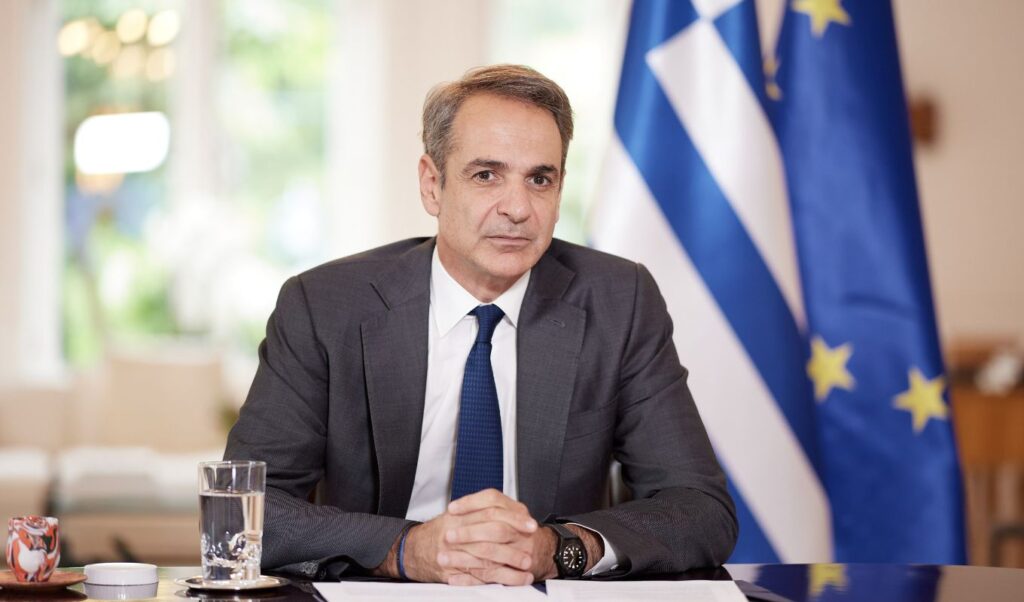
Prime Minister Kyriakos Mitsotakis emphasizes the government’s determination to confront every source of corruption and lawbreaking in his traditional Sunday post, following the dismantling of an extortion and bribery network in Athens urban planning departments. The Prime Minister stresses that the fight against corruption requires a plan, persistence and political will, noting that the case confirms authorities’ determination to conduct thorough investigations. “There are no safe havens, there are no untouchables,” he states characteristically, sending a message of zero tolerance toward criminal networks.
As he notes, the government is promoting the transfer of building permit issuance and control to the unified digital Land Registry, aiming to enhance transparency and limit phenomena of opacity and clientelist relationships.
In his post, Kyriakos Mitsotakis also refers to the progress of the state’s digital transformation through gov.gr, interventions in the healthcare sector, migration reforms, the labor market, railway network modernization, as well as cultural projects and urban regeneration across the country.
Full post by Kyriakos Mitsotakis:
Good morning everyone! I assume most of you are already moving – like me, as much as I can – to the World Cup rhythm. You know what I was thinking? How quickly we get used to major changes. Look at VAR, for example. When it first entered football, it seemed strange to us, it brought reactions and discussions. Today, however, no one can imagine football without it, because it brought a real revolution in the game’s reliability. It became, in other words, self-evident. This exact thought brings me to one of our very important milestones: these days gov.gr completes 6 years of operation. Here, of course, there were no doubts or reactions. We all embraced gov.gr from the first moment, because the need to escape bureaucracy was enormous. But the conclusion is the same: if you think about it, we got used to the good so quickly that we almost forgot what our lives were like six years ago. Back then, for a simple authorization, certificate or declaration, you had to waste an entire morning in queues and hassle. Today, we have 2,257 digital services that are processed from our computer or mobile phone, without travel, hassle and cost. In these 6 years, gov.gr has served more than 9 million citizens, more than 431 million documents and certificates covering all areas of daily life have been issued. The most important thing, however, is not the numbers. It’s that we proved the state can change. Become faster, simpler, more transparent and more citizen-friendly. And simultaneously reduce the sources of bureaucracy, opacity and corruption that tormented citizens and society for decades.
Do we stop here? Of course not. We have already put into operation the new Unified Digital CRM Infrastructure, so that every citizen and business request or case can be monitored in a unified way, whether it starts through gov.gr, through KEP offices, or through telephone service. I always believed that technology gives Greece a unique opportunity. Not just to cover the lost ground separating it from other European countries, but to lead in sectors where until a few years ago we thought we were lagging. And I’m confident that the best in this journey is still ahead of us.
This modernization, however, is not limited only to the digital state. It extends dynamically to our big bet, which is none other than the new National Health System. And when I say new NHS, I don’t refer only to the modernization of hospitals and health centers or new equipment, which are also progressing at fast pace. I refer to a different way of providing health services, where care quality will not depend on whether someone lives in Athens, on a small island or in a mountain village. The development of the National Telemedicine Network with 335 stations across the country fits into this logic. 329 have already been installed and by the end of June, doctors and patients will be able to connect in real time, regardless of distance. Together with the 3,000 home monitoring systems for patients with chronic diseases and the telemedicine equipment that Mobile Health Units will have, we take another step so that health services reach the citizen and not the citizen being forced to travel to find them.
Another important reform is the “bracelet” in Emergency Departments. Now, digital patient tracking is applied in 73 hospitals – and continuously expanding – with results in waiting times in EDs being very encouraging: just in May, over 280,000 cases in connected hospitals had average service time below the annual average. At KAT, which had the highest nationwide attendance (10,300 cases), the average service time was 2 hours and 37 minutes. Also, this week two more renovated Emergency Departments were delivered – at “Korgialenio-Benakeio” General Hospital and Kastoria Hospital, two Health Centers – in Argos Orestiko and Litochoro, and the new Cardiology Clinic at Kifisia General Oncology Hospital “Agioi Anargyroi”.
I close health topics with an initiative I consider particularly important, because it concerns an aspect of care that in our country we discussed much less than we should have. For the first time, Greece acquires a National Strategy for Palliative Care, aiming by 2030 to have a comprehensive support system for people living with serious and life-threatening diseases, as well as their families. Palliative care concerns quality of life itself. Pain and symptom management, psychological support for the patient, maintaining their dignity throughout the illness, but also supporting their loved ones. The first specialized beds will be created at the new Thessaloniki Children’s Hospital “Stavros Niarchos,” while structures already offering this valuable work are simultaneously recognized and integrated into the system.
Let’s move now to bills voted in Parliament. The first concerns regional television station licenses, a pending issue that remained open for almost three decades and was voted with broader consensus. Until today, regional channels operated under a temporary regime. Now, however, we establish a stable operational framework, with clear rules, transparency and objective licensing criteria, giving these channels the opportunity to broadcast in high definition (HD), invest more in their programming and strengthen their employment positions. It’s an institutional intervention that should have been made years ago and whose importance exceeds the television landscape itself. And I’ll explain. Regional media constitute the main source of information and public dialogue for many local communities. Their ability to operate with stable rules, invest in their programming, utilize modern technologies and maintain jobs benefits information, regions and ultimately democracy itself. We definitively leave behind a temporary regime that lasted excessively many years. The same bill included a regulation that solves a chronic and fair demand from journalists at ERT, APE-MPE and the General Secretariat for Communication and Information regarding recognition of their prior service, also a fair demand.
The second important bill voted this week concerns an issue that concerns all of Europe and is none other than migration. By establishing necessary national provisions, our country adapts to the new European Pact on Migration and Asylum, which provides for stricter protection of external borders, faster asylum procedures and greater support for member states on the front line of migration flows, like Greece. Our country had a leading role in shaping this new European policy, as for years it argued that migration management cannot be the exclusive responsibility of first reception states. Additionally, let me say that together with 4 other countries we lead the initiative to create “return hubs” in third countries outside the EU for migrants whose asylum applications are definitively rejected and whose countries of origin will not accept their repatriation. Instead of staying in closed facilities, as happens today in Greece, they will be transferred to “return hubs” operating outside the EU. This is provided for by the new European Pact and our goal is for the first agreements for creating these structures to be concluded in 2026, so they are operational from 2027.
Remaining in Parliament “climate,” the Constitutional Revision Committee was formed and has a two-month deadline to submit its report with provisions to be revised. New Democracy approached the discussion with specific and complete proposals for upgrading our Constitutional Charter – I won’t repeat them – but I want to highlight the hypocritical stance of opposition parties and especially PASOK. The main opposition declared that even if New Democracy proposes for revision an article that PASOK has proposed, PASOK MPs will not vote for their own proposal! I admit I find it difficult to understand this logic which additionally betrays insecurity – despite claims to the contrary – about PASOK’s position in the next elections. When we discuss the Constitution, the goal should be seeking the broadest possible consensus and not rejecting a proposal only because the political opponent submits it. I hope, as the process progresses, the logic of consensus will finally prevail and not the logic of petty partisan confrontation.
Let me now turn to news concerning the labor market and addressing unemployment. This week we announced 1,000 new jobs for people with disabilities in the Regions, which come in addition to the 3,000 positions already existing in Municipalities. I know that for many of our fellow citizens with disabilities, finding work continues to be more difficult – and it shouldn’t be. That’s why we persist in policies that create more employment opportunities and more participation opportunities in the labor market.
Very important news from last week also concerns railways. Signaling and remote control were put into full operation on the Thessaloniki-Eidomeni section, with 75 kilometers of new, modern traffic control systems being added to the network. This is another intervention part of the overall network modernization, which continues with projects underway in Thessaly.
Another equally important event is the dismantling of the extortion and bribery network in Athens urban planning departments by the Hellenic Police.
It’s an event that confirms, in the most emphatic way, that the battle against corruption is not won with wishful thinking, but with planning, persistence and political will. Nine months ago, from the TIF podium, I had announced an emblematic reform: transferring the critical work of issuing and controlling building permits from scattered municipal structures to the new, unified and digital Land Registry. Because we know that sources of opacity and clientelist dependencies are more effectively addressed when the state acquires modern tools of control, transparency and accountability. The message is clear: there are no safe havens, there are no “untouchables.” Just as we clashed through the now independent AADE with all kinds of networks in local tax offices, so we clash with every network of lawbreaking in local urban planning offices. We will continue hitting every pocket of corruption, no matter how powerful it thinks it is. This case was investigated and brought to Justice following an anonymous complaint to the Hellenic Police. Which means every complaint is investigated and if substantiated goes all the way. That’s why I call on citizens to trust the authorities and not hesitate to report when they face such cases. This determination is accompanied by work with measurable impact. Just last month we completed the country’s land registration at 99%, closing a nearly two-hundred-year pending issue for the Greek state. We have set 2030 as the horizon, so Greece has fully organized spatial planning and clear land uses in every corner of our homeland. It’s a “silent” but deep reform that strengthens legality, enhances development and restores the citizen’s trust relationship with the state. Because, ultimately, when there’s will, the state can take on anyone and win.
I started the review with gov.gr’s digital revolution and now I’ll refer to another digital tool that concerns accelerating justice delivery. Consider that today there are cases of appeals against payment orders and enforcement acts that have received hearing dates even for 2038! Only in Athens Court of First Instance about 36,500 such cases are pending. So what do we do? With the new Electronic Appeals Platform, which will be put into full operation from September 1st to inform all involved, the possibility is given to drastically accelerate their clearance, even by a decade. It’s another intervention that utilizes technology to address chronic justice dysfunctions.
Let me go now to Thessaloniki, where the Metropolitan Park Pavlos Melas opened its gates, a space that western Thessaloniki had been waiting to acquire for many years. A former 340-acre military camp is gradually being transformed into a large space of green, walking, recreation and culture, open to everyone. The new “Thessalonikeon Metropolis” Museum is already operating, hosting important finds from Thessaloniki Metro excavations, while work continues with renovation of more buildings and public spaces in coming years.
And since I mentioned projects that change the image of cities, yesterday in Rhodes I had the opportunity to walk in the archaeological site of Pervola, which has now been configured as an open museum. The ancient Neoria, the Roman Tetrapylon and the Palace Gardens of the Grand Master compose a unique journey through the island’s history. It’s truly an impressive renovation, which I recommend you visit, since we also have summer!
I close… cinematically, with news that gave me particular joy. Greece will be the Guest of Honor at the Marché du Film of the Cannes Festival in 2027. If we also consider that in September our country will be honored at the Venice Film Festival, while a few months later Athens will host the European Film Awards, it becomes clear that Greek cinema and audiovisual production are gaining increasingly greater international presence. It’s a development that justifies the systematic work done in recent years by the Ministry of Culture and EKOME to support Greek creators and make Greece an attractive destination for international productions. Congratulations to everyone!
Before I say goodbye, let me make a reference to today’s World Blood Donor Day. Voluntary blood donation is an act of offering with invaluable worth, reminding us that solidarity is not expressed with big words but with simple actions that can save lives. A big thank you to all volunteer blood donors in our country. And I wish this day becomes an occasion for even more of our fellow citizens to become volunteer blood donors. Have a good Sunday!