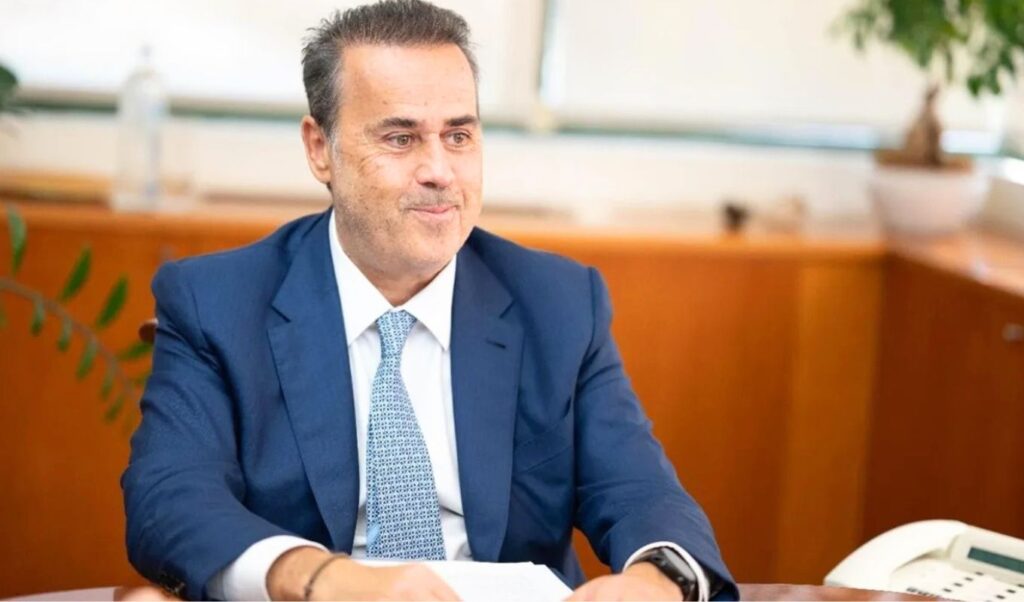
An intense week with strong energy and geopolitical implications was completed in the United States by Environment and Energy Minister Stavros Papastavrou, conducting a series of meetings that extended from Washington to Houston and from energy diplomacy forums to the headquarters of the world’s largest oil companies. Within just a few days, the minister met with US Energy Secretary Chris Wright, participated in crucial regional energy processes, and had contacts with top executives from the international energy industry.
Read: Eastern Mediterranean at the center of new energy geopolitics – Papastavrou’s contacts in the USA
If one follows Stavros Papastavrou’s trip from end to beginning, the thread of developments leads to one specific development: the establishment of the East Med Energy Center (EMEC), a new institution that aims to become the permanent cooperation center between Greece, Cyprus, Israel, and the United States.
The relevant declaration was signed in Houston, on the sidelines of the 3+1 format ministerial meeting. The minister characterized the development as a “historic moment,” noting that the new center aims to become the permanent institution through which the four countries will coordinate initiatives for energy security, economic cooperation, innovation, and regional connectivity. There appears to be more news coming next week in Athens.
During his meeting with Chevron leadership in Houston, Stavros Papastavrou informed the American side that necessary approvals for Block 10 are progressing and invited them to the Greek capital to complete the final steps of the process. All that remains now is the signing of the Farm-In Agreement between Chevron and HELLENiQ ENERGY, which will lead to the official entry of the American energy giant into the concession with a 70% stake and taking on the operator role. It should be noted that at the end of May, the two companies submitted a joint application for Chevron’s participation in Block 10, off the Kyparissiakos Gulf, as well as for transferring the operator role from HELLENiQ ENERGY to the American company.
The minister briefed Vice President of Exploration Kevin McLachlan on all developments regarding concessions where Chevron has a presence. From Chevron, Mr. Papastavrou moved to ExxonMobil, where he met with the head of the company’s exploration programs for Europe and North Africa, Neil Hartley. On the table were Middle East developments, the increasingly important role of the Eastern Mediterranean on the hydrocarbon map, and the preparation progress for the exploratory drilling scheduled for the Northwestern Ionian in February 2027. The Houston contacts confirmed that the “engines” of the Greek hydrocarbon program have now been set in motion.
Vertical Corridor among key topics on Washington’s agenda
The Vertical Corridor was also one of the main topics on Washington’s agenda. From the Global Energy Forum platform of the Atlantic Council, Environment and Energy Minister, US Department of Energy Special Envoy Joshua Volz, Gastrade CEO Kostis Sifnaios, and former US Deputy Secretary of State Jeffrey Pyatt highlighted the project’s role in supplying Central and Southeast Europe with American LNG through Greece.
The corridor’s extension to Hungary, Slovakia, and the Western Balkans, the need for long-term LNG supply agreements and capacity reservations in infrastructure, as well as removing regulatory barriers that continue to limit the project’s development monopolized interest. Eyes are also on the long-term capacity reservation auction scheduled for early July, considered crucial for the route’s commercial utilization.
This development aligns with efforts to expand the route to Hungary, Slovakia, and the Western Balkans, while discussions proceed for new agreements with regional countries, including Romania, Bulgaria, Ukraine, Serbia, and North Macedonia. As Mr. Papastavrou stated from the US, “after decades during which natural gas flowed from East to West, we now have a Vertical Corridor bringing American LNG to Greece and through Bulgaria and Romania reaching Moldova and Ukraine.”
During his transatlantic trip, Mr. Papastavrou also had a bilateral meeting with Egypt’s Minister of Petroleum and Mineral Resources, Karim Badawi. The focus was on the Greece-Egypt electrical interconnection (GREGY) and cooperation prospects in carbon capture and storage (CCS). However, the Vertical Corridor was also on the discussion table in this case, which Cairo appears to be considering as a potential route for transporting Egyptian LNG to Central and Southeast European markets through Greece. This prospect was also highlighted during the East Mediterranean Gas Forum ministerial meeting in Washington, where Karim Badawi made special reference to the importance of Greece-Egypt cooperation for connecting Eastern Mediterranean natural gas markets with Europe. According to the Egyptian approach, Greek LNG terminals and the Vertical Corridor can function as the main gateway for channeling Egyptian natural gas quantities to European markets.
The agenda unfolded on the other side of the Atlantic demonstrates that Greece is trying to seize the opportunity created by the era’s geopolitical and energy reshuffling, moving simultaneously on multiple fronts.
Published in Sunday’s Afternoon Edition