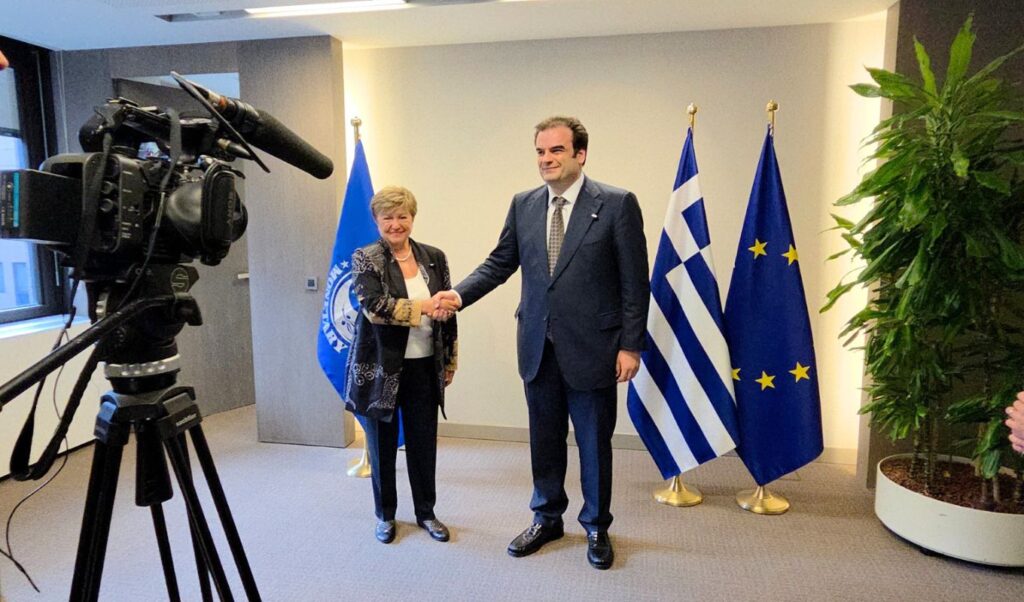
“Congratulations to Greece for what it has achieved,” said International Monetary Fund Managing Director Kristalina Georgieva, during her meeting with Minister of National Economy and Finance and Eurogroup President Kyriakos Pierrakakis, in Brussels, where she praised our country for the spectacular progress of its economy and the new role it now plays as a force for stability and reforms. The meeting took place on the occasion of Greece’s participation in SEETAC (Southeast Europe Regional Technical Assistance Centre), the IMF’s new Regional Technical Assistance Centre for Southeast Europe, in which Greece participates as a founding partner. “The country today ranks among Europe’s top economies”, added Ms. Georgieva referring to Greece, with Mr. Pierrakakis noting in his statements that our country “confirms its leading role in Southeast Europe”.
IMF director: “I want to recognize Greece’s remarkable journey”
Specifically, after the meeting, the IMF Managing Director stated: “Thank you very much. My mission today is to express my deep gratitude to Greece for its partnership with the IMF in an effort to strengthen the capabilities and expertise of countries aspiring to join the European Union.
At the same time, I want to recognize the remarkable journey of Greece, a country that faced serious difficulties during the Eurozone crisis, but has emerged as a country that today ranks among Europe’s top economies. It is one of only five countries recording a fiscal surplus, and this surplus gives it the ability to generously share its experience and financially support countries advancing in their accession process to the European Union.
Let me close with two messages: First, congratulations to Greece for what it has achieved, for its spectacular progress and for the leadership that brought the country to where it stands today. Your role has been decisive.
And second, I wish every success to the new Centre, the 18th in the IMF’s family of regional centers, and I welcome Greece as a founding partner of this new venture. This is a new era of cooperation between Greece and the IMF: from recipient of technical assistance to provider of expertise to others.”
Pierrakakis: practical expression of Greece’s leading role in the broader region
For his part, Mr. Pierrakakis stated: “Dear Kristalina, it is a great joy to have you with us today, you, the Managing Director of the IMF, on a day marked by this important announcement we just made: Greece’s participation in SEETAC, the IMF’s Regional Technical Assistance Centre for Southeast Europe.
This participation will be supported by Greece’s annual contribution of 1 million euros, with a five-year horizon. However, I would like to emphasize that, as you also pointed out, this is not just a financial commitment. It is primarily about the expertise and knowledge we gained through implementing reforms. Because it is precisely these reforms that create sustainable fiscal surpluses and sustainable economic growth rates.
I would like to focus on two points. First, this decision has strong symbolism. It sends a powerful message from our side. Because Greece was once a country that participated in an IMF program, while today it is transformed into a country that contributes reform experience, knowledge and expertise to countries in the Western Balkans and Moldova.
And second, it constitutes a practical expression of Greece’s leading role in the broader region, which for us is accompanied by greater responsibility: to contribute to accelerating convergence among the countries of the region, to strengthening their resilience and to promoting greater prosperity for all.
Thank you again warmly for being here with us today. I look forward to continuing our discussions both today and at tomorrow’s Eurogroup in Luxembourg.”
Greece’s participation in SEETAC – new phase of cooperation with IMF
According to a ministry announcement, Greece’s participation in SEETAC represents a new phase of the country’s cooperation with the IMF and strengthens its role as a factor of stability, reforms and knowledge transfer in Southeast Europe.
Greece will contribute 1 million euros annually for the next five years (total 5 million euros), and will participate in the Centre’s Steering Committee, acquiring an institutional role in shaping its strategic priorities, approving annual work programs and monitoring their implementation.
SEETAC constitutes the IMF’s new Regional Capacity Development Center for Southeast Europe. It will cooperate with Albania, Bosnia-Herzegovina, Kosovo, Montenegro, North Macedonia, Serbia and Moldova, aiming to strengthen economic institutions and policy formulation in the region’s countries.
Its operation will focus on critical areas of economic governance, such as fiscal policy, tax administration, public financial management, monetary and financial policy, macroeconomic frameworks and forecasts, statistical systems, as well as legal and institutional issues. Support will be provided through technical assistance, training programs, knowledge exchange and practical advisory support.
The initiative gains particular significance at a time when the European Union is bringing enlargement back to the center of its strategic agenda. Through its participation in the Centre, Greece will actively contribute to preparing the region’s countries for their European path, utilizing the experience it gained from reforms and modernization of its institutions in recent years.
The initiative gains additional significance in view of the Greek presidency of the European Union Council during the second half of 2027, when enlargement and the European perspective of the Western Balkans are expected to be top European priorities.
SEETAC is integrated into the IMF’s global network of Regional Capacity Development Centers and is expected to begin operations by January 2027. It will be headquartered in Rome and will operate as the IMF’s regional office for Southeast Europe.
According to the ministry, Greece’s participation also has an additional special symbolism. A country that a few years ago was in an economic adjustment program and received technical and financial support from international organizations is now among the countries that actively contribute to financing and transferring expertise to other countries. From a country that received aid, Greece is evolving into a country that shares experiences, knowledge and best practices with its neighbors and practically supports their European path.