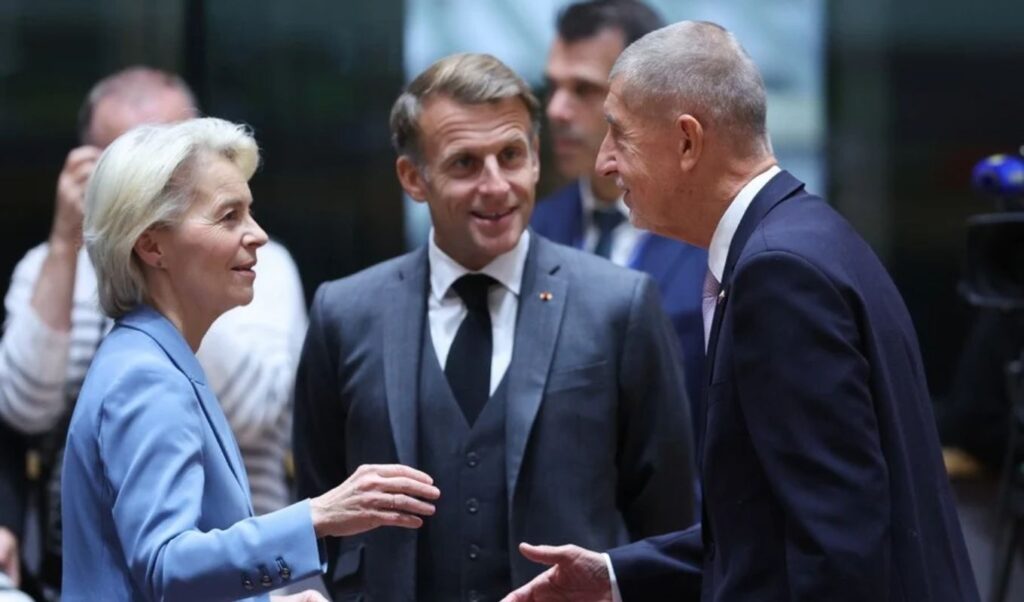
The European Union Summit in Brussels has become a arena of intense political and economic negotiations, with leaders of the 27 member states searching for common ground on the next seven-year budget, tackling the energy crisis, and continuing support for Ukraine. Disagreements remain sharp, as European capitals appear deeply divided both on the overall level of EU spending and on how resources should be allocated. At the same time, the political calendar is adding extra pressure to the talks, with French President Emmanuel Macron effectively setting the end of 2026 as the deadline for reaching an agreement.
Read also: EU Summit: Top-level clash over money, energy, China and Ukraine — Mitsotakis’ red lines
Macron: “From January onwards there will be no political room”
According to Politico, citing four European diplomats, Emmanuel Macron warned fellow leaders during the closed-door session on the evening of Thursday, October 15, that the agreement on the new European budget must be finalized before 2027 begins. The French President reportedly explained that, given the presidential elections scheduled for April 2027, he would not have the necessary political room to sign off on such a significant fiscal agreement during the pre-election period. “From January onwards there will be no political room,” he is reported to have said, according to one of the diplomats briefed on the discussion.
His intervention is being interpreted as a clear signal to European governments that the December Summit may represent the last real opportunity for a political compromise before France enters its election campaign mode.
A €1.622 trillion budget and a deep rift among the “27”
At the heart of the deliberations lies the new EU Multiannual Financial Framework for the period 2028–2034, which will set the bloc’s funding priorities for the next seven years. The Common Agricultural Policy, regional cohesion, boosting European competitiveness, defence, and financial support for Ukraine are the main battlegrounds, as member states are being asked to divide limited resources among ever-growing needs. The compromise proposal put forward by the Irish presidency envisages a budget of €1.622 trillion — a reduction of €141 billion compared to the European Commission’s original proposal.
Even this revised version, however, does not appear to be bridging the divide. On one side, Germany, Sweden, and the Netherlands — countries known for their strict approach to EU spending — are insisting on the need to keep the budget in check, citing pressures on their national public finances. On the other side, France, Italy, Spain, and other countries are expressing concern that the cuts would limit the EU’s ability to fund critical policies and respond to new economic and geopolitical challenges.
Merz: Negotiations will be difficult and time-consuming
The scale of the disagreements was also reflected in the words of German Chancellor Friedrich Merz, who warned that European leaders are still far from reaching an agreement. Commenting on the December Summit, he suggested that the talks could last longer than usual, remarking pointedly that participants should make sure to bring extra shirts.
His comments reflect the difficulties expected in the final rounds of negotiations, as the differences go beyond the overall budget figure and extend to individual funding allocations. Sweden has already rejected the proposed negotiating framework, while Spanish Prime Minister Pedro Sánchez described the compromise proposal as “clearly insufficient” and “unacceptable for Spain.”
The reactions from across the European political spectrum illustrate just how difficult it remains to strike a balance between fiscal discipline and the need to strengthen common European policies.
Mitsotakis pushes for relaxation of fiscal rules
Alongside the budget negotiations, European leaders are also grappling with the challenge of high energy costs, which continue to weigh heavily on households and businesses.
Greek Prime Minister Kyriakos Mitsotakis intervened in the relevant discussions, calling for greater flexibility in the application of European fiscal rules, so that governments can fund support measures to counter high energy prices. The Greek proposal centres on making use of the additional tax revenues generated by inflation, with the aim of channelling part of those resources back into the real economy.
According to Politico, Athens argues that existing EU spending limits restrict member states’ ability to deploy available fiscal resources for subsidies, energy interventions, and energy efficiency programmes. In essence, Greece is seeking to create additional fiscal space for targeted interventions, without jeopardising broader stability objectives.
The Commission’s reservations and the spending dispute
Athens’ proposal is, however, not finding favour with the European Commission, which has already rejected similar requests from Greece and Italy for greater fiscal flexibility. The European Commission argues that the inflationary impact has already been factored into the way the existing fiscal rules operate, and has expressed fears that additional exemptions could undermine efforts to keep public spending under control.
The disagreement highlights a broader dilemma facing the European Union: how to enable governments to protect citizens and businesses from rising prices without disrupting fiscal balance.
Austrian initiative on electricity prices
On the energy side of the Summit, Austrian Chancellor Christian Stocker also weighed in, reviving a proposal he had first put forward in June for greater transparency in the functioning of European electricity markets. The Austrian initiative focuses on the wholesale market pricing mechanism, where natural gas frequently sets the final price of electricity — even when a significant share of electricity generation comes from cheaper energy sources.
“Only if we know exactly how energy prices are formed can we move on to the next steps,” a European diplomat said, describing the rationale behind the Austrian proposal. Also on the table are possible interventions in the EU Emissions Trading System, with some governments calling for temporary changes to help contain energy costs. Other countries, however, are warning that weakening the mechanism could harm investment in clean energy and undermine key European climate policy objectives.
Among the options under consideration are a windfall tax on energy companies’ exceptional profits, reductions in certain energy-related levies, and the granting of targeted state aid. So far, however, no common European position has emerged either on the scope of the measures or on how they would be financed.
Ukraine and defence add further pressure on the EU budget
Additional strain on the negotiations is being created by the growing funding needs of Ukraine and new demands for strengthening European defence. The European Union has agreed to provide a loan of €90 billion for the 2026–2027 period, of which €60 billion is earmarked for military support and €30 billion for budgetary assistance.
Despite this agreement, questions remain open regarding how Kyiv’s financing needs in 2027 will be covered, while the ongoing armed conflict with Russia is adding to the uncertainty. At the same time, European governments are being called upon to increase their defence spending — a factor that makes it even harder to reach a compromise on the priorities of the new EU budget.
Countdown to the December Summit
With disagreements remaining substantive and fiscal demands on the rise, the push to reach an agreement is turning into a race against the clock ahead of the December Summit. Emmanuel Macron’s message that from January 2027 there will no longer be the necessary political room to conclude the negotiations adds yet another pressure factor to an already challenging process.
For European leaders, the task is no longer simply to find a numerical compromise on a €1.622 trillion budget, but to forge a common strategy that combines fiscal stability with economic growth, energy security, and the bloc’s heightened geopolitical demands.
The coming weeks are therefore expected to be decisive in determining whether the European Union will manage to bridge its internal divisions and put in place the economic and political framework for the 2028–2034 period in time.