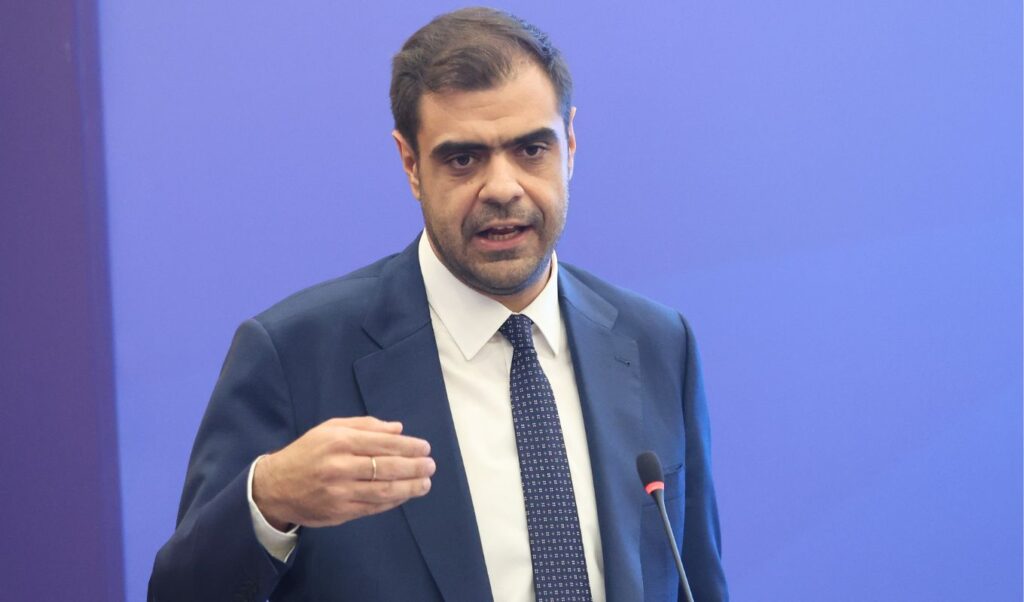
Government spokesperson Pavlos Marinakis addressed the measures to be announced at the Thessaloniki International Fair (TIF) and the cost of living crisis, which the government has set as its absolute top priority, stressing that the TIF measures will be permanent in nature and will apply to all citizens.
Pavlos Marinakis spoke about the government’s economic policy, tackling imported inflation, support measures for households and self-employed workers, and public debt management ahead of the TIF announcements. He also addressed the housing crisis, Greece’s strategy on national issues, Greek-Turkish relations, digital protection for minors, online identity verification, and the modernization of public infrastructure.
Marinakis: The cost of living is the absolute top priority
In an interview with News24/7, the government spokesperson began by addressing the significance of the early debt repayment on citizens’ everyday lives. He stressed that the most pressing problem facing Greek society — particularly the middle class and lower-income households — is imported inflation, which the government has designated as its absolute top priority. However, he drew a clear distinction from the opposition, emphasizing that offering unsubstantiated promises for short-term popularity does not solve real problems.
He underlined that government policy is built on securing the required revenues not through overtaxation, but through tackling tax evasion, creating new jobs, and cutting taxes and contributions. Reflecting on the causes of the debt crisis and the bailout memoranda, he explained that from 1980 onwards, for decades the country lived beyond its means due to political competition over who could appear more generous, mortgaging the future of the next generations. The current early repayment of public debt may not have an immediate impact on citizens’ wallets, but it represents a critical condition that boosts economic credibility, attracts investment, increases exports, and creates new jobs. He also responded to opposition criticism by clarifying that, under European fiscal rules and expenditure ceilings, these funds cannot legally be redirected to benefits — but faster repayment saves resources on interest payments and safeguards the country’s future.
TIF measures will be permanent and will apply to all citizens
Regarding the measures to be announced at the Thessaloniki International Fair, ahead of the Prime Minister’s upcoming announcements, the government spokesperson outlined two core principles. First, that measures are announced only after the required funding has been secured in advance, in contrast to the irresponsible promises of the past. Second, that all of Kyriakos Mitsotakis’s announcements will be reflected in the budget and implemented in practice.
On the 13th pension payment: Mr. Marinakis clarified that fully restoring the 13th and 14th pension installments as well as the 13th and 14th monthly salary would require a total of eight billion euros — a sum that simply does not exist, as available resources amount to just over one billion. He acknowledged that imposing income criteria is often unfair to middle-income pensioners who genuinely need support, but stressed that it is unavoidable given the limited resources available. The government’s goal, he said, is the fair distribution of available funds through permanent measures targeting pensioners, public and private sector employees, and self-employed workers, while avoiding temporary one-off bonuses.
On addressing the housing crisis and whether a “My Home III” program will follow: On the housing issue, he highlighted the success of the “My Home I” and “My Home II” programs, which helped more than 30,000 young people purchase their own home. While he did not rule out a future equivalent program if the necessary resources are found, he emphasized that the real solution lies in expanding tax incentives and benefits. The aim is to channel more properties onto the market, increase housing supply, and thereby stabilize or bring down rents.
On Airbnb: The government spokesperson argued that short-term rentals are not the primary cause of rising rents, with the bigger problem being vacant and closed properties. For this reason, the government offers tax exemptions and renovation grants of up to €36,000 for those who convert short-term rentals into long-term leases or open up vacant homes, while also imposing restrictions in high-pressure areas. He further suggested that, in the long term, more drastic measures should be considered to make keeping a property vacant financially unviable, while making clear that the housing issue requires time and complex solutions.
On support for the self-employed and presumptive taxation: Mr. Marinakis noted that anti-tax evasion measures — such as electronic payments and the IRIS payment system — have increased public revenues despite tax cuts. He acknowledged that the imposition of presumptive tax assessments has frustrated many self-employed workers, but stressed that the objective is not to keep them permanently. If other tax compliance measures prove effective, the government intends to examine a gradual abolition of presumptive taxation for compliant taxpayers who meet their obligations, such as using POS terminals and the work card system.
On Tsipras’s return
Commenting on Alexis Tsipras’s interventions, the government spokesperson said that no political opponent should be underestimated, but criticized the attempt to rebuild a narrative that life was better in 2019. He cited data showing that youth and female unemployment has been cut nearly in half and that 600,000 new jobs have been created between 2019 and today, despite a succession of international crises, the pandemic, and wars. He stressed that comparing the current period to the SYRIZA years of governance is an insult to citizens’ intelligence, as the economy back then was a laggard in growth, while today investment and exports are surging.
On inflation and disposable income
Mr. Marinakis acknowledged the pressure that rising prices place on households, but argued that the government is exhausting every avenue available to boost income based on actual revenues. He noted that in monthly inflation indices, Greece frequently performs better than the European average, particularly in food prices, while making clear that this is not cause for celebration but that the political exploitation of an international problem would be wrong. What matters, he said, is ensuring that the country does not return to the kind of policies that would mortgage the future of the next generations.
On Turkey and marine parks
On the subject of foreign policy, he used the analogy of an athlete to explain that Greece’s marine parks were designed strictly in accordance with international law, within national jurisdiction and with European Union approval, delivering tangible results. By contrast, Turkey’s challenges and unilateral maps are illegal actions with no international standing, often serving as PR fireworks directed at a Greece that has grown stronger through EEZ delimitation agreements, the extension of nautical miles, and defense procurement programs.
On Turkish provocations and Samaras’s statements
Responding to the criticism of former Prime Minister Antonis Samaras, the government spokesperson reminded that all former prime ministers — including Mr. Samaras himself — met with the Turkish President even during periods of heightened Turkish provocations, following the national line of dialogue. He noted that it is easy to adopt more aggressive rhetoric when out of power, and emphasized that the current government combines dialogue with a decisive strengthening of the country’s deterrent capabilities.
On whether there is a risk of Greece being drawn into war
Mr. Marinakis gave an emphatic assurance that there is absolutely no risk of Greece being directly drawn into the armed conflicts in the region. He did, however, note that the international situation remains highly volatile and that the country keeps its Armed Forces on alert, with operational assets deployed as deemed necessary to safeguard national security.
On the transfer of Patriot missiles from Karpathos to Crete
Regarding the operational repositioning of air defense systems, the government spokesperson declined to engage in tactical analysis, criticizing those who seek to construct narratives of capitulation. He underlined that over the past seven years, the most significant steps in the country’s modern history have been taken to strengthen national defense and foreign policy.
On social media and minors
Mr. Marinakis addressed the need to protect minors from the dangers of the digital world, citing international initiatives to restrict mobile phone use in schools and encourage a return to traditional learning. He stressed that the indiscriminate use of social media undermines children’s critical thinking. He also backed the Greek proposal at European level for mandatory user identity verification on platforms when creating an account. He clarified that this proposal does not eliminate the use of pseudonyms in interactions with other users, but would allow the justice system to immediately identify perpetrators in cases of criminal offenses, cyberbullying, or disinformation.
On Georgiadis’s Meta AI glasses
Finally, when asked to comment on Health Minister Adonis Georgiadis’s use of smart glasses, he noted that legislation on personal data protection and recording applies equally to everyone without exception. He stressed, however, that focusing on such matters undermines the substantive work being carried out in the health sector, including the renovation of health centers and hospitals and the increase in healthcare workers’ salaries.