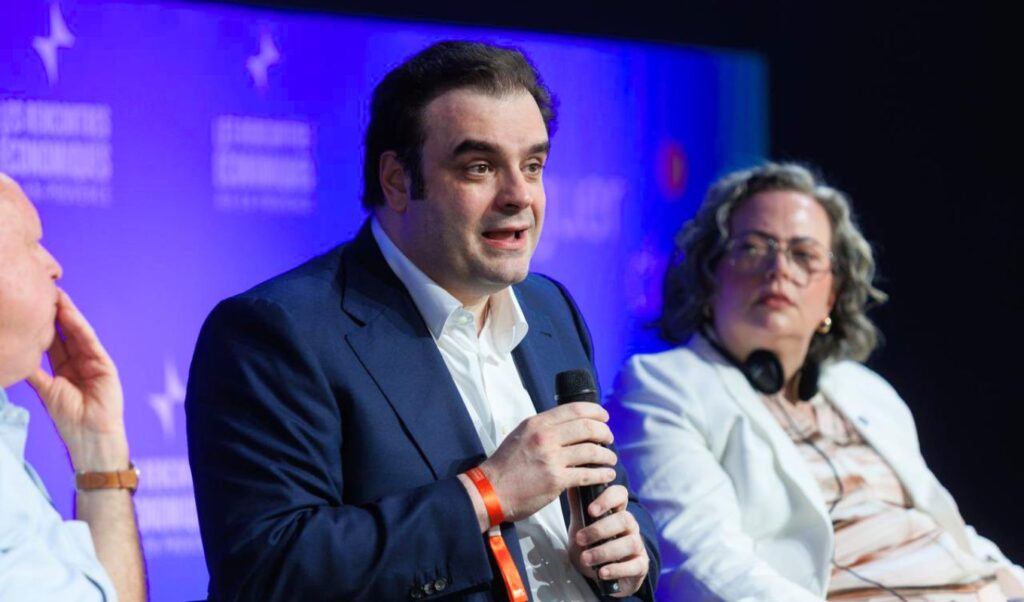
“For Europe, if I had to sum it up in one phrase, I would say that the era of geopolitical innocence is over,” said Kyriakos Pierrakakis from the French city of Aix-en-Provence, where he participated in a discussion titled “One World, Conflicting Visions: Who Sets the Standards?” as part of the “Les Rencontres Économiques d’Aix-en-Provence” forum organized by Le Cercle des Économistes. In his remarks, the Minister of National Economy and Finance and President of the Eurogroup emphasized the need for a mindset shift in Europe and the completion of the single market across all strategic sectors.
Read also: Pierrakakis: “Need for a central European frequency auction instead of 27 national ones” (Video)
Pierrakakis: “We need a change of mindset”
Mr. Pierrakakis stated: “For Europe, if I had to sum it up in one phrase, I would say that the era of geopolitical innocence is over. And I’m not referring only to the Russian invasion of Ukraine, but to a much deeper shift in the framework through which we perceive things.
A second element is that the way we understand how policy tools should be used in Europe is changing fundamentally. Allow me to share a small incident, one that actually relates to Greenland.
At the first Eurogroup meeting I chaired, in January, the discussion outside the room was dominated by Greenland. Inside the room, however, we had to elect the Vice President of the European Central Bank. There were six candidates, and those with more experience than me were telling me that, with six candidates, it would take months to settle on one — that’s just how Europe typically works.
What we decided, together with my colleagues, was this: if we cannot elect a Vice President of the European Central Bank at a moment when we are called upon to defend European sovereignty, the sovereignty of Greenland, and territorial integrity more broadly, then the least one could say is that the image this would project would be extremely damaging. So we elected the ECB Vice President in two and a half hours — while everyone expected the process to take four, five, or even six months.
Why do I mention this? Not because the way officials are elected within European institutions is of particular interest to the general public, but because it is a textbook example of the political will to change. The good news about Europe is that we know very well what we have failed to complete over many years. There is what I would call “the dividend of the obvious.” We know we haven’t completed the Capital Markets Union, the Banking Union, the Energy Union — and we also know that we need a coherent doctrine for technology.
Technology will change everything, and I’m not referring only to artificial intelligence, which is today’s obvious topic of conversation. A new major technological debate will follow, then another, and then another… That is why we need an overarching doctrine and a strategy for how to strengthen the capabilities that underpin our sovereignty. If I had to encode it in one phrase, I would say that the mistake is treating sovereignty as synonymous with autonomy. Autonomy is just one dimension of sovereignty. Sovereignty can be exercised in many different ways — and this is something Europe itself has already demonstrated.
It can be exercised through control. We have European champions. We have champions in technology. We have champions in banking. What we need is a change of mindset. And this change of mindset means we must stop thinking in terms of national champions — French, Greek, or German — and start thinking in terms of European champions.
“The era of geopolitical innocence is now over”
“Should we do more of this across every sector? Absolutely. In technology, but also in banking, in stock markets, in every field. If we fail to develop European companies that will grow into European — and by extension global — champions, they will not be able to compete internationally in a world being transformed at unprecedented speed by technology. So part of this discussion is about policies. Another part is about the changing international environment. But the most important dimension, in my view, is the change of mindset.
Because of everything happening in the world today, because, as I said at the outset, the era of geopolitical innocence is now over, the current generation of policymakers fully understands this. All those plans that previous generations discussed for decades — whether it’s the Capital Markets Union, the Banking Union, the Energy Union, technology, or telecommunications — must now be implemented simultaneously. Only then can we provide a meaningful answer to your question. That is why I am optimistic. Not only because, as Churchill’s famous saying goes, ‘there is no point being anything else.’ I am optimistic because I genuinely believe this generation can get it done.”
“The first step is to put our own house in order”
When asked whether Europe needs some kind of “electroshock” to take control of its own internal affairs, and in response to comments about the opportunity Europe faces in the new geopolitical landscape taking shape, the Minister said:
“The good news is that we know very well what the obvious things are that we haven’t done for years. Defence is perhaps the most telling example. Are there easy, readily implementable solutions in defence? Of course there are. Today, each member state procures the same systems separately, 27 different times. And yet, we all need certain common capabilities: border protection, satellites, unmanned aerial vehicles.
The value of common European procurement is therefore enormous. Have we done it before? Yes, we have. It’s called the European Space Agency. In the space sector, we have already proven that we can cooperate effectively. But the harder part is something else: making strategic choices.
What do I mean by this? We don’t have unlimited resources. If we want to strengthen European sovereignty — and this is why I stressed earlier that it is not the same as full autonomy — we cannot create European versions of everything. Today, the three major American cloud service providers hold approximately two thirds of the European market. No European company currently holds a market share above 2%. So this is not the most obvious field in which a European champion can emerge.
In 5G infrastructure, however, we had — and still have — significant comparative advantages. Europe has two global champions, one in Finland and one in Sweden, which are the main competitors to Chinese companies. These are not American businesses. So what did we do as Europeans? Did we build a fully integrated ecosystem around these companies, especially when the first Trump administration had adopted a very specific stance on this issue? The answer is no. We still have a fragmented European telecoms market. We are still running 27 separate 5G auctions and will very likely do the same for 6G. We still don’t have a clear, common strategy.
So the first step is to put our own house in order. To fix the structural weaknesses of the European economy and the European framework, so as to unlock the obvious growth potential that is already right in front of us. And the second is to make strategic choices that reduce our dependencies. The goal is not full autonomy. It is to avoid one-sided dependencies, to diversify risks, and to shield Europe against the uncertainties of the future. This is entirely achievable. And we have every capacity to make it happen.”
Artificial intelligence
On developments in the field of artificial intelligence and technology more broadly, and how they will shape the new economic reality, Mr. Pierrakakis commented:
“To that I would add that technology will be just as decisive a factor as geopolitics. I would say we tend to over-rationalize the past, dramatize the present, and underestimate the future. Today, the density of developments is unprecedented. The technological acceleration that once unfolded over decades is now compressed into a matter of months. Think about the transition my own generation lived through: from video rental stores to Netflix. How long did that take? Ten, fifteen years?
In artificial intelligence, however, changes are now happening within months — even weeks. We typically perceive the world in a linear way. But technological developments move exponentially. And political systems, historically, react at a far slower pace. This is the great challenge we face today, alongside all the other challenges we are already dealing with.
That is why we must be prepared. But first and foremost, we must fully understand the scale and nature of the changes unfolding before us. As Europeans, we have the capacity to respond. We have the “hardware” — the infrastructure, the capabilities, the human capital. What we have lacked for many years is the “software”: the right policies and the political will. Today, we have both.”