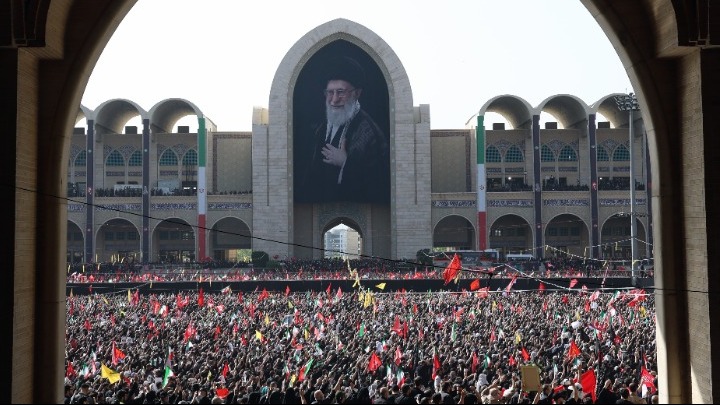
Tehran is sending messages to multiple audiences at a critical juncture in negotiations aimed at achieving a ceasefire in the Middle East. While seeking to reposition itself geopolitically, Iran is holding firm to its established positions and continuing to issue stark warnings to the West. At the same time, as the public lying-in-state of Ayatollah Ali Khamenei gets underway — during which mourners chanted “death to America” and “death to Israel” — Iran’s leadership is rallying support around the theocratic regime, even as talks continue over a possible repositioning on its nuclear program and broader regional role.
Iran: The public lying-in-state of Ayatollah Ali Khamenei and threats to the West
Against a backdrop of intense emotion, with chants against the US and Israel dominating the public lying-in-state of Ali Khamenei in Tehran, Iran is escalating its rhetoric toward the West, issuing fresh warnings over the Strait of Hormuz.
Iranian Deputy Foreign Minister Kazem Gharibabadi warned that “the Strait of Hormuz is not a theater for gunboat diplomacy by extra-regional powers,” responding to statements from the United Kingdom and France that they stand ready to help ensure freedom of navigation in the region.
“Iran, as a responsible power and guarantor of security in the Strait, warns that it will not tolerate any military adventurism,” he wrote on social media, adding that “security here belongs to the coastal nations, and to them alone.”
He adopted particularly forceful language, warning that “those who created this crisis will be held accountable for the consequences of their adventurism” and that “those who fan the flames of crisis will be consumed by the fire they ignite.” “This is not a suggestion — it is a warning,” he concluded.
Strait of Hormuz: The statements by Macron and Starmer
Gharibabadi’s remarks came one day after a joint statement by French President Emmanuel Macron and British Prime Minister Keir Starmer, in which both leaders reaffirmed their intention to work with allies to protect global security, freedom of navigation, and international law.
Meanwhile, thousands of Iranians are converging on Tehran’s Grand Mosalla, where the public lying-in-state of the late Supreme Leader Ali Khamenei has begun. His coffin, draped with his black turban, is on display at the vast religious complex, whose halls are covered in black mourning banners, portraits of the Ayatollah, and red flags — symbols of martyrdom and vengeance.
To accommodate the thousands of pilgrims who have traveled to the capital from across the country, Iranian authorities have deployed extensive support measures, including more than 400 Red Crescent tents and water tankers, as temperatures are expected to exceed 35 degrees Celsius.
The coming days will reveal whether Tehran chooses the path of de-escalation or continues to invest in hardline rhetoric and a show of force. For now, the signals coming from Iran’s leadership are twofold: on one hand, channels of communication with the international community remain open, while on the other, warnings to the West continue to be repeated — as the public lying-in-state of Ali Khamenei serves as a powerful rallying symbol for the theocratic regime and its long-standing strategic choices.
Heartfelt farewell from Shia sisters across the globe to our beloved Martyr Sayyed Ali Khamenei (RA). Your light of resistance lives forever in our hearts and the Ummah’s struggle. Allah bless Iran and the axis of resistance. https://t.co/IaFl96DdUB
— Alireza Hassan (@AHassan_rouhani) July 4, 2026
SELAMAT JALAN AYATOLLAH ALI KHAMENEI PEMIMPIN BESAR PEMBELA ISLAM …. https://t.co/brFY3yIewC
— 📢☝RAKYAT BICARA☝📡 (@Alfa_Rohadi) July 4, 2026
#WATCH | Scenes from the second day of the massive, million-strong public funeral procession for the leader and martyr Sayyed Ali Khamenei in #Tehran. pic.twitter.com/9nEA6btaYM
— Al Mayadeen English (@MayadeenEnglish) July 4, 2026