The Counter-Terrorism Unit’s investigation into the arson attack on a residential apartment building in Thessaloniki — which claimed the life of one woman and left several residents injured — remains ongoing. Authorities are closely examining the suspects’ movements, the number of individuals involved, and possible links to other recent attacks. According to Greek Police spokesperson Constantia Dimoglidou, the powerful second explosion heard by local residents was most likely caused by a vehicle beneath which the improvised explosive device had been placed.
Speaking on ERTnews to journalist Dimitris Kottaridis, Dimoglidou explained that the ignition of the car’s fuel triggered the second blast, causing the fire to spread rapidly through the apartment building — resulting in one woman’s death and injuries to several other residents.
The Counter-Terrorism Unit, assisted by Thessaloniki-based services and central divisions of the Hellenic Police, is focusing its efforts on mapping the suspects’ route. Investigators are working to determine how many individuals took part in the three attacks under examination and whether the same group was responsible for all three incidents.
Thessaloniki arson attack: Greek Police data on improvised explosive device attacks
During the briefing, Greek Police data was presented showing that between 2024 and 2026, in the Attica region alone, 191 case files have been recorded involving attacks with improvised incendiary or explosive devices, with 159 arrests made.
As spokesperson Dimoglidou emphasized, the Hellenic Police are systematically identifying perpetrators and building criminal case files, which are subsequently referred to the judiciary. She stressed that the Thessaloniki incident has demonstrated in the most tragic way possible the danger posed by the use of improvised explosive devices. Even a “simple” device, she noted, can cause loss of life, serious injuries, and extensive material damage — as was the case in the Thessaloniki apartment building.
Authorities have expressed cautious optimism that the investigation will yield results in the coming period, despite the fact that some evidence may have been destroyed during firefighting operations. Forensic laboratory results are expected within the next few days and are anticipated to play a key role in identifying the perpetrators and fully resolving the case.
The three key pieces of evidence that could identify the perpetrators
The Counter-Terrorism Unit’s investigation is focusing on three main lines of inquiry. The first involves remnants of the incendiary device — fragments of insulating tape, gas canisters, and plastic containers — from which investigators are seeking DNA profiles and fingerprints. “The wiring assembly is the most basic method we encounter, so we cannot extract much from that alone. Police do not expect anyone to claim responsibility, given that a death and injuries have occurred,” spokesperson Constantia Dimoglidou clarified.
Of critical importance is the seized CCTV footage, through which investigators are seeking to identify the individuals involved in the attacks as well as any vehicles used. “We have only silhouettes from the video footage. Officers certainly do not believe that only three individuals were involved — at least three people definitely participated in the attacks… if we are talking about common individuals,” Dimoglidou added.
At the same time, authorities are working to map the suspects’ full route — specifically, their point of origin, where they obtained the devices, how they reached the attack sites, and how they made their escape.
According to police sources, since the attacks took place at night, the darkness is hampering the identification of the suspects, while a significant amount of evidence was destroyed by the fire and subsequent firefighting efforts. At the Thessaloniki Police Headquarters, Citizens’ Protection Minister Michalis Chrysochoidis convened a high-level meeting with senior Counter-Terrorism and Organized Crime Division officers who travelled from Athens to review the progress of the investigation.
A possible fourth suspect is being investigated
Based on evidence gathered so far, authorities believe at least three individuals were involved in the attack, reportedly travelling on two motorcycles. Investigators are also seriously considering the possibility of a fourth person who may have played a supporting role before or after the attacks.
Condition of the injured
All four people injured in the attacks are reported to be in a stable condition. Panagiotis Nestouras has been discharged, as has one of the two other residents. The second resident will remain under observation in the cardiology ward, while Afroditi Nestoura is receiving treatment in the burns unit of Papanikolaou Hospital. According to the latest information, her condition is described by medical staff as stable and controlled; however, the date of her discharge remains unknown, as she has sustained multiple burns to her hands and legs.
“The stairwell became a chimney — you couldn’t breathe”
A harrowing eyewitness account has emerged from Giorgos Papadopoulos, a resident of the Thessaloniki apartment building targeted in the deadly arson attack. Having been treated at Hippokrateio Hospital and subsequently discharged, he described the terrifying moments experienced by residents — the explosions, the thick smoke, and the desperate efforts to rescue the victim’s daughter.
Speaking to ERTnews on the programme “Weekend from 5,” Giorgos Papadopoulos said that residents are waiting for the case to be solved, while restoration work on the building has already begun.
“We are waiting for the perpetrators to be found. Repairs have started. But the fact that a human life was lost overshadows everything. Our deepest condolences to her family. We are trying to return to our daily lives as much as possible, but it was a tragic and shocking event,” he said. Describing the night of the attack, the resident recalled that he went downstairs after hearing the noise and found a car in flames. “I didn’t risk going further outside because I was afraid there would be an explosion. I immediately went back up to the flat and within a minute or two the second explosion happened. Doors and windows shattered and the stairwell turned into a chimney,” he said. He described how the smoke instantly filled the entire building, creating a suffocating atmosphere. “You couldn’t breathe. You immediately felt a burning sensation in your chest,” he recalled.
The rescue of Afroditi Nestoura
He also recounted the moment Afroditi Nestoura, the victim’s daughter, managed to reach their apartment while desperately searching for a way out. “Afroditi had come upstairs, looking for a door, and entered our flat. I found her on the balcony, semi-conscious and in shock. We tried to bring her round and I called on the rescuers to come up and take her,” he said. According to Papadopoulos, the young woman had burns on her hands and legs and, once she regained consciousness, kept asking about her parents.
Reflecting on the neighbourhood and the building itself, Giorgos Papadopoulos stressed that residents had never previously noticed any threats or suspicious incidents that might have foreshadowed such an attack. “We hadn’t received any threatening message or noticed any other incident. It’s a residential neighbourhood with a few small shops. Nothing had caught our attention,” he concluded.
The moment the perpetrator plants the explosive device at Savvas Anastasiadis’ home
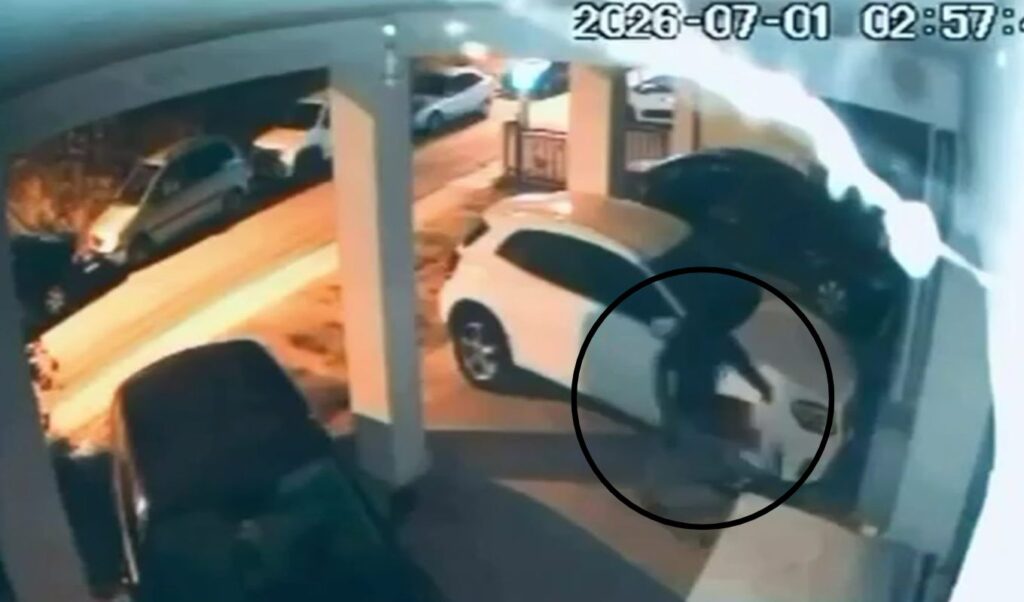
A key piece of footage obtained by ERTnews captures the moment an unidentified individual enters the ground-floor parking area of the apartment building belonging to former New Democracy MP Savvas Anastasiadis and plants the explosive device at the entrance.
Specifically, a security camera recorded a person descending from a peri-urban forest, dressed in jeans, a black top, a cap, and with a scarf covering their face. The individual was carrying a black bag containing the explosive device, which they left at the building’s entrance. The explosion occurred approximately 20 minutes later.
The forensic evidence gathered from the explosions at the homes of ruling party officials in Thessaloniki is currently being analysed in forensic laboratories in order to identify the perpetrators of the attacks that claimed the life of Vagia Nestoura. Authorities are searching for DNA in the remnants of the explosive devices and on a piece of insulating tape found at one of the scenes, while witness statements and visual material converge on the possibility that a fourth individual may have been part of the bombers’ support network.