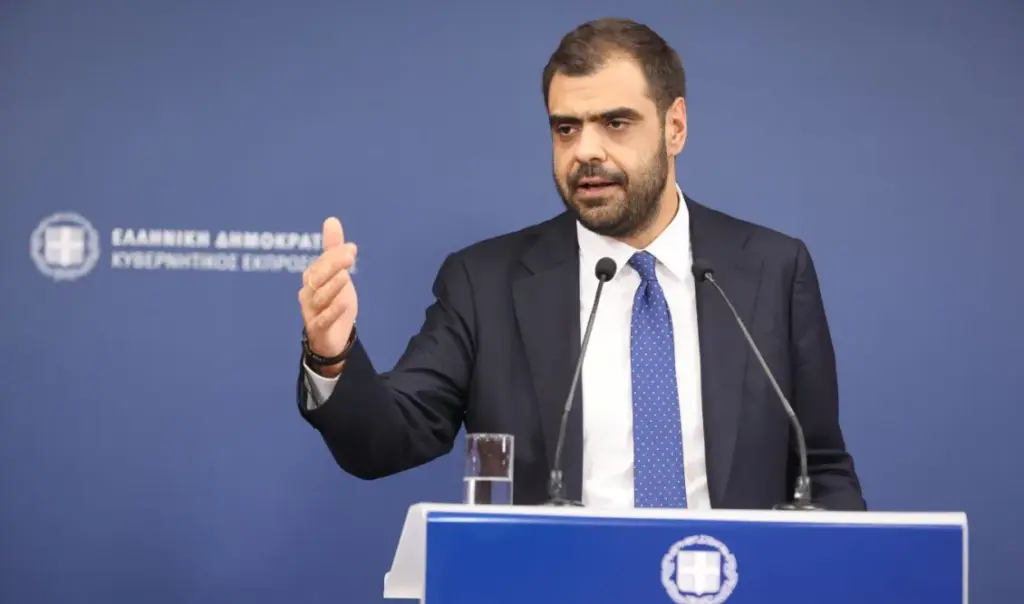
Political violence cannot be treated with double standards, emphasizes Deputy Minister to the Prime Minister and government spokesperson, Pavlos Marinakis, in an article published in Parapolitika, prompted by the triple arson attack in Thessaloniki that resulted in the death of Vagia Nestora. Mr. Marinakis stresses that there is no longer any room for ambiguity or excuses in the face of criminal acts, arguing that any attempt to romanticize terrorism ultimately undermines democracy.
Read also: Maximos: Unmasking terrorism and exposing the opposition — In the crosshairs: dismantling anarchist groups as criminal organizations on par with Golden Dawn
He further underlines that those who plant explosive devices and commit acts of violence cannot be labeled “activists” or portrayed as vehicles of political expression — they are criminals. And when such criminal acts result in the loss of human life, “there is only one word for it: terrorism.” He also warns that the political and ideological tolerance of violence is just as dangerous as the actions of those who carry it out, noting that “tolerance is the fertilizer of lawlessness,” and insisting that in a democracy, there are no “good” or “bad” forms of terrorism.
Pavlos Marinakis’ article in Parapolitika: Every attempt to romanticize political violence must stop
There are moments when a society is called upon to decide which side of history it wants to stand on. With democracy or with violence. With the rule of law or with terrorism. With citizens who participate freely in political life, or with those who believe they can impose their views through explosive devices, threats, and bloodshed.
There is no longer any room for evasion. Someone who plants explosive devices outside people’s homes is not an “activist,” is not staging an “intervention,” is not expressing a “radical viewpoint.” They are a criminal. And when that criminal act costs human lives, there is only one word for it: terrorism.
Yet equally as dangerous as the actions of the perpetrators themselves is the long-standing political and ideological tolerance of violence. For years, certain individuals have chosen to romanticize such practices — to change the language in order to soften reality. To speak of “collectives,” of “interventions,” of “dynamic mobilizations,” as if attacking someone’s home could ever constitute a form of political expression. No democracy can survive when it normalizes violence. When it considers it acceptable for political opponents, journalists, judges, academics, or anyone who publicly expresses their views to be targeted. Every person’s home is sacred. Their family is entirely outside the bounds of any political dispute. Whoever crosses that line is not simply attacking an individual — they are attacking democracy itself.
That is why blanket condemnations after each tragedy are not enough. What is needed is consistency. You cannot condemn violence when it produces casualties, while at the same time coddling those who breed it, justify it, or rebrand it with more palatable terminology when it has not yet reached its most extreme outcome. Tolerance is the fertilizer of lawlessness. And every time society looks the other way, certain individuals grow even bolder. The response of a law-governed state can be nothing other than the full and uncompromising enforcement of the law — without concessions, without fear, without ideological exceptions. Perpetrators must be brought to justice and punished in a way that sends a clear message. Not out of a desire for revenge, but because that is what the rule of law demands.
The time has come to unmask this once and for all. Every attempt to romanticize political violence must stop. It must be made absolutely clear that in a democracy, there are no “good” or “bad” forms of terrorism. There are only criminal acts, against which we are all obligated to stand firm — without asterisks, without qualifications. Because when violence finds an alibi, sooner or later it goes looking for its next victim.
Published in Parapolitika