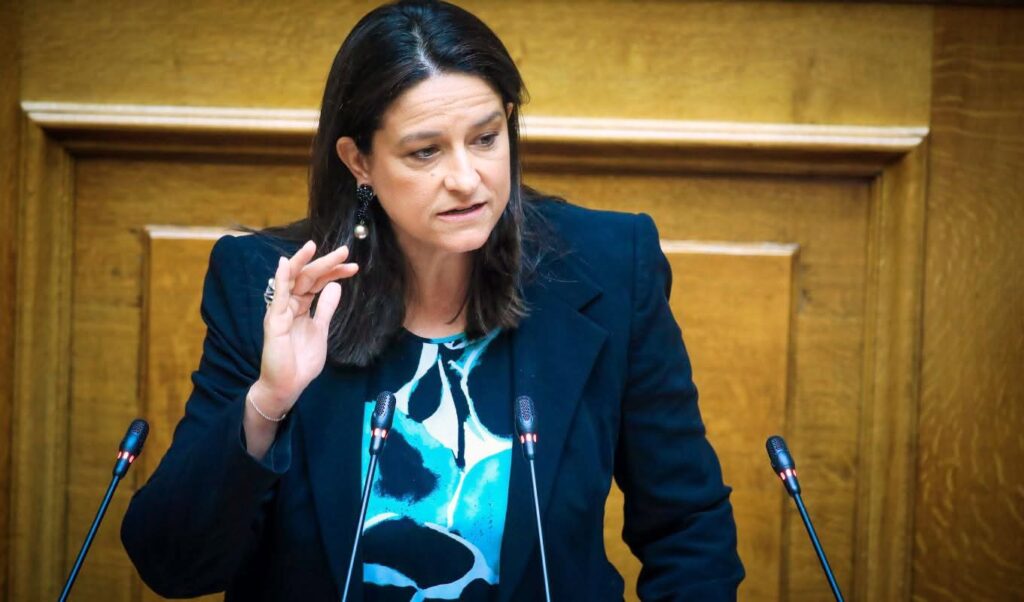
Greece’s Minister of Labor and Social Insurance, Niki Kerameus, announced the permanent abolition of widow’s pension cuts that were introduced under the so-called Katrougalos law, putting an end to a decade-long issue. Speaking in an interview on OPEN television, Minister Kerameus reminded viewers that “we tend to call it the Katrougalos law, but it is actually Tsipras’s law — let’s not forget that,” adding that the legislation had held hundreds of thousands of pensioners hostage for a decade.
Read also: Widow’s pensions: Who benefits from the changes, and what happens with retroactive payments
As Minister Kerameus explained, “there are three categories:
First category: Under the Tsipras-Katrougalos law, approximately 8,500 widow’s pensioners were receiving 70% of their deceased spouse’s pension, and after three years, that 70% was reduced to 35%. What changes? These individuals will see an increase in their pensions — from 35% back up to 70%.
Second category: There were around 75,000 widow’s pensioners who were about to face this same cut — dropping from 70% to 35% — and who even risked being asked to repay retroactive amounts. The answer for them is that nothing will be cut, because the post-three-year reduction is being abolished entirely. Everyone under the Katrougalos law stays at 70%, and neither the state nor EFKA (the social security agency) will claw back a single euro.
Third category: Pensioners who were receiving two national pensions from different entitlements — one based on their own contributions and one based on widowhood rights. The Tsipras-Katrougalos law, subsequently upheld by the Council of State, ruled that two such national pensions could no longer be drawn simultaneously. With the provision we are introducing, we are saying that you may continue to receive two national pensions from different entitlements.”
Kerameus: “An end to the decade-long captivity of hundreds of thousands of our fellow citizens”
The Labor Minister described the intervention as structural, extending across the entire social insurance system and specifically addressing widow’s pensions, bringing “an end, with empathy, to the captivity of hundreds of thousands of our fellow citizens.”
She further clarified that this reform was not made arbitrarily, but became possible at this particular time due to the overperformance of the Digital Work Card initiative.
“In the first four months of 2026 alone, thanks to the bold implementation of the Digital Work Card, we have already exceeded our medium-term target by €517 million. So we are not simply coming to support society — we are doing so through the dividends of growth,” the Minister emphasized.
“What does it actually mean to vote ‘present’ on a fundamental right and on the fundamental principle of equal pay between men and women?”
Responding to PASOK’s spokesperson, who attempted to claim credit for the reform, Minister Kerameus stated: “Mr. Tsoukalas can very easily come out and say ‘stop cutting widow’s pensions.’ Indeed. But you have to work out how to do it — first legally, and second, with what funding. The reason this is happening now is that this government and this Prime Minister faithfully implemented the Digital Work Card, despite fierce opposition. That decision had a clear, tangible benefit for the economy, and Kyriakos Mitsotakis’s commitment is that this dividend be returned to society.
So, in the first four months of 2026, we recorded an overperformance of €517 million from the Ministry of Labor alone. We are therefore coming forward immediately to return that dividend to society — and that is why this reform is happening now.”
The Minister also criticized the stance taken by PASOK and its leader, Mr. Androulakis, during the vote on the bill transposing the EU directive on equal pay for men and women performing equivalent work.
Kerameus pointed out that when PASOK’s leader was a Member of the European Parliament, he had voted in favor of the European directive — yet the previous day, he did not vote yes for the very same directive. “That is PASOK’s responsible opposition,” the Labor Minister remarked sharply, adding that PASOK voted “yes” on every individual article of the bill, but voted “present” on the bill’s general principle. “What does it actually mean to vote ‘present’ on a fundamental right and on the fundamental principle of equal pay between men and women? Women are listening to us. What does it mean for the official opposition to vote ‘present’?” she asked.
Minister Kerameus noted that SYRIZA adopted the same position and went on to address PASOK’s stance on hazardous and unhealthy work conditions. “Yesterday they told us: ‘We submitted 24 amendments.’ If you look at those 24 amendments, each one covers a different scope. One covers the entire healthcare workforce — every single person employed in the country’s healthcare sector classified under hazardous and unhealthy conditions, with no impact assessment whatsoever. What does it cost? What is the burden on the social insurance system? What are the consequences if a large number of staff leave the National Health System? That is PASOK’s opposition,” she stressed.
“We must be very careful not to return to the period that brought us to the brink of catastrophe”
The Labor Minister emphasized that the government’s priority is to increase citizens’ disposable income within the country’s fiscal constraints. She referenced the 41.5% increase in the minimum wage — from €650 to €950 — and the subsequent measures taken to support pensioners. Specifically, she cited overall pension increases of more than 16%, the annual €300 bonus paid every November to low-income and disability pensioners, and the abolition of the personal difference clause, while stressing the importance of remaining within fiscal limits. “We must be very careful not to return to the period that brought us to the brink of catastrophe,” she said.
On the abolition of the personal difference clause, Kerameus noted that when she took office at the Ministry of Labor, there was no fiscal room to eliminate it — but two years later, thanks to revenues generated by the Digital Work Card, it became possible.
The Minister also referred to the abolition of the withholding tax on working pensioners, describing the measure as fiscally beneficial.
“We have 320,000 new jobs in the first five months alone”
Turning to the labor market, the Minister highlighted that unemployment has fallen to 8.1%, that approximately 600,000 people who were receiving unemployment benefits in 2019 are now employed and paying social security contributions and taxes, while the minimum wage has risen from €650 to €920 and the average wage has climbed from €1,200 to over €1,500. “Yesterday, the latest labor market data were released — the employment flows for the first five months of 2026. This is the best five-month period since 2001, the best in the last 25 years. That means 320,000 new jobs created in the first five months alone.”
On the cost of living, Minister Kerameus stated: “We are constantly striving to do more. Purchasing power comes down to two things: one part concerns potential cartel behavior, where the Competition Commission — which is of course an independent authority — does everything in its power to impose sanctions on any practices that may have such characteristics, meaning illegal ones. The other part is how you can expand disposable income. There is no better recipe against the high cost of living than raising wages and cutting taxes and contributions.”
“We implemented the Digital Work Card very faithfully and prudently”
The Minister also underscored the significance of the Digital Work Card and how the measure has boosted state revenues: “We implemented the Digital Work Card very faithfully and prudently. In some sectors, declared overtime hours increased by 1,200% — a staggering figure. We measured the overtime declared in a given sector before the Card was introduced and after, and 1,200% more overtime hours appeared. What does that mean? It means an increase in revenues. And pay attention, because this is important: just last week I extended the Work Card to another half a million workers. This will undoubtedly generate additional revenue.”
Finally, Minister Kerameus strongly condemned the arson attack in Thessaloniki, stating: “What happened two days ago constitutes a murderous attack — and I choose my words carefully, because when you go somewhere with gas canisters, that means you intend to kill. Tragically, this was confirmed in the most heartbreaking way with the death of Vagia Nestora. We are talking about practices, about acts of violence that we believed we had left behind. This party, New Democracy, has lost many people — many of its own members — to such acts of violence. What is our position? The condemnation by everyone is self-evident, but it requires more than that. Condemnation alone is not enough. What is also needed is the political isolation of such acts of violence.”