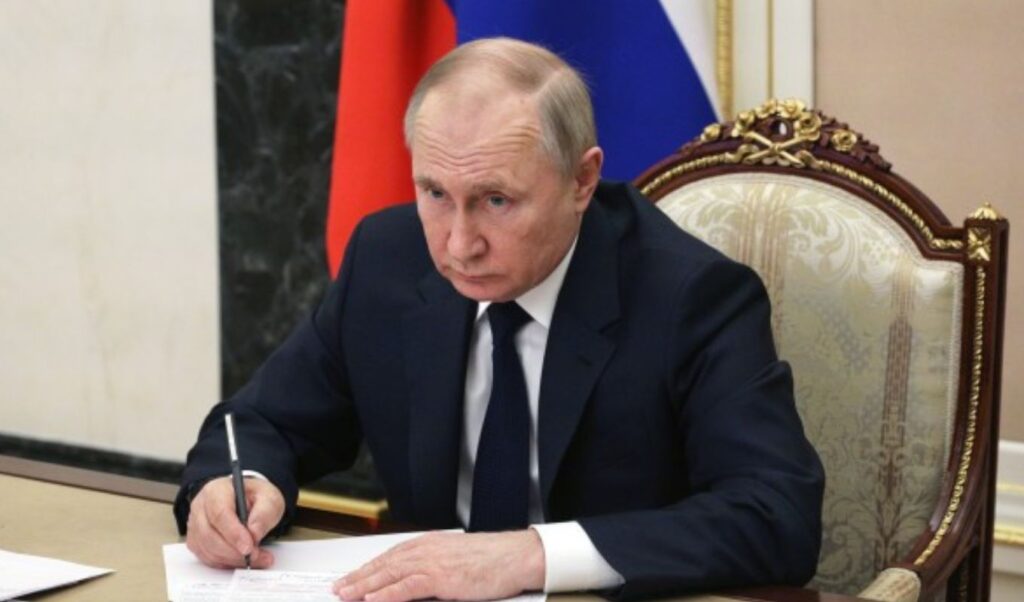
Russian President Vladimir Putin appears to be facing a complex web of challenges that could trigger rapid and far-reaching developments, according to an analysis published by Forbes. The American magazine’s piece outlines scenarios of deep political instability and suggests that Putin’s hold on power could be seriously threatened within the next three years. The article, written by contributor Melik Kaylan, draws on assessments of the trajectory of the war in Ukraine, Russia’s internal power dynamics, and the mounting international pressures closing in on the Kremlin.
Read also: Putin admits fuel shortages for the first time following Ukrainian strikes: “We see the problems”
The political cost of the war in Ukraine
According to the Forbes analysis, the war in Ukraine has transformed from what was billed as a “quick operation” into a prolonged war of attrition — one that is exacting a heavy toll on Moscow. Ongoing Ukrainian strikes on military installations and energy infrastructure inside Russian territory, combined with the mounting hardships faced by ordinary Russian citizens, are presented as factors steadily eroding the Kremlin’s image of stability and control.
The analyst argues that in authoritarian regimes, the “perception of control” is paramount. Once that perception begins to crack, a leader’s political legitimacy unravels far more quickly than it would in democratic systems.
“We all know how the situation in the Ukraine war has changed, but the image being projected matters just as much as the reality on the ground. When disasters occur so severe that neither Putin nor Russian public opinion can ignore them, reality itself shifts. This whole barbaric adventure in Ukraine will come to look like a catastrophe,” Kaylan wrote in Forbes.
He went on to note that while Crimea became a powerful symbol following its annexation, conditions on the peninsula have deteriorated sharply since the war began — a reality felt both by local residents and by the Russian military operating there. “Crimea has essentially been cut off from fuel supplies. A traffic jam of cars trying to leave the peninsula in the middle of peak tourist season creates a damaging optic. The Russians have only one remaining fuel supply line: the Kerch Bridge. A highly symbolic piece of infrastructure that has been struck multiple times but still stands. The fuel tankers crossing it will make easy targets, promising a massive fireball if hit in an attack. My sources within Ukrainian intelligence tell me that a major strike of this kind is imminent,” the Forbes article states.
The blows to Putin’s image
The Forbes contributor, citing a Russian military blogger, goes on to explain how the Russian army is being threatened from within by the specter of mutiny. Specifically, the analysis references Alexander Lunin, a Russian military blogger and veteran of the Ukraine invasion, who recently posted a video in which he warned of rebellion and demanded a personal televised interview with Putin. As the article notes: “At last count, the video had 11 million views. A follow-up video in which he walked back his position was subsequently published, but videos from soldiers supporting him and threatening to turn their weapons on officers who had been brutalizing them appeared online. Lunin is now in prison. Prigozhin’s mutiny comes vividly to mind.”
The article further notes that Putin’s image is absorbing repeated blows, as Ukrainian strikes deep inside Russia — particularly those targeting energy facilities and industrial zones — are causing serious, undeniable disruptions that cannot be concealed from the public. This situation does nothing to bolster the Russian president’s standing.
The two main scenarios for Putin’s future
The Forbes piece outlines two primary scenarios for how Putin’s political trajectory could unfold.
The first scenario involves a sudden overthrow of Putin, potentially triggered by internal conflict or even an assassination attempt. In this case, according to Kaylan, a period of intense power struggles would follow, as various power centers competed to fill the vacuum left behind.
The second scenario is described as more “institutional” in nature — a controlled political end, engineered through a process resembling a “show trial,” in which Putin would be cast as the regime’s central scapegoat. This approach, the analysis suggests, would allow Russia’s ruling elites to distance themselves from the war’s consequences while preserving the continuity of the state apparatus.
The “Ceaușescu model” and fears of sudden collapse
In exploring possible post-Putin scenarios for Russia, the Forbes analysis draws a striking historical parallel with Romanian dictator Nicolae Ceaușescu, who was executed in 1989 just days after his regime collapsed.
The so-called “Ceaușescu model” describes a sudden and violent transfer of power, in which a leader is removed not through an orderly political transition but abruptly — under pressure from the military or internal security forces that choose to “sacrifice” him in order to prevent a wider destabilization of the country.
According to the analysis, while extreme, such a scenario falls within the theoretical range of possibilities for Russia’s future — particularly if Vladimir Putin’s regime finds itself simultaneously confronted with intensifying domestic pressure, military setbacks, and fractures among the ruling elite.
The historical comparison is not meant to imply identical circumstances, but rather serves as a case study in how authoritarian systems, when pushed to a breaking point, may attempt a controlled or “sacrificial” removal of their leader in order to preserve state continuity and minimize the risk of chaos or civil conflict.
Particular emphasis is placed on Russia’s internal power balance, with specific references to institutions such as the FSB and Rosgvardiya (National Guard).
According to the analysis, these security structures function simultaneously as pillars of the regime and as competing centers of power — a dynamic that, in a crisis scenario, could give rise to violent internal clashes. The piece also highlights that political and military elites may act preemptively, driven by fears of purges or of being made to shoulder blame should the regime collapse.
“Putin’s days are numbered”
Melik Kaylan writes that the invasion of Ukraine could ultimately bring about Putin’s downfall before the war even concludes, pointing to what he sees as a recurring historical pattern in Russia. “Historically, the major regime changes that have occurred in Russia came about as a result of catastrophic military campaigns abroad: World War I and the invasion of Afghanistan,” he notes.
The analysis also examines the role of international actors, with a particular focus on China’s potential posture — which, according to the article, could prove decisive in shaping Moscow’s internal balance of power, should Beijing choose to shift its stance toward the Kremlin.
In its overall conclusion, the analysis underscores that Putin’s future hinges on whether current trends continue or accelerate. The author argues that if pressure from the war, internal contradictions, and international isolation persists, a political tipping point could materialize within the next three years. As the piece starkly concludes: “Putin’s days are numbered. If this trajectory is not reversed, Putin could be toppled within three years.”