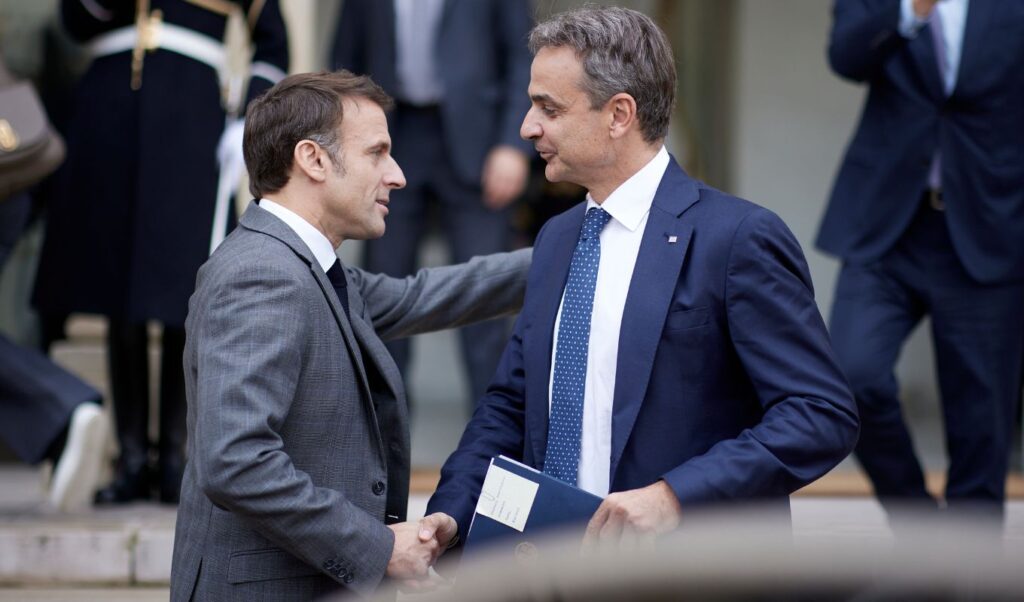
The renewal of the Greek-French Strategic Partnership Agreement for another five years will officially become reality on April 24-25 with Emmanuel Macron’s visit to Athens. However, the French president’s visit and his discussions with Kyriakos Mitsotakis take on broader significance, as the bilateral military agreement does not simply protect the interests of Greece and France alone, but at this stage, with military conflicts raging in the Middle East and Ukraine, it highlights and strengthens the need for EU strategic autonomy.
Read: Macron in Athens on April 24 & 25 – Greek-French defense cooperation takes center stage
While much discussion is already taking place in Brussels about creating a “European NATO,” as the North Atlantic Alliance faces enormous cohesion issues that directly threaten the organization’s continued existence and Donald Trump remains furious with allies. Primarily, however, Macron’s visit underscores the strong bonds between the two countries and is expected to seal the continuation of close cooperation in critical sectors focused on the southeastern Mediterranean, which appears to unite the two nations. This is because the agreement simultaneously establishes the common Athens-Paris line in this sensitive region and more broadly in Europe. Given these circumstances, during the French president’s stay in the Greek capital, the level of strategic alliance that both sides have built in recent years is expected to be confirmed.
“Greek-French cooperation is not simply a defense procurement, but a pillar of stability for all of Europe,” commented Élysée officials, referring to the continuation of the Belharra frigate and Rafale fighter jet programs. At the same time, Emmanuel Macron’s visit to the Greek capital coincides with France’s presentation of its new “nuclear deterrence” defense doctrine that takes on a European dimension, as it will include six countries, including Greece, which are examining cooperation and joint nuclear deterrence exercises.
Kyriakos Mitsotakis referred to this prospect in his recent CNN interview, saying that “preliminary discussions have begun regarding certain proposals by President Macron, given that France is the only country currently possessing nuclear deterrent power in the European Union.” The other countries expected to join the “nuclear umbrella” are Germany, Poland, the Netherlands, Belgium, Sweden, and Denmark. In this sense, new developments are expected regarding European defense autonomy, and given the common pace of Athens and Paris toward a defensively stronger and more autonomous Europe that will not depend on NATO and the United States.