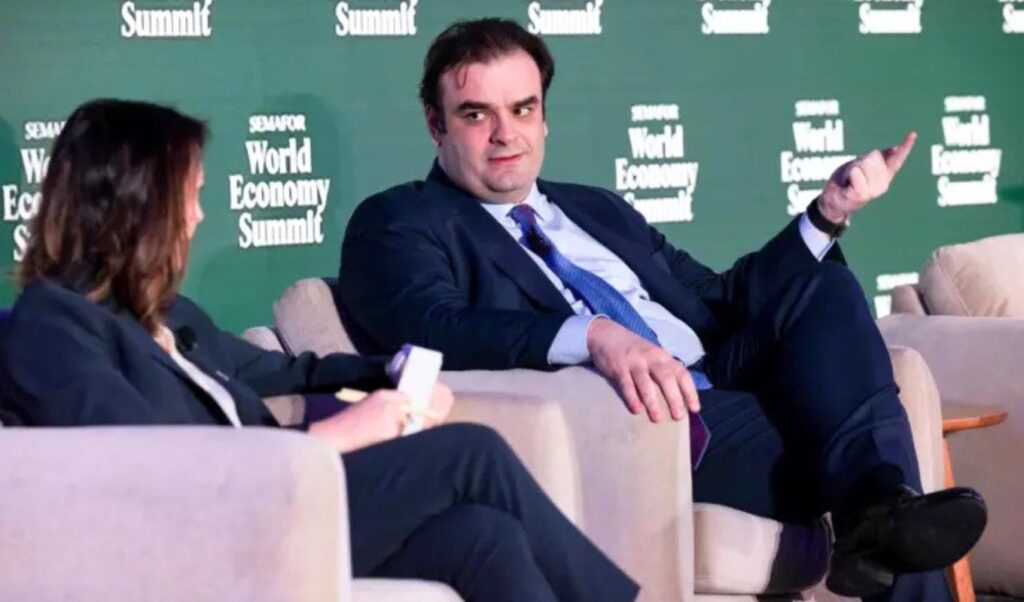
Warning about the scale of energy disruption caused by the war in Iran was issued by the Minister of National Economy and Finance, Kyriakos Pierrakakis, speaking at the Semafor World Economy conference, on the sidelines of the Spring Meeting of the IMF and the World Bank. As he noted, the international economy may face one of the most serious energy crises in modern history, with impacts that could exceed both the oil crises of the 1970s and the energy disruption caused by the Russian invasion of Ukraine in 2022.
The minister noted that European economies have already begun revising growth forecasts downward, while inflationary pressures are simultaneously increasing, a development expected under energy shock conditions. Although the stagflation scenario is not yet the baseline forecast, it remains a real risk, depending on the duration and intensity of the crisis. “The critical question is the timing and depth of the crisis,” he characteristically stated.
Pierrakakis: Measures should be targeted to support households and businesses without creating long-term fiscal imbalances
In his capacity as President of the Eurogroup, Mr. Pierrakakis emphasized the importance of coordinating European policies, noting that the 2022 experience offers valuable lessons. Support measures, he said, should be targeted, temporary and tailored to support households and businesses without creating long-term fiscal imbalances. “We now know what worked and what didn’t,” he noted, adding that the main goal is to protect the most vulnerable while maintaining fiscal discipline.
Beyond crisis management, the minister highlighted the need to accelerate structural changes in the European Union, particularly regarding deepening the single market and strengthening financial integration. As he pointed out, Europe continues to not fully utilize its potential, mainly due to internal obstacles.
How he commented on EU-US relations and developments in Hungary
Regarding Europe-United States relations, Mr. Pierrakakis reiterated their strategic character, despite occasional tensions. “There may be disagreements, but common interests remain,” he emphasized, highlighting the importance of cooperation in areas such as technology and artificial intelligence.
Referring to the trajectory of the Greek economy over the past decade, the minister emphasized that recovery was based on fiscal stability, political consistency and persistence in reforms. He gave particular emphasis to the digital transformation of the state, with the Gov.gr platform as a characteristic example, which contributed to both improving services and enhancing tax compliance.
Mr. Pierrakakis also referred to political developments in Hungary, expressing satisfaction with the election of a more pro-European government, which he characterized as a positive development for European coordination.