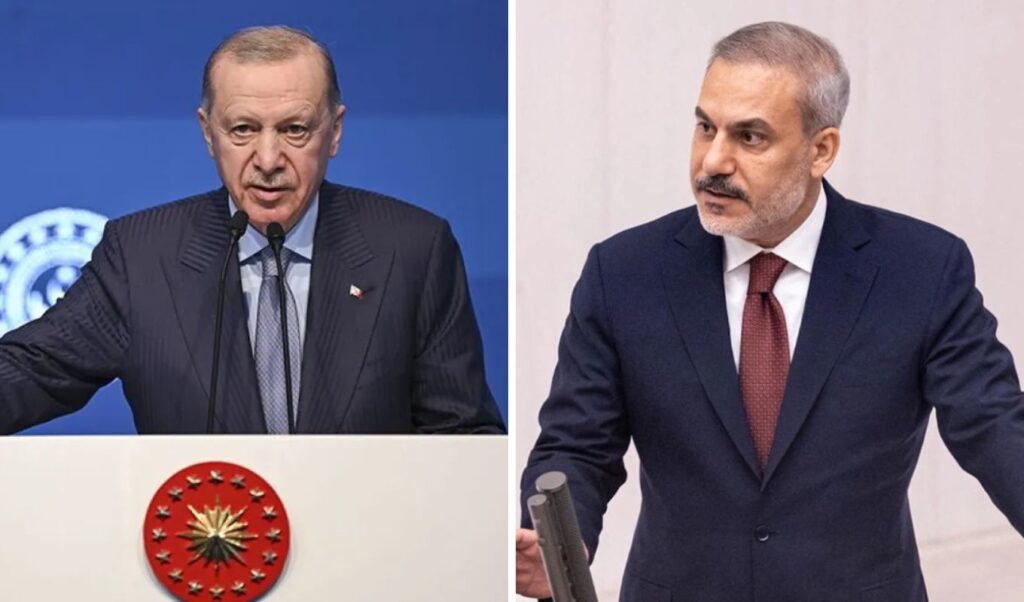
While Greece seeks to leverage its multiple roles as a member of the European Union and NATO by cultivating relationships with other powers in the broader Eastern Mediterranean region through active diplomacy, Turkey appears to be monitoring the regional power realignment with skepticism and gradually escalating its confrontational rhetoric. Yesterday’s statements by Turkish Foreign Minister Hakan Fidan did not surprise Athens. “It’s nothing new or surprising,” diplomatic sources from the Foreign Ministry tell parapolitika.gr, attributing the Turkish official’s statements to “the familiar way he always positions himself.” Moreover, as the same sources clarify, the controversial statements are not part of any official announcement from Turkey’s Foreign Ministry but constitute responses within the framework of an interview, and they were not the only topic that dominated the interview, they characteristically note.
According to the same diplomatic sources, what worries Ankara most are the regional developments and Israel’s ambitions in its neighborhood. This is why Hakan Fidan said, among other things: “Neither Greece nor the Greek Cypriot sector needs military cooperation with Israel in the region. There is the European Union, Greece is already a NATO member, the Greek Cypriot sector has the support of the European Union. The pursuit of such cooperation, namely the pursuit of creating a military alliance, what logic does it serve? Strategically, they cannot explain it either to themselves or to me.” As the same sources made clear to parapolitika.gr, Greece may belong to the European Union and NATO, but it is not obligated to avoid establishing relations with other states. In any case, the Greek side, as evidenced by yesterday’s Foreign Ministry announcement, reiterates that both the bilateral Greece-Israel relationship and the trilateral Greece-Cyprus-Israel cooperation are based on agreements aimed at peaceful purposes.
Provocative statements also from Turkey’s defense minister
It’s worth noting that provocative statements against Athens were made not only by Foreign Minister Hakan Fidan, but also by Turkish Defense Minister Yaşar Güler, who in an interview with Italian newspaper “Il Messaggero,” referring to EU states that have deployed defense systems around Cyprus, pointed out that “the deployment of defense systems around Cyprus – a name that in my opinion should be written in quotation marks – by the EU, under the cover of the US-Israel-Iran war, represents an attempt by the southern Greek Cypriot administration and Greece to increase their military presence on the island and escalate tensions. Turkey remains determined to protect the security of the ‘Turkish Republic of Northern Cyprus’ and the rights of the Turkish Cypriot people.”
The escalation observed recently with aggressive rhetoric against our country from Turkish officials does not appear to be assessed as something that raises concerns about disturbing the “calm waters” in the Aegean. Senior diplomatic sources believe that “essentially they mirror the situation as it develops in the Middle East” and characteristically emphasize “it’s not about escalation, but about a shift in their rhetoric.” Greek-Turkish relations in the Eastern Mediterranean are now being shaped through a changing geopolitical dynamic. For the Greek side, developments function as security and deterrence factors, but for Turkey they raise concerns about strategic imbalance and “encirclement.”