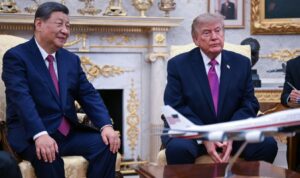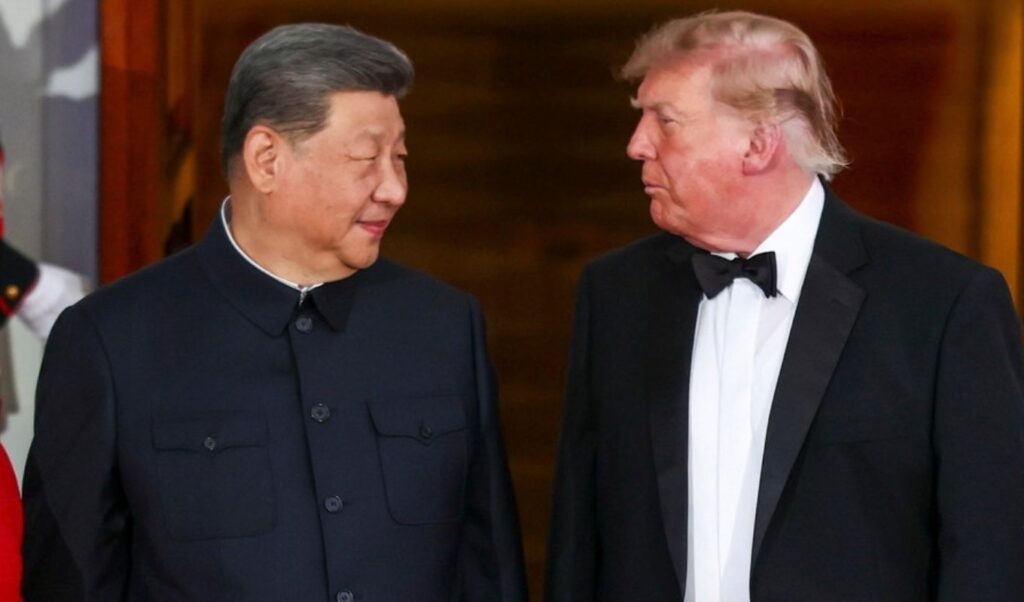
American President Donald Trump concluded his three-day meetings with Chinese President Xi Jinping on Friday, accompanying him to the United States National Archives. On Thursday, Democratic senators criticized the summit, arguing that Trump had failed to secure meaningful concessions from Beijing on trade, security, artificial intelligence, or human rights. They also criticized him for not publicly addressing China’s military pressure on Taiwan, and called for the immediate delivery of already-approved military aid and arms sales to the island.
Trump & Xi: How the summit unfolded
Thursday’s lavish state summit at the White House was rich in symbolism but limited in tangible results, with no indication of major agreements or significant breakthroughs between the world’s two largest economies. Nevertheless, Trump highlighted progress made through the bilateral trade mechanism, stating that American farmers and ranchers had gained — in his words — expanded access to the Chinese market. The two leaders also identified Artificial Intelligence as an area with potential for cooperation.
Trump has a gift for President Xi. pic.twitter.com/SL4QdBaUSz
— Clash Report (@clashreport) September 24, 2026
During his welcome remarks to Xi, Trump said the two leaders would view at the National Archives “some of the greatest treasures in American history,” including the Declaration of Independence, the U.S. Constitution, and the Bill of Rights. He added that they would also see “documents that speak to the long and valued relationship” between China and the United States, as well as the cultural exchanges between the two peoples.
“Just as our ancestors crossed oceans centuries ago to trade, to learn, and to build a better world, our two countries are truly doing the same today, and we are very proud of this relationship,” the American president remarked.
China has not commented on the upcoming visit to the National Archives; however, analysts suggest that Xi may be particularly interested in historical documents related to the U.S. decision in 1979 to sever official diplomatic relations with Taiwan (the Republic of China) and formally recognize the People’s Republic of China (Beijing) as the sole legitimate government of China, thereby adopting the “One China” policy.
China holds firm on the Taiwan issue
China considers the self-governing democratic island of Taiwan part of its territory, and Xi Jinping has long sought to persuade Trump to publicly declare that the United States opposes Taiwan’s independence — rather than simply stating that it does not support it, which has been Washington’s position for decades.
Beijing is also pushing for an end to American arms sales to the island.
The Taiwan question
As expected, Xi raised the Taiwan issue during Thursday’s meeting with Trump, expressing hope that the United States would “handle the Taiwan question prudently.” China’s state news agency also reported that Xi “hopes the American side will uphold the correct position of opposing Taiwan independence.”
The United States, like most countries, does not maintain official diplomatic relations with Taipei; however, Washington is Taiwan’s most important international supporter and, under U.S. law, is obligated to provide the island with the means to defend itself.
U.S. allies in Asia are expected to closely monitor how Trump addresses the Taiwan issue in the wake of Xi’s visit.
Following the previous summit with the Chinese president in May, Trump — whose administration had approved an $11 billion arms sale package to Taiwan in December — had stated that he was holding a second package worth approximately $14 billion in reserve, describing it as “a very good negotiating chip.”
Craig Singleton of the American think tank Foundation for Defense of Democracies assessed that Beijing may believe it has established a new framework in its relationship with Trump regarding Taiwan. As he noted, Xi’s use of the word “uphold” is significant, as it “suggests that Beijing believes Washington is already behaving in ways it desires.”
“In the context of the current pause in arms sales to Taiwan, China may increasingly treat this restraint as a new baseline rather than a temporary interruption,” he said, adding: “Beijing’s goal is to get Trump to internalize Chinese red lines into his own definition of a stable relationship.”
Trump:
Xi and I both understand that we represent different systems, but the ties between our people endure, and we’ve never gotten along better. pic.twitter.com/VdOrTl3ToY
— Clash Report (@clashreport) September 24, 2026
“This is the autopen… it’s Biden.” 🤣
President Trump shows off the legendary Presidential Walk of Fame to President Xi. pic.twitter.com/qUQEM6XoLj
— The White House (@WhiteHouse) September 24, 2026